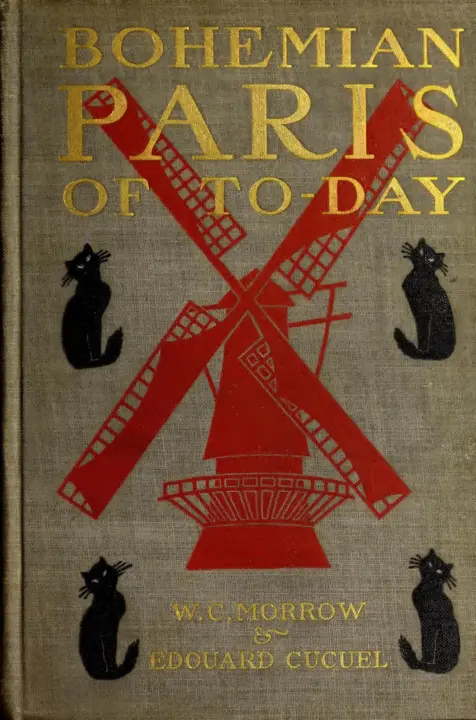
Bohemian Paris of To-day Second Edition
W. C. Morrow & Edward Cucuel
THE CLASSIC COLLECTION · 1897
"The Ape, the Idiot & Other People" by W. C. Morrow is a collection of short stories written in the late 19th century. The stories explore themes of freedom, companionship, and the human condition, often through the lens of unusual relationships, as exemplified by the interactions between an escaped ape and an idiot in the first tale. At the start of the first story, "The Resurrection of Little Wang Tai," we are introduced to Romulus, an anthropoid ape who escapes from a circus train, experiencing the thrill and confusion of newfound freedom for the first time. As Romulus explores the world around him, he encounters a gentle, child-like inmate of an idiot asylum named Moses. Drawn together by their shared desire for freedom and connection, Romulus and Moses embark on a whimsical adventure that eventually leads them to a graveyard, where a poignant scene plays out involving the burial of a young girl named Wang Tai. This encounter deepens their bond, illustrating the complexities of companionship across species and mental capacities, setting a tone for the themes that will unfold throughout the collection.
Introduction adapted from the source catalogue; source summaries may be automatically generated.
Free to read · English · 56,360 words · No account needed
MAKE TIME FOR A GOOD BOOK
On by default. Untick to stop anonymous reading totals. Each page counts after 10 seconds in view. How this works.
Anonymous counting is on unless you have switched it off.
"Yes," said I, eagerly; but Arnold smiled and shook his head. "I fear there will not be time," he said. But I refused to heed him and directed that the surgeon be called immediately. I was writing at Arnold's dictation when the two men entered the room.
There was something of nerve and assurance in the young surgeon that struck my attention. His manner, though quiet, was bold and straightforward and his movements sure and quick. This young man had already distinguished himself in the performance of some difficult hospital laparotomies, and he was at that sanguine age when ambition looks through the spectacles of experiment. Dr. Raoul Entrefort was the new-comer's name. He was a Creole, small and dark, and he had travelled and studied in Europe.
"Speak freely," gasped Arnold, after Dr. Entrefort had made an
examination.
"What think you, doctor?" asked Entrefort of the older man.
"I think," was the reply, "that the knife-blade has penetrated the ascending aorta, about two inches above the heart. So long as the blade remains in the wound the escape of blood is comparatively small, though certain; were the blade withdrawn the heart would almost instantly empty itself through the aortal wound."
Meanwhile, Entrefort was deftly cutting away the white shirt and the undershirt, and soon had the breast exposed. He examined the gem-studded hilt with the keenest interest.
"You are proceeding on the assumption, doctor," he said, "that this
weapon is a knife."
"Certainly," answered Dr. Rowell, smiling; "what else can it be?"
"It is a knife," faintly interposed Arnold.
"Did you see the blade?" Entrefort asked him, quickly.
"I did--for a moment."
Entrefort shot a quick look at Dr. Rowell and whispered, "Then it is not suicide." Dr. Rowell looked puzzled and said nothing.
"I must disagree with you, gentlemen," quietly remarked Entrefort; "this is not a knife." He examined the handle very narrowly. Not only was the blade entirely concealed from view within Arnold's body, but the blow had been so strongly delivered that the skin was depressed by the guard. "The fact that it is not a knife presents a very curious series of facts and contingencies," pursued Entrefort, with amazing coolness, "some of which are, so far as I am informed, entirely novel in the history of surgery."
A quizzical expression, faintly amused and manifestly interested, was upon Dr. Rowell's face. "What is the weapon, doctor?" he asked.
"A stiletto."
Arnold started. Dr. Rowell appeared confused. "I must confess," he said, "my ignorance of the differences among these penetrating weapons, whether dirks, daggers, stilettos, poniards, or bowie-knives."
Your reading position is saved on this browser. Take it to another device with a library code. Reading pages adapt to text, rather than matching a printed edition.
BEHIND THE BOOK
This eBook is for the use of anyone anywhere in the United States and most other parts of the world at no cost and with almost no restrictions whatsoever. You may copy it, give it away or re-use it under the terms of the Project Gutenberg License included with this eBook or online at www.gutenberg.org. If you are not located in the United States, you will have to check the laws of the country where you are located before using this eBook. Read the source licence.
The original source file, including credits and licence, is retained by this library. Request an original-format copy at no charge. Please include the book title and Project Gutenberg identifier #21616.
KEEP YOUR CURIOSITY GOING
Coulson Kernahan

Maurice Baring
Frances Wright
Cécile Tormay

Frederic Jesup Stimson

W. H. P. (William Henry Pope) Jarvis