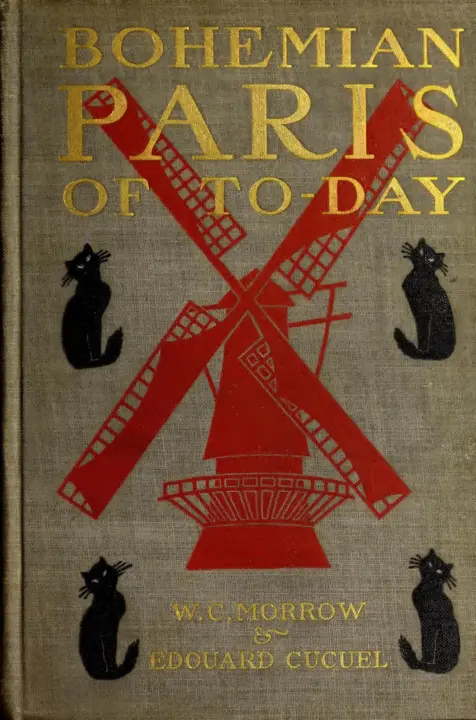
Bohemian Paris of To-day Second Edition
W. C. Morrow & Edward Cucuel
THE CLASSIC COLLECTION · 1897
"The Ape, the Idiot & Other People" by W. C. Morrow is a collection of short stories written in the late 19th century. The stories explore themes of freedom, companionship, and the human condition, often through the lens of unusual relationships, as exemplified by the interactions between an escaped ape and an idiot in the first tale. At the start of the first story, "The Resurrection of Little Wang Tai," we are introduced to Romulus, an anthropoid ape who escapes from a circus train, experiencing the thrill and confusion of newfound freedom for the first time. As Romulus explores the world around him, he encounters a gentle, child-like inmate of an idiot asylum named Moses. Drawn together by their shared desire for freedom and connection, Romulus and Moses embark on a whimsical adventure that eventually leads them to a graveyard, where a poignant scene plays out involving the burial of a young girl named Wang Tai. This encounter deepens their bond, illustrating the complexities of companionship across species and mental capacities, setting a tone for the themes that will unfold throughout the collection.
Introduction adapted from the source catalogue; source summaries may be automatically generated.
Free to read · English · 56,360 words · No account needed
MAKE TIME FOR A GOOD BOOK
On by default. Untick to stop anonymous reading totals. Each page counts after 10 seconds in view. How this works.
Anonymous counting is on unless you have switched it off.
The Permanent Stiletto
I had sent in all haste for Dr. Rowell, but as yet he had not arrived, and the strain was terrible. There lay my young friend upon his bed in the hotel, and I believed that he was dying. Only the jewelled handle of the knife was visible at his breast; the blade was wholly sheathed in his body.
"Pull it out, old fellow," begged the sufferer through white, drawn lips, his gasping voice being hardly less distressing than the unearthly look in his eyes.
"No, Arnold," said I, as I held his hand and gently stroked his forehead. It may have been instinct, it may have been a certain knowledge of anatomy that made me refuse.
"Why not? It hurts," he gasped. It was pitiful to see him suffer, this strong, healthy, daring, reckless young fellow.
Dr. Rowell walked in--a tall, grave man, with gray hair. He went to the bed and I pointed to the knife-handle, with its great, bold ruby in the end and its diamonds and emeralds alternating in quaint designs in the sides. The physician started. He felt Arnold's pulse and looked puzzled.
"When was this done?" he asked.
"About twenty minutes ago," I answered.
The physician started out, beckoning me to follow.
"Stop!" said Arnold. We obeyed. "Do you wish to speak of me?" he asked.
"Yes," replied the physician, hesitating.
"Speak in my presence then," said my friend; "I fear nothing." It was said in his old, imperious way, although his suffering must have been great.
"If you insist----"
"I do."
"Then," said the physician, "if you have any matters to adjust they should be attended to at once. I can do nothing for you."
"How long can I live?" asked Arnold.
The physician thoughtfully stroked his gray beard. "It depends," he finally said; "if the knife be withdrawn you may live three minutes; if it be allowed to remain you may possibly live an hour or two--not longer."
Arnold never flinched.
"Thank you," he said, smiling faintly through his pain; "my friend here will pay you. I have some things to do. Let the knife remain." He turned his eyes to mine, and, pressing my hand, said, affectionately, "And I thank you, too, old fellow, for not pulling it out."
The physician, moved by a sense of delicacy, left the room, saying, "Ring if there is a change. I will be in the hotel office." He had not gone far when he turned and came back. "Pardon me," said he, "but there is a young surgeon in the hotel who is said to be a very skilful man. My specialty is not surgery, but medicine. May I call him?"
Your reading position is saved on this browser. Take it to another device with a library code. Reading pages adapt to text, rather than matching a printed edition.
BEHIND THE BOOK
This eBook is for the use of anyone anywhere in the United States and most other parts of the world at no cost and with almost no restrictions whatsoever. You may copy it, give it away or re-use it under the terms of the Project Gutenberg License included with this eBook or online at www.gutenberg.org. If you are not located in the United States, you will have to check the laws of the country where you are located before using this eBook. Read the source licence.
The original source file, including credits and licence, is retained by this library. Request an original-format copy at no charge. Please include the book title and Project Gutenberg identifier #21616.
KEEP YOUR CURIOSITY GOING
Coulson Kernahan

Maurice Baring
Frances Wright
Cécile Tormay

Frederic Jesup Stimson

W. H. P. (William Henry Pope) Jarvis