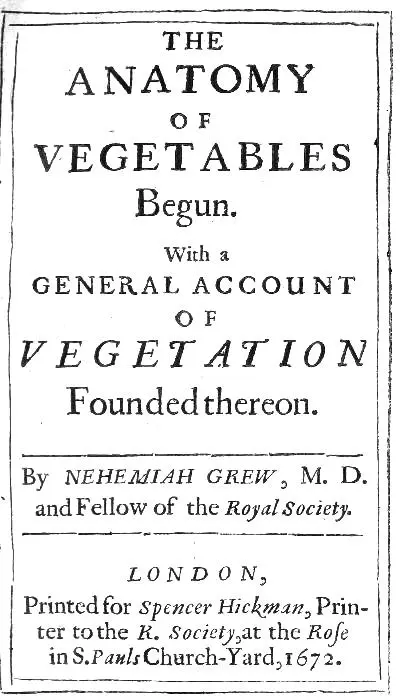
The Anatomy of Vegetables Begun With a General Account of Vegetation founded thereon
Nehemiah Grew
THE CLASSIC COLLECTION · 1675
The anatomy of plants by Nehemiah Grew is a scientific treatise written in the late 17th century. It lays out a systematic, microscope-aided account of plant structure and life processes, contending that plants possess organized internal “organs” and mechanical operations comparable to those of animals. The work’s aim is a “philosophical history” of plants that connects anatomy, sap flow, and the sensory qualities of colors, odors, and tastes to their faculties and practical uses in medicine, cultivation, and the arts.
The opening of this treatise presents a transcriber’s note on editorial choices and a helpful contents overview, followed by the Royal Society’s endorsement and a dedication to the monarch asserting the novelty and wonder of plant microstructure. Grew’s preface recounts how lecture work grew into a larger project, how peers in the Royal Society encouraged and licensed it, how it stood alongside Malpighi’s parallel studies, and how he combined naked-eye inspection with microscopy and explanatory plates. He then introduces his “Idea of a Philosophical History of Plants,” first surveying what botanists already know and where knowledge is deficient, and arguing why deeper inquiry is both possible and worthwhile. He proposes a multi-part program: comparative study of external features (figures, proportions, seasons, places, motions), rigorous anatomy of all parts with and without the microscope, and analysis of plant “contents” (sap, mucilages, milks, oils, gums) including their receptacles, motions, quantities, consistence, colors, smells, tastes, and faculties. Finally, he sketches an experimental toolkit—infusion, digestion, decoction, distillation, drying, roasting, burning, calcination, and mixtures—to relate these observations to causes and uses. This is only a summary of the opening portion, which sets the plan and methods rather than presenting the full body of results.
Introduction adapted from the source catalogue; source summaries may be automatically generated.
Free to read · English · 166,478 words · No account needed
MAKE TIME FOR A GOOD BOOK
On by default. Untick to stop anonymous reading totals. Each page counts after 10 seconds in view. How this works.
Anonymous counting is on unless you have switched it off.
42. §. Saccharum Saturni, with Oyl of Vitriol, stirs not at all. With Spirit of Salt, huffs a little. With Spirit of Nitre much more. Hence the acid of the Vinegar, and not the Alkaly of the Lead, is the predominant Principle.
43. §. Common Salt stirs neither with Spirit of Salt, nor with Spirit of Nitre; nor with Aqua fortis. But with Oyl of Vitriol it maketh a great Effervescence with noise and steams. Hence, even common Salt, though it be not reckoned amongst alkaline Salts, yet is far nearer in nature to that, than to an acid. Hence also the Spirit of Salt is a subalkaline Acid, and of a very different nature from Oyl of Sulphur or Vitriol.
44. §. Salt Armoniac, with Spirit of Nitre, stirreth not. But with Oyl of Vitriol it maketh a great Effervescence. Hence Spirit of Nitre is a subalkalizate Spirit.
45. §. Oyl of Vitriol and Spirit of Nitre, though both acids, yet make a great smoak; greater than that which the Spirit maketh of it self. Which confirms the last precedent Corollary.
46. §. Oyl of Vitriol and Spirit of Salt, though both acids, yet make a strong Effervescence, with noise and fumes. Which further confirms, what was noted before, sc. that Spirit of Salt is a subalkaline Acid.
47. §. Spirit of Salt Armoniac, with Oyl of Vitriol, makes an Effervescence so extraordinary quick, and as it were instantaneous, that nothing seemeth quicker. Whence it is probable, That if Gun-powder were made of Salt Armoniac, instead of Nitre, or with both mixed together; it would be far stronger, than any kind now in use. And thus far for Minerals.
48. §. I have only one Corollary to add, from the whole; which is, That whoever doth undertake the Natural History of a Country, (such as that the Learned Dr. Plot hath exceedingly well done of Oxfordshire) the foregoing Method, seemeth so easie, cheap, and indeceitful, for the finding out and well distinguishing the natures of all kinds of Metalls, Ores, Salts, Earths, Stones, or other subterraneal Bodies; as cannot, I think, be supply’d, but by others of greater difficulty and expence.
What may be observed of the PARTS of Animals.
I NOW proceed to the several Parts of Animals; as Hairs, Hoofs, Horns, Shells and shelly Insects, Bones, Flesh and the several Viscera, Silk, Blood, Eggs, Musk, Castor, Gall, Urine, Dungs, Salts and Stones.
Your reading position is saved on this browser. Take it to another device with a library code. Reading pages adapt to text, rather than matching a printed edition.
BEHIND THE BOOK
This eBook is for the use of anyone anywhere in the United States and most other parts of the world at no cost and with almost no restrictions whatsoever. You may copy it, give it away or re-use it under the terms of the Project Gutenberg License included with this eBook or online at www.gutenberg.org. If you are not located in the United States, you will have to check the laws of the country where you are located before using this eBook. Read the source licence.
The original source file, including credits and licence, is retained by this library. Request an original-format copy at no charge. Please include the book title and Project Gutenberg identifier #77434.
KEEP YOUR CURIOSITY GOING

John Muir

Asa Gray
Asa Gray

Florence Nightingale
Elizabeth Robins Pennell
Denison Olmsted