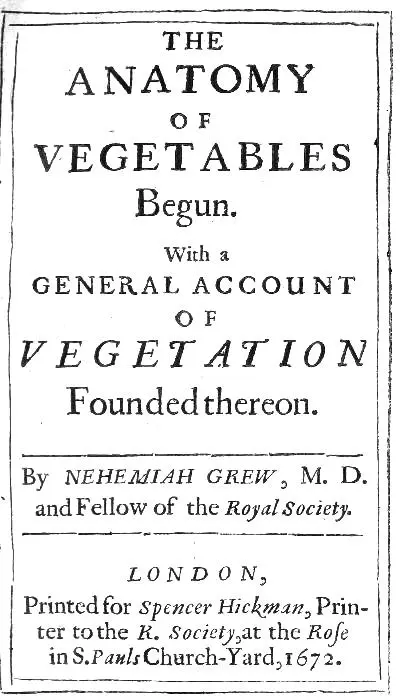
The Anatomy of Vegetables Begun With a General Account of Vegetation founded thereon
Nehemiah Grew
THE CLASSIC COLLECTION · 1675
The anatomy of plants by Nehemiah Grew is a scientific treatise written in the late 17th century. It lays out a systematic, microscope-aided account of plant structure and life processes, contending that plants possess organized internal “organs” and mechanical operations comparable to those of animals. The work’s aim is a “philosophical history” of plants that connects anatomy, sap flow, and the sensory qualities of colors, odors, and tastes to their faculties and practical uses in medicine, cultivation, and the arts.
The opening of this treatise presents a transcriber’s note on editorial choices and a helpful contents overview, followed by the Royal Society’s endorsement and a dedication to the monarch asserting the novelty and wonder of plant microstructure. Grew’s preface recounts how lecture work grew into a larger project, how peers in the Royal Society encouraged and licensed it, how it stood alongside Malpighi’s parallel studies, and how he combined naked-eye inspection with microscopy and explanatory plates. He then introduces his “Idea of a Philosophical History of Plants,” first surveying what botanists already know and where knowledge is deficient, and arguing why deeper inquiry is both possible and worthwhile. He proposes a multi-part program: comparative study of external features (figures, proportions, seasons, places, motions), rigorous anatomy of all parts with and without the microscope, and analysis of plant “contents” (sap, mucilages, milks, oils, gums) including their receptacles, motions, quantities, consistence, colors, smells, tastes, and faculties. Finally, he sketches an experimental toolkit—infusion, digestion, decoction, distillation, drying, roasting, burning, calcination, and mixtures—to relate these observations to causes and uses. This is only a summary of the opening portion, which sets the plan and methods rather than presenting the full body of results.
Introduction adapted from the source catalogue; source summaries may be automatically generated.
Free to read · English · 166,478 words · No account needed
MAKE TIME FOR A GOOD BOOK
On by default. Untick to stop anonymous reading totals. Each page counts after 10 seconds in view. How this works.
Anonymous counting is on unless you have switched it off.
42. §. By Assation; thus Apples, by roasting, eat more Sowre. The Root of Horse-Radish, toasted, tasteth like a Turnep. Potatoes, Onions, and many other Roots, and Parts, have their Tastes, either Altered or Refracted; which chiefly, and in what manner, should be observed. There is one alteration, as remarkable, as commonly known; and is that which followeth upon roasting or baking in one kind of the Waldensian Pears, which, for a Walden, we corruptly call a Warden.
43. §. By Ustion; wherein some Plants, or Parts of them, burn very quietly; others, not without violent motions; so Fenil-Seeds, held in the flame of a Candle, will spit and spurtle, like the Serum of Blood. Some Vegetables lose their Smell, as Roses; others, keep it, as Rosemary; and others, mend it, as Lignum Aloes, To note, not only the alteration of their Qualities, but what they yield; as Turpentine, which, in Distillation, yieldeth Oyl and Water, both limpid; upon Ustion, sheweth nothing but a black Soot. So Benzoine, by Distillation, Oyl; by Ustion, white Flowers, as is known.
44. §. By Calcination; and here to observe, wherein the Caput Mortuum of one, may differ from, or agree in Nature with that of another; and also to compare these with those of Animal Bodies. As also in their Quantities. And to compare them with what they yield by Distillation and Ustion as to both. Thus far they have been tryed singly, or by themselves. They should also be examined.
45. §. By Composition; not only with Water, as in simple Infusions, &c. but with any other Bodies, which may have a power of acting upon them, or upon which, these may have a power to act. And so to make Infusions, Destillations, Decoctions, Digestions, in divers kinds of Liquors, as Vinegar, Urine, Spirit of H. H. Wine, Blood, Milk, or others. So in Infusions, some Red Colours are heightned by Acids; Blews, turned Purple. So fetid Spirits (as of H.H.) may be rendred much more grateful, by being Rectified, once or twice, with fresh Aromaticks, To observe also what follows, upon mixing the Liquors, or other Parts of Plants together, as Oyl of Turpentine, by Digestion with a Lixivial Salt, extracteth thence a Red Tincture. Or with Salts, Earths, Metals, or any other Bodies; as the Juyce of the green Leaves of Rasberry, Primrose, and divers other Plants (I think principally such as are Astringent) expressed upon Steel, as it drieth, becometh of a Purple Colour.
Your reading position is saved on this browser. Take it to another device with a library code. Reading pages adapt to text, rather than matching a printed edition.
BEHIND THE BOOK
This eBook is for the use of anyone anywhere in the United States and most other parts of the world at no cost and with almost no restrictions whatsoever. You may copy it, give it away or re-use it under the terms of the Project Gutenberg License included with this eBook or online at www.gutenberg.org. If you are not located in the United States, you will have to check the laws of the country where you are located before using this eBook. Read the source licence.
The original source file, including credits and licence, is retained by this library. Request an original-format copy at no charge. Please include the book title and Project Gutenberg identifier #77434.
KEEP YOUR CURIOSITY GOING

John Muir

Asa Gray
Asa Gray

Florence Nightingale
Elizabeth Robins Pennell
Denison Olmsted