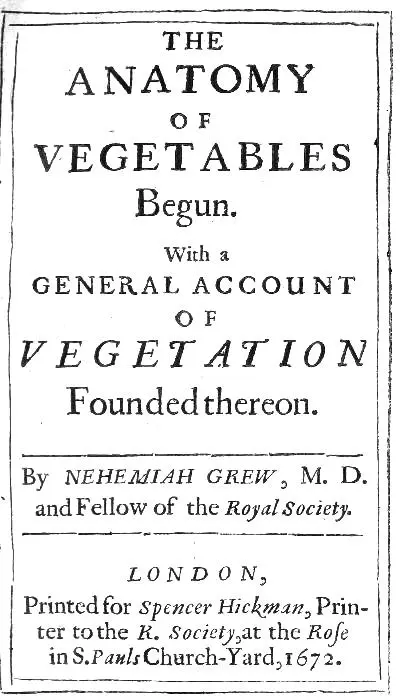
The Anatomy of Vegetables Begun With a General Account of Vegetation founded thereon
Nehemiah Grew
THE CLASSIC COLLECTION · 1675
The anatomy of plants by Nehemiah Grew is a scientific treatise written in the late 17th century. It lays out a systematic, microscope-aided account of plant structure and life processes, contending that plants possess organized internal “organs” and mechanical operations comparable to those of animals. The work’s aim is a “philosophical history” of plants that connects anatomy, sap flow, and the sensory qualities of colors, odors, and tastes to their faculties and practical uses in medicine, cultivation, and the arts.
The opening of this treatise presents a transcriber’s note on editorial choices and a helpful contents overview, followed by the Royal Society’s endorsement and a dedication to the monarch asserting the novelty and wonder of plant microstructure. Grew’s preface recounts how lecture work grew into a larger project, how peers in the Royal Society encouraged and licensed it, how it stood alongside Malpighi’s parallel studies, and how he combined naked-eye inspection with microscopy and explanatory plates. He then introduces his “Idea of a Philosophical History of Plants,” first surveying what botanists already know and where knowledge is deficient, and arguing why deeper inquiry is both possible and worthwhile. He proposes a multi-part program: comparative study of external features (figures, proportions, seasons, places, motions), rigorous anatomy of all parts with and without the microscope, and analysis of plant “contents” (sap, mucilages, milks, oils, gums) including their receptacles, motions, quantities, consistence, colors, smells, tastes, and faculties. Finally, he sketches an experimental toolkit—infusion, digestion, decoction, distillation, drying, roasting, burning, calcination, and mixtures—to relate these observations to causes and uses. This is only a summary of the opening portion, which sets the plan and methods rather than presenting the full body of results.
Introduction adapted from the source catalogue; source summaries may be automatically generated.
Free to read · English · 166,478 words · No account needed
MAKE TIME FOR A GOOD BOOK
On by default. Untick to stop anonymous reading totals. Each page counts after 10 seconds in view. How this works.
Anonymous counting is on unless you have switched it off.
29. §. But especially their Tastes, which it much importeth us more precisely to distinguish; First, by their general Kinds; for the number, even of these, may be computed greater than usually it is. I remember not, that Heat and Acritude, with respect to Taste, are distinguished; yet Arum-Root is very Pungent, without any proper Heat; and Cloves, are very Hot, without any proper Pungency. So the White Roots of Yarrow, have a Taste, hardly any other way perceptible, than by causing a gentle glowing and continued Warmth upon the Tongue. Also their Respondencies one to another; as that of Zedoary, and of the lesser Cardamoms, is somewhat like to Camphire. Likewise their Degrees; in which there is a great latitude, and may be extended from One to Ten, or with easie distinction, from One to Five: So the Root of Sorrel, is Bitter in the first; of Dock, in the second; of Dog-Rose, in the third; of Dandelyon, in the fourth; of Gentian, in the fifth: observing them, not only as they vary in several Kinds of Plants, but the several Species of one, as in Cichory, Hawkweed, Dandelyon. And then their Compositions; for Tastes are as truly conjunct in one Part, as Colours: by which, the latitude is still greater; In that all Kinds of Tastes, in all their Degrees, and in differing Numbers, may be variously Compounded together: For the most part, Two, as in the Leaves of sharp-pointed Dock, Astringent, and Sowre; in Sorrel-Roots, Astringent and Bitter; and in Aloes, Bitter and Sweet; the one in the fifth, the other, in the first Degree; as upon an unprejudiced tryal may be perceived: and yet more evidently in the Gall of any Land-Animal. Sometimes three, as in Agrimony, Bitter, Rough, and Sowrish and in Agarick, Bitter, Rough, and Sweet. And sometimes, perhaps more. The Sensible distinctions of all which, may lye almost as wide, as of Plants themselves. Wherefore, although it may be thought rashness, to take away the distinctions of Hot, Cold, Moist, Dry, Thin, Gross, and other Qualities, in their several Degree, which the Ancients have affixed to particular Plants: yet since they have done it, to many of them, with much uncertainty; and that, withal, they are, more properly, the Effects and Operations of Plants, than their Qualites; Practical Observation, may therefore approve it useful, to add these Sensible Ones of various Tastes, precisely distinguishing their Conjugations and Degrees. Lastly, their several Varieties and Mutations, with respect to the Subject wherein they reside, should also be noted. As, of all Tastes found in Plants, Bitter and Sowr, are most common; Sweet and Salt, most rare. Which latter, is not only perceptible in some Sea-Plants; but upon some others, as upon the fresh Leaves of Tamarisk; which being licked while they grow, or when immediately gathered, are plainly Saltish. How they vary with the Age of the Plant, or Part; as the Roots of Radishes, growing up to Seed, lose the strength of their Tast; so most Fruits are first Sowre, then Sweet. What proper to the several Parts of any one Plant; so the Leaves of Wormwood are extraordinary Bitter; the Root scarcely so at all; of an Hot, but quite different Taste. What more Common, or Rare, to any Part; so no Root that I ever tasted, is Sowre. And how they Alternate in several Plants; as the Root of Stock-July-flower is biting, not the Leaves; on the contrary, the Leaves of the Water-Arsmart, are Biting; but not the Root; and the like. To which we may add the difference of Time wherein the Tastes of Plants are perceived; as those of Arum, and Rape-Crowfoot, are both Biting; but that of the first, as it is slowly perceived, so it continues long; that of the other, quickly comes, and quickly goes.
Your reading position is saved on this browser. Take it to another device with a library code. Reading pages adapt to text, rather than matching a printed edition.
BEHIND THE BOOK
This eBook is for the use of anyone anywhere in the United States and most other parts of the world at no cost and with almost no restrictions whatsoever. You may copy it, give it away or re-use it under the terms of the Project Gutenberg License included with this eBook or online at www.gutenberg.org. If you are not located in the United States, you will have to check the laws of the country where you are located before using this eBook. Read the source licence.
The original source file, including credits and licence, is retained by this library. Request an original-format copy at no charge. Please include the book title and Project Gutenberg identifier #77434.
KEEP YOUR CURIOSITY GOING

John Muir

Asa Gray
Asa Gray

Florence Nightingale
Elizabeth Robins Pennell
Denison Olmsted