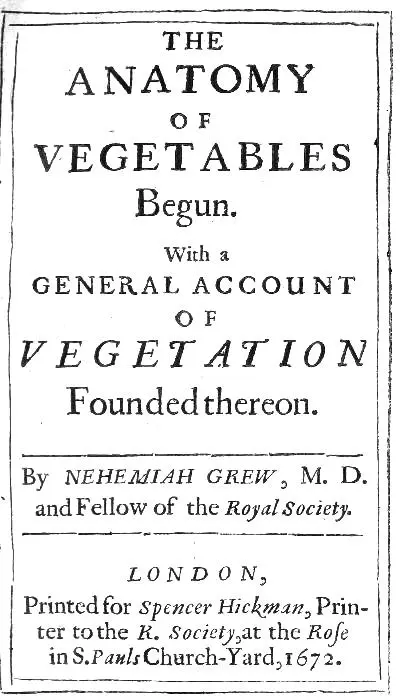
The Anatomy of Vegetables Begun With a General Account of Vegetation founded thereon
Nehemiah Grew
THE CLASSIC COLLECTION · 1675
The anatomy of plants by Nehemiah Grew is a scientific treatise written in the late 17th century. It lays out a systematic, microscope-aided account of plant structure and life processes, contending that plants possess organized internal “organs” and mechanical operations comparable to those of animals. The work’s aim is a “philosophical history” of plants that connects anatomy, sap flow, and the sensory qualities of colors, odors, and tastes to their faculties and practical uses in medicine, cultivation, and the arts.
The opening of this treatise presents a transcriber’s note on editorial choices and a helpful contents overview, followed by the Royal Society’s endorsement and a dedication to the monarch asserting the novelty and wonder of plant microstructure. Grew’s preface recounts how lecture work grew into a larger project, how peers in the Royal Society encouraged and licensed it, how it stood alongside Malpighi’s parallel studies, and how he combined naked-eye inspection with microscopy and explanatory plates. He then introduces his “Idea of a Philosophical History of Plants,” first surveying what botanists already know and where knowledge is deficient, and arguing why deeper inquiry is both possible and worthwhile. He proposes a multi-part program: comparative study of external features (figures, proportions, seasons, places, motions), rigorous anatomy of all parts with and without the microscope, and analysis of plant “contents” (sap, mucilages, milks, oils, gums) including their receptacles, motions, quantities, consistence, colors, smells, tastes, and faculties. Finally, he sketches an experimental toolkit—infusion, digestion, decoction, distillation, drying, roasting, burning, calcination, and mixtures—to relate these observations to causes and uses. This is only a summary of the opening portion, which sets the plan and methods rather than presenting the full body of results.
Introduction adapted from the source catalogue; source summaries may be automatically generated.
Free to read · English · 166,478 words · No account needed
MAKE TIME FOR A GOOD BOOK
On by default. Untick to stop anonymous reading totals. Each page counts after 10 seconds in view. How this works.
Anonymous counting is on unless you have switched it off.
7. §. THIS Parenchymous Part, in many Roots, is of one Uniform Contexture; as in Asparagus, Hors-Radish, Peony, Potato, and others. In many others, it is, as it were, of a Diversified Woof; the Bladders being, though every where Regular, yet either in Shape, Size, or Situation, different in some Parts hereof, from what they are, in other intermediate ones. For these Parts, are like so many White Rays, streaming, by the Diameter of the Root, from the inward Edge toward the Circumference of the Barque; as in Lovage, Melilot, Parsnep, &c. cut transversly, is apparent. ♦ Tab. 8, 9. ♦ They are, though not in direct Lines, continued also by the length of the Root; so that they are, as it were, so many Membrances, by which the other Parts of the Barque, are disterminated.
8. §. The Continuation of these Diametral Rays, or Portions, is divers: sometimes, but half through the Barque, or somewhat more, or less, as in Melilot. ♦ Tab. 9. ♦ And it is probable, that to the Roots of all or most Trefoyls, and also of the Leguminous Kind, this is proper, To have their Diametral Rays come short of the Circumference. ♦ Tab. 8. ♦ Sometimes, they run quite through to the very Skin, as in Lovage. And I think, in the Roots of all Umbelliferous Plants: In which therefore, the Skin seems to have a closer Communion with the Diametral Rays, and to be originated especially therefrom. They usually stand at an Equal Distance in the same Root: But with respect to divers Roots, their Distance varies; ♦ Tab. 7, 8. ♦ so less, in Parsnep, greater in Bugloss. They are commonly Rectilinear, as in Lovage; ♦ Tab. 8. ♦ but sometimes winding to and fro, as in a Carrot.
9. §. They are not always of one Size: in a Carrot near the Inner Edge of the Barque, exceeding Slender, and scarcely discernable; in others, Thicker, as in the Three greater ones of Melilot, and in common Chervil. ♦ Tab. 8, 9. ♦ Both by their Distance, and Size, they are also less or more Numerous; some, only as they are nearer; some, as smaller; others, as both. And ’tis proper, I think, to the Intybous kind, either to have none, or but a few. Sometimes they are of the same Thickness quite, through the Barque from edge to edge, as in Marsh-Mallow. ♦ Tab. 7. ♦ And sometimes are considerably spread or dilated as they aproach the Skin, wherewith they are joyned, and whereinto they more visibly run, as in Parsley, or the smaller part of the Root of Lovage. ♦ Tab. 8. ♦ And in some Roots, as of Scorzonera, at some times of the year, when less succulent, almost the whole Parenchyma seems to be of the Nature of the Diametral Rays, in other Roots. The Bladders of these Diametral Portions, are sometimes, greater than those of the other Parenchymous Parts, as in Parsley; and I think sometimes less. Yet as there, so here, variously sized; to about six or eight Degrees; and those of Parsley about the third, fourth, and fifth. Their Figure is Sometimes more oblong; and their direction or respect more towards the Center of the Root.
Your reading position is saved on this browser. Take it to another device with a library code. Reading pages adapt to text, rather than matching a printed edition.
BEHIND THE BOOK
This eBook is for the use of anyone anywhere in the United States and most other parts of the world at no cost and with almost no restrictions whatsoever. You may copy it, give it away or re-use it under the terms of the Project Gutenberg License included with this eBook or online at www.gutenberg.org. If you are not located in the United States, you will have to check the laws of the country where you are located before using this eBook. Read the source licence.
The original source file, including credits and licence, is retained by this library. Request an original-format copy at no charge. Please include the book title and Project Gutenberg identifier #77434.
KEEP YOUR CURIOSITY GOING

John Muir

Asa Gray
Asa Gray

Florence Nightingale
Elizabeth Robins Pennell
Denison Olmsted