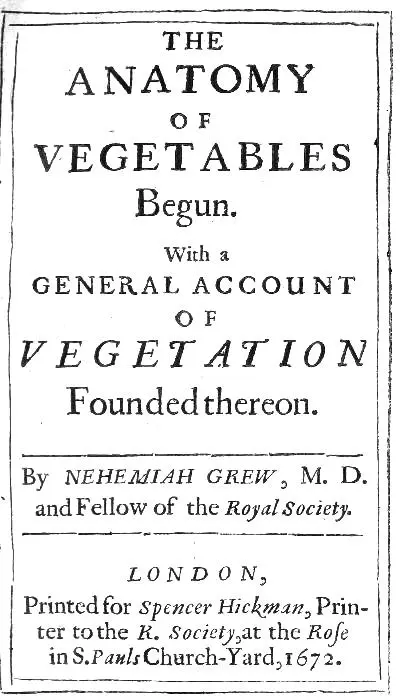
The Anatomy of Vegetables Begun With a General Account of Vegetation founded thereon
Nehemiah Grew
THE CLASSIC COLLECTION · 1675
The anatomy of plants by Nehemiah Grew is a scientific treatise written in the late 17th century. It lays out a systematic, microscope-aided account of plant structure and life processes, contending that plants possess organized internal “organs” and mechanical operations comparable to those of animals. The work’s aim is a “philosophical history” of plants that connects anatomy, sap flow, and the sensory qualities of colors, odors, and tastes to their faculties and practical uses in medicine, cultivation, and the arts.
The opening of this treatise presents a transcriber’s note on editorial choices and a helpful contents overview, followed by the Royal Society’s endorsement and a dedication to the monarch asserting the novelty and wonder of plant microstructure. Grew’s preface recounts how lecture work grew into a larger project, how peers in the Royal Society encouraged and licensed it, how it stood alongside Malpighi’s parallel studies, and how he combined naked-eye inspection with microscopy and explanatory plates. He then introduces his “Idea of a Philosophical History of Plants,” first surveying what botanists already know and where knowledge is deficient, and arguing why deeper inquiry is both possible and worthwhile. He proposes a multi-part program: comparative study of external features (figures, proportions, seasons, places, motions), rigorous anatomy of all parts with and without the microscope, and analysis of plant “contents” (sap, mucilages, milks, oils, gums) including their receptacles, motions, quantities, consistence, colors, smells, tastes, and faculties. Finally, he sketches an experimental toolkit—infusion, digestion, decoction, distillation, drying, roasting, burning, calcination, and mixtures—to relate these observations to causes and uses. This is only a summary of the opening portion, which sets the plan and methods rather than presenting the full body of results.
Introduction adapted from the source catalogue; source summaries may be automatically generated.
Free to read · English · 166,478 words · No account needed
MAKE TIME FOR A GOOD BOOK
On by default. Untick to stop anonymous reading totals. Each page counts after 10 seconds in view. How this works.
Anonymous counting is on unless you have switched it off.
With Him, it was, You were pleased to commit to Me, the further prosecution of this Work; the Beginnings whereof, were by Your Order formerly made publique. Had I consulted my own Abilities altogether, I should scarcely have ventured upon it; seeing very little, for which I could think well of my self, saving, That I had learned, upon good grounds, to think of You with greatest Honour. But I also considered, That to insist hereon too much, might be a reflection upon Your Judgments, who had thought fit to make choice of Me. And, That You were not more the Patrons of Wit, than of Industry; and of All, who shall endeavour to find out, or to confirm the Truth of Things. Withal, I looked upon Nature, as a Treasure so infinitely full; that as all Men together, cannot exhaust it; so no Man, but may find out somewhat therein, if he be resolved to Try.
In compliance therefore with Your Commands, I have hereunto devoted a very considerable part of my Time. These, adding force to my own Desires, of being somewhat instrumental to the Improvement of Medicinal, and other wholesom Knowledge: if peradventure, as we increase herein, we may become better, and more happy. As to which Improvement, though I could not hope; yet, I would not dispair. I have already prepared the Soil, and made some Plantation: what remaineth behind, and the Vintage of the whole, will depend much upon the continued Influence of Your Beams: for how unpromising soever the Stock may be; yet the Fruit cannot but be somewhat matured, upon which You are pleased to shine. I am also confident, that the same Nobilty and Goodness, which accept the endeavours, will likewise pardon the faults, of,
My Lord,
Your Lordships most humbly
and most sincerly
devoted Servant
September 1. 1673.
The FIRST PART.
OF the Original of Roots, §. 1, 2, 3. Of their Figures, 4, to 8. Of their Motions, 9, to 15. And of their Ages, 16, to the end.
OF the Skin. Its external Accidents, and Original, §. 1, 2. Compounding Parts. Whereof the one Parenchymous, 3. The other Lignous, 4, to the end.
OF the Barque. Its Original and external Accidents, §. 1. Size, 2. Compounding Parts: Whereof the one Parenchymous, 3. The Bladders of the Parenchyma, 4, 5, 6. The Diametral Portions, 7, to 11. The other Part, Lignous, consisting of long Pipes or Vessels, 12, to 17, Of several Kinds, 18, to 23. In different Proportion, 24, 25. And in different and elegant Position. 26, to the end.
Your reading position is saved on this browser. Take it to another device with a library code. Reading pages adapt to text, rather than matching a printed edition.
BEHIND THE BOOK
This eBook is for the use of anyone anywhere in the United States and most other parts of the world at no cost and with almost no restrictions whatsoever. You may copy it, give it away or re-use it under the terms of the Project Gutenberg License included with this eBook or online at www.gutenberg.org. If you are not located in the United States, you will have to check the laws of the country where you are located before using this eBook. Read the source licence.
The original source file, including credits and licence, is retained by this library. Request an original-format copy at no charge. Please include the book title and Project Gutenberg identifier #77434.
KEEP YOUR CURIOSITY GOING

John Muir

Asa Gray
Asa Gray

Florence Nightingale
Elizabeth Robins Pennell
Denison Olmsted