
Last letters from the living dead man
David Patterson (Spirit) Hatch
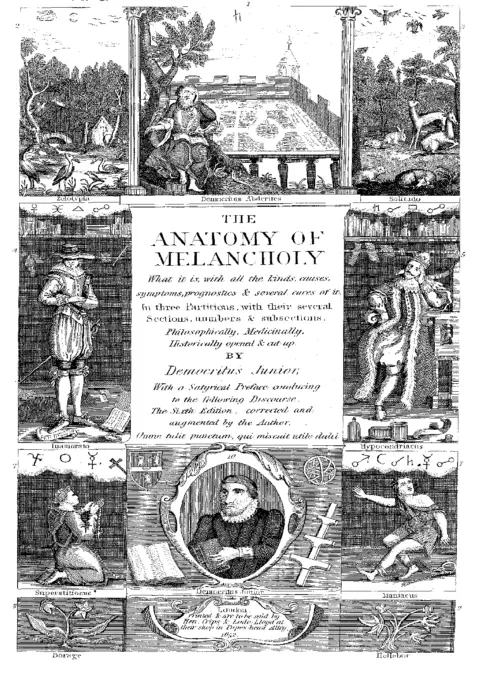
THE CLASSIC COLLECTION · 1617
"The Anatomy of Melancholy" by Robert Burton is a medical treatise first published in 1621. This massive work explores depression and its causes, symptoms, and cures, but ranges far beyond medicine into history, astronomy, geography, and literature. Written under the pseudonym Democritus Junior, Burton blends scientific analysis with humor and satire across over 500,000 words. Drawing from ancient authorities and medieval sources, he examines melancholy as both a passing mood and a serious ailment, creating a unique work that inspired generations of writers.
Introduction adapted from the source catalogue; source summaries may be automatically generated.
Free to read · English · 529,097 words · No account needed
MAKE TIME FOR A GOOD BOOK
On by default. Untick to stop anonymous reading totals. Each page counts after 10 seconds in view. How this works.
Anonymous counting is on unless you have switched it off.
Who will not be affected so in like case, or see those well-furnished cloisters and galleries of the Roman cardinals, so richly stored with all modern pictures, old statues and antiquities? Cum se—spectando recreet simul et legendo, to see their pictures alone and read the description, as [3316]Boisardus well adds, whom will it not affect? which Bozius, Pomponius, Laetus, Marlianus, Schottus, Cavelerius, Ligorius, &c., and he himself hath well performed of late. Or in some prince's cabinets, like that of the great dukes in Florence, of Felix Platerus in Basil, or noblemen's houses, to see such variety of attires, faces, so many, so rare, and such exquisite pieces, of men, birds, beasts, &c., to see those excellent landscapes, Dutch works, and curious cuts of Sadlier of Prague, Albertus Durer, Goltzius Vrintes, &c., such pleasant pieces of perspective, Indian pictures made of feathers, China works, frames, thaumaturgical motions, exotic toys, &c. Who is he that is now wholly overcome with idleness, or otherwise involved in a labyrinth of worldly cares, troubles and discontents, that will not be much lightened in his mind by reading of some enticing story, true or feigned, whereas in a glass he shall observe what our forefathers have done, the beginnings, ruins, falls, periods of commonwealths, private men's actions displayed to the life, &c. [3317] Plutarch therefore calls them, secundas mensas et bellaria, the second course and junkets, because they were usually read at noblemen's feasts. Who is not earnestly affected with a passionate speech, well penned, an elegant poem, or some pleasant bewitching discourse, like that of [3318] Heliodorus, ubi oblectatio quaedam placide fuit, cum hilaritate conjuncta? Julian the Apostate was so taken with an oration of Libanius, the sophister, that, as he confesseth, he could not be quiet till he had read it all out. Legi orationem tuam magna ex parte, hesterna die ante prandium, pransus vero sine ulla intermissione totam absolvi.[3319]O argumenta! O compositionem! I may say the same of this or that pleasing tract, which will draw his attention along with it. To most kind of men it is an extraordinary delight to study. For what a world of books offers itself, in all subjects, arts, and sciences, to the sweet content and capacity of the reader? In arithmetic, geometry, perspective, optics, astronomy, architecture, sculpture, painting, of which so many and such elaborate treatises are of late written: in mechanics and their mysteries, military matters, navigation, [3320]riding of horses, [3321]fencing, swimming, gardening, planting, great tomes of husbandry, cookery, falconry, hunting, fishing, fowling, &c., with exquisite pictures of all sports, games, and what not? In music, metaphysics, natural and moral philosophy, philology, in policy, heraldry, genealogy, chronology, &c., they afford great tomes, or those studies of [3322]antiquity, &c., et [3323]quid subtilius Arithmeticis inventionibus, quid jucundius Musicis rationibus, quid divinius Astronomicis, quid rectius Geometricis demonstrationibus? What so sure, what so pleasant? He that shall but see that geometrical tower of Garezenda at Bologna in Italy, the steeple and clock at Strasburg, will admire the effects of art, or that engine of Archimedes, to remove the earth itself, if he had but a place to fasten his instrument: Archimedes Coclea, and rare devices to corrivate waters, musical instruments, and tri-syllable echoes again, again, and again repeated, with myriads of such. What vast tomes are extant in law, physic, and divinity, for profit, pleasure, practice, speculation, in verse or prose, &c.! their names alone are the subject of whole volumes, we have thousands of authors of all sorts, many great libraries full well furnished, like so many dishes of meat, served out for several palates; and he is a very block that is affected with none of them. Some take an infinite delight to study the very languages wherein these books are written, Hebrew, Greek, Syriac, Chaldee, Arabic, &c. Methinks it would please any man to look upon a geographical map, [3324]sauvi animum delectatione allicere, ob incredibilem rerum varietatem et jucunditatem, et ad pleniorem sui cognitionem excitare, chorographical, topographical delineations, to behold, as it were, all the remote provinces, towns, cities of the world, and never to go forth of the limits of his study, to measure by the seale and compass their extent, distance, examine their site. Charles the Great, as Platina writes, had three fair silver tables, in one of which superficies was a large map of Constantinople, in the second Rome neatly engraved, in the third an exquisite description of the whole world, and much delight he took in them. What greater pleasure can there now be, than to view those elaborate maps of Ortelius, [3325]Mercator, Hondius, &c.? To peruse those books of cities, put out by Braunus and Hogenbergius? To read those exquisite descriptions of Maginus, Munster, Herrera, Laet, Merula, Boterus, Leander, Albertus, Camden, Leo Afer, Adricomius, Nic. Gerbelius, &c.? Those famous expeditions of Christoph. Columbus, Americus Vespucius, Marcus Polus the Venetian, Lod. Vertomannus, Aloysius Cadamustus, &c.? Those accurate diaries of Portuguese, Hollanders, of Bartison, Oliver a Nort, &c. Hakluyt's voyages, Pet. Martyr's Decades, Benzo, Lerius, Linschoten's relations, those Hodoeporicons of Jod. a Meggen, Brocard the monk, Bredenbachius, Jo. Dublinius, Sands, &c., to Jerusalem, Egypt, and other remote places of the world? those pleasant itineraries of Paulus Hentzerus, Jodocus Sincerus, Dux Polonus, &c., to read Bellonius' observations, P. Gillius his surveys; those parts of America, set out, and curiously cut in pictures, by Fratres a Bry. To see a well-cut herbal, herbs, trees, flowers, plants, all vegetables expressed in their proper colours to the life, as that of Matthiolus upon Dioscorides, Delacampius, Lobel, Bauhinus, and that last voluminous and mighty herbal of Beslar of Nuremberg, wherein almost every plant is to his own bigness. To see birds, beasts, and fishes of the sea, spiders, gnats, serpents, flies, &c., all creatures set out by the same art, and truly expressed in lively colours, with an exact description of their natures, virtues, qualities, &c., as hath been accurately performed by Aelian, Gesner, Ulysses Aldrovandus, Bellonius, Rondoletius, Hippolitus Salvianus, &c. [3326]Arcana coeli, naturae secreta, ordinem universi scire majoris felicitatis et dulcedinis est, quam cogitatione quis assequi possit, aut mortalis sperare. What more pleasing studies can there be than the mathematics, theoretical or practical parts? as to survey land, make maps, models, dials, &c., with which I was ever much delighted myself. Tails est Mathematum pulchritudo (saith [3327] Plutarch) ut his indignum sit divitiarum phaleras istas et bullas, et puellaria spectacula comparari; such is the excellency of these studies, that all those ornaments and childish bubbles of wealth, are not worthy to be compared to them: credi mihi ( [3328]saith one) extingui dulce erit Mathematicarum artium studio, I could even live and die with such meditation, [3329]and take more delight, true content of mind in them, than thou hast in all thy wealth and sport, how rich soever thou art. And as [3330]Cardan well seconds me, Honorificum magis est et gloriosum haec intelligere, quam provinciis praeesse, formosum aut ditem juvenem esse. [3331]The like pleasure there is in all other studies, to such as are truly addicted to them, [3332]ea suavitas (one holds) ut cum quis ea degustaverit, quasi poculis Circeis captus, non possit unquam ab illis divelli; the like sweetness, which as Circe's cup bewitcheth a student, he cannot leave off, as well may witness those many laborious hours, days and nights, spent in the voluminous treatises written by them; the same content. [3333]Julius Scaliger was so much affected with poetry, that he brake out into a pathetical protestation, he had rather be the author of twelve verses in Lucan, or such an ode in [3334]Horace, than emperor of Germany. [3335]Nicholas Gerbelius, that good old man, was so much ravished with a few Greek authors restored to light, with hope and desire of enjoying the rest, that he exclaims forthwith, Arabibus atque Indis omnibus erimus ditiores, we shall be richer than all the Arabic or Indian princes; of such [3336]esteem they were with him, incomparable worth and value. Seneca prefers Zeno and Chrysippus, two doting stoics (he was so much enamoured of their works), before any prince or general of an army; and Orontius, the mathematician, so far admires Archimedes, that he calls him Divinum et homine majorem, a petty god, more than a man; and well he might, for aught I see, if you respect fame or worth. Pindarus, of Thebes, is as much renowned for his poems, as Epaminondas, Pelopidas, Hercules or Bacchus, his fellow citizens, for their warlike actions; et si famam respicias, non pauciores Aristotelis quam Alexandri meminerunt (as Cardan notes), Aristotle is more known than Alexander; for we have a bare relation of Alexander's deeds, but Aristotle, totus vivit in monumentis, is whole in his works: yet I stand not upon this; the delight is it, which I aim at, so great pleasure, such sweet content there is in study. [3337]King James, 1605, when he came to see our University of Oxford, and amongst other edifices now went to view that famous library, renewed by Sir Thomas Bodley, in imitation of Alexander, at his departure brake out into that noble speech, If I were not a king, I would be a university man: [3338] and if it were so that I must be a prisoner, if I might have my wish, I would desire to have no other prison than that library, and to be chained together with so many good authors et mortuis magistris. So sweet is the delight of study, the more learning they have (as he that hath a dropsy, the more he drinks the thirstier he is) the more they covet to learn, and the last day is prioris discipulus; harsh at first learning is, radices amarcae, but fractus dulces, according to that of Isocrates, pleasant at last; the longer they live, the more they are enamoured with the Muses. Heinsius, the keeper of the library at Leyden in Holland, was mewed up in it all the year long: and that which to thy thinking should have bred a loathing, caused in him a greater liking. [3339]I no sooner (saith he) come into the library, but I bolt the door to me, excluding lust, ambition, avarice, and all such vices, whose nurse is idleness, the mother of ignorance, and melancholy herself, and in the very lap of eternity, amongst so many divine souls, I take my seat, with so lofty a spirit and sweet content, that I pity all our great ones, and rich men that know not this happiness. I am not ignorant in the meantime (notwithstanding this which I have said) how barbarously and basely, for the most part, our ruder gentry esteem of libraries and books, how they neglect and contemn so great a treasure, so inestimable a benefit, as Aesop's cock did the jewel he found in the dunghill; and all through error, ignorance, and want of education. And 'tis a wonder, withal, to observe how much they will vainly cast away in unnecessary expenses, quot modis pereant (saith [3340]Erasmus) magnatibus pecuniae, quantum absumant alea, scorta, compotationes, profectiones non necessariae, pompae, bella quaesita, ambitio, colax, morio, ludio, &c., what in hawks, hounds, lawsuits, vain building, gormandising, drinking, sports, plays, pastimes, &c. If a well-minded man to the Muses, would sue to some of them for an exhibition, to the farther maintenance or enlargement of such a work, be it college, lecture, library, or whatsoever else may tend to the advancement of learning, they are so unwilling, so averse, that they had rather see these which are already, with such cost and care erected, utterly ruined, demolished or otherwise employed; for they repine many and grudge at such gifts and revenues so bestowed: and therefore it were in vain, as Erasmus well notes, vel ab his, vel a negotiatoribus qui se Mammonae dediderunt, improbum fortasse tale officium exigere, to solicit or ask anything of such men that are likely damned to riches; to this purpose. For my part I pity these men, stultos jubeo esse libenter, let them go as they are, in the catalogue of Ignoramus. How much, on the other side, are all we bound that are scholars, to those munificent Ptolemies, bountiful Maecenases, heroical patrons, divine spirits, [3341]———qui nobis haec otio fecerunt, namque erit ille mihi semper Deus———
Your reading position is saved on this browser. Take it to another device with a library code. Reading pages adapt to text, rather than matching a printed edition.
BEHIND THE BOOK
This eBook is for the use of anyone anywhere in the United States and most other parts of the world at no cost and with almost no restrictions whatsoever. You may copy it, give it away or re-use it under the terms of the Project Gutenberg License included with this eBook or online at www.gutenberg.org. If you are not located in the United States, you will have to check the laws of the country where you are located before using this eBook. Read the source licence.
The original source file, including credits and licence, is retained by this library. Request an original-format copy at no charge. Please include the book title and Project Gutenberg identifier #10800.
KEEP YOUR CURIOSITY GOING
David Patterson (Spirit) Hatch
Coulson Kernahan

Ralph Waldo Emerson
Frances Wright

Edwin Abbott Abbott

Joseph Droz