
Last letters from the living dead man
David Patterson (Spirit) Hatch
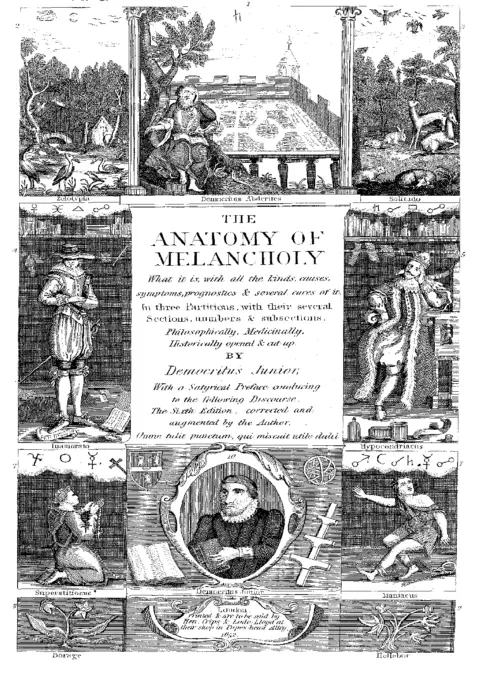
THE CLASSIC COLLECTION · 1617
"The Anatomy of Melancholy" by Robert Burton is a medical treatise first published in 1621. This massive work explores depression and its causes, symptoms, and cures, but ranges far beyond medicine into history, astronomy, geography, and literature. Written under the pseudonym Democritus Junior, Burton blends scientific analysis with humor and satire across over 500,000 words. Drawing from ancient authorities and medieval sources, he examines melancholy as both a passing mood and a serious ailment, creating a unique work that inspired generations of writers.
Introduction adapted from the source catalogue; source summaries may be automatically generated.
Free to read · English · 529,097 words · No account needed
MAKE TIME FOR A GOOD BOOK
On by default. Untick to stop anonymous reading totals. Each page counts after 10 seconds in view. How this works.
Anonymous counting is on unless you have switched it off.
as at an ordinary with us, bakehouse or barber's shop. When that great Gonsalva was upon some displeasure confined by King Ferdinand to the city of Loxa in Andalusia, the only, comfort (saith [3289]Jovius) he had to ease his melancholy thoughts, was to hear news, and to listen after those ordinary occurrences which were brought him cum primis, by letters or otherwise out of the remotest parts of Europe. Some men's whole delight is, to take tobacco, and drink all day long in a tavern or alehouse, to discourse, sing, jest, roar, talk of a cock and bull over a pot, &c. Or when three or four good companions meet, tell old stories by the fireside, or in the sun, as old folks usually do, quae aprici meminere senes, remembering afresh and with pleasure ancient matters, and such like accidents, which happened in their younger years: others' best pastime is to game, nothing to them so pleasant. [3290]Hic Veneri indulget, hunc decoquit alea—many too nicely take exceptions at cards, [3291]tables, and dice, and such mixed lusorious lots, whom Gataker well confutes. Which though they be honest recreations in themselves, yet may justly be otherwise excepted at, as they are often abused, and forbidden as things most pernicious; insanam rem et damnosam, [3292]Lemnius calls it. For most part in these kind of disports 'tis not art or skill, but subtlety, cony-catching, knavery, chance and fortune carries all away: 'tis ambulatoria pecunia, [3293]———puncto mobilis horae Permutat dominos, et cedit in altera jura.
They labour most part not to pass their time in honest disport, but for filthy lucre, and covetousness of money. In foedissimum lucrum et avaritiam hominum convertitur, as Daneus observes. Fons fraudum et maleficiorum, 'tis the fountain of cozenage and villainy. [3294]A thing so common all over Europe at this day, and so generally abused, that many men are utterly undone by it, their means spent, patrimonies consumed, they and their posterity beggared; besides swearing, wrangling, drinking, loss of time, and such inconveniences, which are ordinary concomitants: [3295]for when once they have got a haunt of such companies, and habit of gaming, they can hardly be drawn from it, but as an itch it will tickle them, and as it is with whoremasters, once entered, they cannot easily leave it off: Vexat mentes insania cupido, they are mad upon their sport. And in conclusion (which Charles the Seventh, that good French king, published in an edict against gamesters) unde piae et hilaris vitae, suffugium sibi suisque liberis, totique familiae, &c. That which was once their livelihood, should have maintained wife, children, family, is now spent and gone; maeror et egestas, &c., sorrow and beggary succeeds. So good things may be abused, and that which was first invented to [3296] refresh men's weary spirits, when they come from other labours and studies to exhilarate the mind, to entertain time and company, tedious otherwise in those long solitary winter nights, and keep them from worse matters, an honest exercise is contrarily perverted. Chess-play is a good and witty exercise of the mind for some kind of men, and fit for such melancholy, Rhasis holds, as are idle, and have extravagant impertinent thoughts, or troubled with cares, nothing better to distract their mind, and alter their meditations: invented (some say) by the [3297]general of an army in a famine, to keep soldiers from mutiny: but if it proceed from overmuch study, in such a case it may do more harm than good; it is a game too troublesome for some men's brains, too full of anxiety, all out as bad as study; besides it is a testy choleric game, and very offensive to him that loseth the mate. [3298]William the Conqueror, in his younger years, playing at chess with the Prince of France (Dauphine was not annexed to that crown in those days) losing a mate, knocked the chess-board about his pate, which was a cause afterward of much enmity between them. For some such reason it is belike, that Patritius, in his 3. book, tit. 12. de reg. instit. forbids his prince to play at chess; hawking and hunting, riding, &c. he will allow; and this to other men, but by no means to him. In Muscovy, where they live in stoves and hot houses all winter long, come seldom or little abroad, it is again very necessary, and therefore in those parts, (saith [3299]Herbastein) much used. At Fez in Africa, where the like inconvenience of keeping within doors is through heat, it is very laudable; and (as [3300]Leo Afer relates) as much frequented. A sport fit for idle gentlewomen, soldiers in garrison, and courtiers that have nought but love matters to busy themselves about, but not altogether so convenient for such as are students. The like I may say of Col. Bruxer's philosophy game, D. Fulke's Metromachia and his Ouronomachia, with the rest of those intricate astrological and geometrical fictions, for such especially as are mathematically given; and the rest of those curious games. Dancing, singing, masking, mumming, stage plays, howsoever they be heavily censured by some severe Catos, yet if opportunely and soberly used, may justly be approved. Melius est foedere, quam saltare, [3301]saith Austin: but what is that if they delight in it? [3302]Nemo saltat sobrius. But in what kind of dance? I know these sports have many oppugners, whole volumes writ against them; when as all they say (if duly considered) is but ignoratio Elenchi; and some again, because they are now cold and wayward, past themselves, cavil at all such youthful sports in others, as he did in the comedy; they think them, illico nasci senes, &c. Some out of preposterous zeal object many times trivial arguments, and because of some abuse, will quite take away the good use, as if they should forbid wine because it makes men drunk; but in my judgment they are too stern: there is a time for all things, a time to mourn, a time to dance, Eccles. iii. 4. a time to embrace, a time not to embrace, (verse 5.) and nothing better than that a man should rejoice in his own works, verse 22; for my part, I will subscribe to the king's declaration, and was ever of that mind, those May games, wakes, and Whitsun ales, &c., if they be not at unseasonable hours, may justly be permitted. Let them freely feast, sing and dance, have their puppet-plays, hobby-horses, tabors, crowds, bagpipes, &c., play at ball, and barley-breaks, and what sports and recreations they like best. In Franconia, a province of Germany, (saith [3303]Aubanus Bohemus) the old folks, after evening prayer, went to the alehouse, the younger sort to dance: and to say truth with [3304]Salisburiensis, satius fuerat sic otiari, quam turpius occupari, better to do so than worse, as without question otherwise (such is the corruption of man's nature) many of them will do. For that cause, plays, masks, jesters, gladiators, tumblers, jugglers, &c., and all that crew is admitted and winked at: [3305]Tota jocularium scena procedit, et ideo spectacula admissa sunt, et infinita tyrocinia vanitatum, ut his occupentur, qui perniciosius otiari solent: that they might be busied about such toys, that would otherwise more perniciously be idle. So that as [3306]Tacitus said of the astrologers in Rome, we may say of them, genus hominum est quod in civitate nostra et vitabitur semper et retinebitur, they are a debauched company most part, still spoken against, as well they deserve some of them (for I so relish and distinguish them as fiddlers, and musicians), and yet ever retained. Evil is not to be done (I confess) that good may come of it: but this is evil per accidens, and in a qualified sense, to avoid a greater inconvenience, may justly be tolerated. Sir Thomas More, in his Utopian Commonwealth, [3307]as he will have none idle, so will he have no man labour over hard, to be toiled out like a horse, 'tis more than slavish infelicity, the life of most of our hired servants and tradesmen elsewhere (excepting his Utopians) but half the day allotted for work, and half for honest recreation, or whatsoever employment they shall think fit for themselves. If one half day in a week were allowed to our household servants for their merry meetings, by their hard masters, or in a year some feasts, like those Roman Saturnals, I think they would labour harder all the rest of their time, and both parties be better pleased: but this needs not (you will say), for some of them do nought but loiter all the week long. This which I aim at, is for such as are fracti animis, troubled in mind, to ease them, over-toiled on the one part, to refresh: over idle on the other, to keep themselves busied. And to this purpose, as any labour or employment will serve to the one, any honest recreation will conduce to the other, so that it be moderate and sparing, as the use of meat and drink; not to spend all their life in gaming, playing, and pastimes, as too many gentlemen do; but to revive our bodies and recreate our souls with honest sports: of which as there be diverse sorts, and peculiar to several callings, ages, sexes, conditions, so there be proper for several seasons, and those of distinct natures, to fit that variety of humours which is amongst them, that if one will not, another may: some in summer, some in winter, some gentle, some more violent, some for the mind alone, some for the body and mind: (as to some it is both business and a pleasant recreation to oversee workmen of all sorts, husbandry, cattle, horses, &c. To build, plot, project, to make models, cast up accounts, &c.) some without, some within doors; new, old, &c., as the season serveth, and as men are inclined. It is reported of Philippus Bonus, that good duke of Burgundy (by Lodovicus Vives, in Epist. and Pont. [3308]Heuter in his history) that the said duke, at the marriage of Eleonora, sister to the king of Portugal, at Bruges in Flanders, which was solemnised in the deep of winter, when, as by reason of unseasonable weather, he could neither hawk nor hunt, and was now tired with cards, dice, &c., and such other domestic sports, or to see ladies dance, with some of his courtiers, he would in the evening walk disguised all about the town. It so fortuned, as he was walking late one night, he found a country fellow dead drunk, snorting on a bulk; [3309]he caused his followers to bring him to his palace, and there stripping him of his old clothes, and attiring him after the court fashion, when he waked, he and they were all ready to attend upon his excellency, persuading him he was some great duke. The poor fellow admiring how he came there, was served in state all the day long; after supper he saw them dance, heard music, and the rest of those court-like pleasures: but late at night, when he was well tippled, and again fast asleep, they put on his old robes, and so conveyed him to the place where they first found him. Now the fellow had not made them so good sport the day before as he did when he returned to himself; all the jest was, to see how he [3310]looked upon it. In conclusion, after some little admiration, the poor man told his friends he had seen a vision, constantly believed it, would not otherwise be persuaded, and so the jest ended. [3311]Antiochus Epiphanes would often disguise himself, steal from his court, and go into merchants', goldsmiths', and other tradesmen's shops, sit and talk with them, and sometimes ride or walk alone, and fall aboard with any tinker, clown, serving man, carrier, or whomsoever he met first. Sometimes he did ex insperato give a poor fellow money, to see how he would look, or on set purpose lose his purse as he went, to watch who found it, and withal how he would be affected, and with such objects he was much delighted. Many such tricks are ordinarily put in practice by great men, to exhilarate themselves and others, all which are harmless jests, and have their good uses. But amongst those exercises, or recreations of the mind within doors, there is none so general, so aptly to be applied to all sorts of men, so fit and proper to expel idleness and melancholy, as that of study: Studia, senectutem oblectant, adolescentiam, alunt, secundas res ornant, adversis perfugium et solatium praebent, domi delectant, &c., find the rest in Tully pro Archia Poeta. [3312]What so full of content, as to read, walk, and see maps, pictures, statues, jewels, marbles, which some so much magnify, as those that Phidias made of old so exquisite and pleasing to be beheld, that as [3313]Chrysostom thinketh, if any man be sickly, troubled in mind, or that cannot sleep for grief, and shall but stand over against one of Phidias' images, he will forget all care, or whatsoever else may molest him, in an instant? There be those as much taken with Michael Angelo's, Raphael de Urbino's, Francesco Francia's pieces, and many of those Italian and Dutch painters, which were excellent in their ages; and esteem of it as a most pleasing sight, to view those neat architectures, devices, escutcheons, coats of arms, read such books, to peruse old coins of several sorts in a fair gallery; artificial works, perspective glasses, old relics, Roman antiquities, variety of colours. A good picture is falsa veritas, et muta poesis: and though (as [3314]Vives saith) artificialia delectant, sed mox fastidimus, artificial toys please but for a time; yet who is he that will not be moved with them for the present? When Achilles was tormented and sad for the loss of his dear friend Patroclus, his mother Thetis brought him a most elaborate and curious buckler made by Vulcan, in which were engraven sun, moon, stars, planets, sea, land, men fighting, running, riding, women scolding, hills, dales, towns, castles, brooks, rivers, trees, &c., with many pretty landscapes, and perspective pieces: with sight of which he was infinitely delighted, and much eased of his grief. [3315]Continuo eo spectaculo captus delenito maerore Oblectabatur, in manibus tenens dei splendida dona.
Your reading position is saved on this browser. Take it to another device with a library code. Reading pages adapt to text, rather than matching a printed edition.
BEHIND THE BOOK
This eBook is for the use of anyone anywhere in the United States and most other parts of the world at no cost and with almost no restrictions whatsoever. You may copy it, give it away or re-use it under the terms of the Project Gutenberg License included with this eBook or online at www.gutenberg.org. If you are not located in the United States, you will have to check the laws of the country where you are located before using this eBook. Read the source licence.
The original source file, including credits and licence, is retained by this library. Request an original-format copy at no charge. Please include the book title and Project Gutenberg identifier #10800.
KEEP YOUR CURIOSITY GOING
David Patterson (Spirit) Hatch
Coulson Kernahan

Ralph Waldo Emerson
Frances Wright

Edwin Abbott Abbott

Joseph Droz