
Last letters from the living dead man
David Patterson (Spirit) Hatch
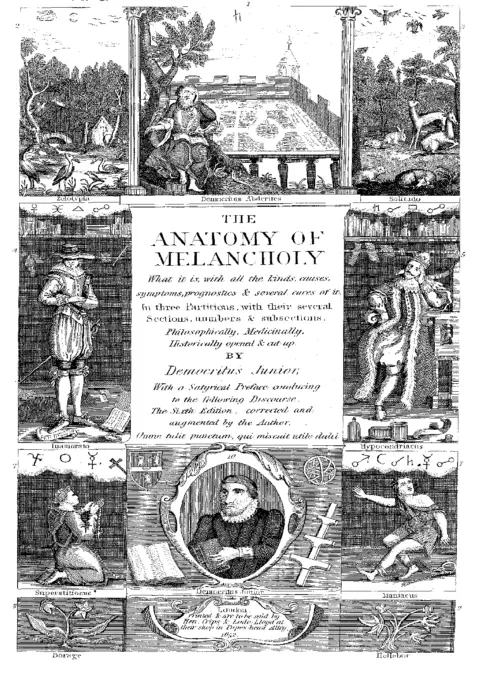
THE CLASSIC COLLECTION · 1617
"The Anatomy of Melancholy" by Robert Burton is a medical treatise first published in 1621. This massive work explores depression and its causes, symptoms, and cures, but ranges far beyond medicine into history, astronomy, geography, and literature. Written under the pseudonym Democritus Junior, Burton blends scientific analysis with humor and satire across over 500,000 words. Drawing from ancient authorities and medieval sources, he examines melancholy as both a passing mood and a serious ailment, creating a unique work that inspired generations of writers.
Introduction adapted from the source catalogue; source summaries may be automatically generated.
Free to read · English · 529,097 words · No account needed
MAKE TIME FOR A GOOD BOOK
On by default. Untick to stop anonymous reading totals. Each page counts after 10 seconds in view. How this works.
Anonymous counting is on unless you have switched it off.
Immediate cause of these precedent Symptoms.
To give some satisfaction to melancholy men that are troubled with these symptoms, a better means in my judgment cannot be taken, than to show them the causes whence they proceed; not from devils as they suppose, or that they are bewitched or forsaken of God, hear or see, &c. as many of them think, but from natural and inward causes, that so knowing them, they may better avoid the effects, or at least endure them with more patience. The most grievous and common symptoms are fear and sorrow, and that without a cause to the wisest and discreetest men, in this malady not to be avoided. The reason why they are so, Aetius discusseth at large, Tetrabib. 2. 2. in his first problem out of Galen, lib. 2. de causis sympt. 1. For Galen imputeth all to the cold that is black, and thinks that the spirits being darkened, and the substance of the brain cloudy and dark, all the objects thereof appear terrible, and the [2660]mind itself, by those dark, obscure, gross fumes, ascending from black humours, is in continual darkness, fear, and sorrow; divers terrible monstrous fictions in a thousand shapes and apparitions occur, with violent passions, by which the brain and fantasy are troubled and eclipsed. [2661]Fracastorius, lib. 2. de intellect, will have cold to be the cause of fear and sorrow; for such as are cold are ill-disposed to mirth, dull, and heavy, by nature solitary, silent; and not for any inward darkness (as physicians think) for many melancholy men dare boldly be, continue, and walk in the dark, and delight in it: solum frigidi timidi: if they be hot, they are merry; and the more hot, the more furious, and void of fear, as we see in madmen; but this reason holds not, for then no melancholy, proceeding from choler adust, should fear. [2662]Averroes scoffs at Galen for his reasons, and brings five arguments to repel them: so doth Herc. de Saxonia, Tract. de Melanch. cap. 3. assigning other causes, which are copiously censured and confuted by Aelianus Montaltus, cap. 5 and 6. Lod. Mercatus de Inter. morb. cur. lib. 1. cap. 17. Altomarus, cap. 7. de mel. Guianerius, tract. 15. c. 1. Bright cap. 37. Laurentius, cap. 5. Valesius, med. cont. lib. 5, con. 1. [2663]Distemperature, they conclude, makes black juice, blackness obscures the spirits, the spirits obscured, cause fear and sorrow. Laurentius, cap. 13. supposeth these black fumes offend specially the diaphragma or midriff, and so per consequens the mind, which is obscured as [2664]the sun by a cloud. To this opinion of Galen, almost all the Greeks and Arabians subscribe, the Latins new and old, internae, tenebrae offuscant animum, ut externae nocent pueris, as children are affrighted in the dark, so are melancholy men at all times, [2665]as having the inward cause with them, and still carrying it about. Which black vapours, whether they proceed from the black blood about the heart, as T. W. Jes. thinks in his treatise of the passions of the mind, or stomach, spleen, midriff, or all the misaffected parts together, it boots not, they keep the mind in a perpetual dungeon, and oppress it with continual fears, anxieties, sorrows, &c. It is an ordinary thing for such as are sound to laugh at this dejected pusillanimity, and those other symptoms of melancholy, to make themselves merry with them, and to wonder at such, as toys and trifles, which may be resisted and withstood, if they will themselves: but let him that so wonders, consider with himself, that if a man should tell him on a sudden, some of his especial friends were dead, could he choose but grieve? Or set him upon a steep rock, where he should be in danger to be precipitated, could he be secure? His heart would tremble for fear, and his head be giddy. P. Byaras, Tract. de pest. gives instance (as I have said) [2666]and put case (saith he) in one that walks upon a plank, if it lie on the ground, he can safely do it: but if the same plank be laid over some deep water, instead of a bridge, he is vehemently moved, and 'tis nothing but his imagination, forma cadendi impressa, to which his other members and faculties obey. Yea, but you infer, that such men have a just cause to fear, a true object of fear; so have melancholy men an inward cause, a perpetual fume and darkness, causing fear, grief, suspicion, which they carry with them, an object which cannot be removed; but sticks as close, and is as inseparable as a shadow to a body, and who can expel or overrun his shadow? Remove heat of the liver, a cold stomach, weak spleen: remove those adust humours and vapours arising from them, black blood from the heart, all outward perturbations, take away the cause, and then bid them not grieve nor fear, or be heavy, dull, lumpish, otherwise counsel can do little good; you may as well bid him that is sick of an ague not to be a dry; or him that is wounded not to feel pain. Suspicion follows fear and sorrow at heels, arising out of the same fountain, so thinks [2667]Fracastorius, that fear is the cause of suspicion, and still they suspect some treachery, or some secret machination to be framed against them, still they distrust. Restlessness proceeds from the same spring, variety of fumes make them like and dislike. Solitariness, avoiding of light, that they are weary of their lives, hate the world, arise from the same causes, for their spirits and humours are opposite to light, fear makes them avoid company, and absent themselves, lest they should be misused, hissed at, or overshoot themselves, which still they suspect. They are prone to venery by reason of wind. Angry, waspish, and fretting still, out of abundance of choler, which causeth fearful dreams and violent perturbations to them, both sleeping and waking: That they suppose they have no heads, fly, sink, they are pots, glasses, &c. is wind in their heads. [2668]Herc. de Saxonia doth ascribe this to the several motions in the animal spirits, their dilation, contraction, confusion, alteration, tenebrosity, hot or cold distemperature, excluding all material humours. [2669]Fracastorius accounts it a thing worthy of inquisition, why they should entertain such false conceits, as that they have horns, great noses, that they are birds, beasts, &c., why they should think themselves kings, lords, cardinals. For the first, [2670] Fracastorius gives two reasons: One is the disposition of the body; the other, the occasion of the fantasy, as if their eyes be purblind, their ears sing, by reason of some cold and rheum, &c. To the second, Laurentius answers, the imagination inwardly or outwardly moved, represents to the understanding, not enticements only, to favour the passion or dislike, but a very intensive pleasure follows the passion or displeasure, and the will and reason are captivated by delighting in it. Why students and lovers are so often melancholy and mad, the philosopher of [2671]Conimbra assigns this reason, because by a vehement and continual meditation of that wherewith they are affected, they fetch up the spirits into the brain, and with the heat brought with them, they incend it beyond measure: and the cells of the inner senses dissolve their temperature, which being dissolved, they cannot perform their offices as they ought. Why melancholy men are witty, which Aristotle hath long since maintained in his problems; and that [2672]all learned men, famous philosophers, and lawgivers, ad unum fere omnes melancholici, have still been melancholy, is a problem much controverted. Jason Pratensis will have it understood of natural melancholy, which opinion Melancthon inclines to, in his book de Anima, and Marcilius Ficinus de san. tuend. lib. 1. cap. 5. but not simple, for that makes men stupid, heavy, dull, being cold and dry, fearful, fools, and solitary, but mixed with the other humours, phlegm only excepted; and they not adust, [2673]but so mixed as that blood he half, with little or no adustion, that they be neither too hot nor too cold. Aponensis, cited by Melancthon, thinks it proceeds from melancholy adust, excluding all natural melancholy as too cold. Laurentius condemns his tenet, because adustion of humours makes men mad, as lime burns when water is cast on it. It must be mixed with blood, and somewhat adust, and so that old aphorism of Aristotle may be verified, Nullum magnum ingenium sine mixtura dementiae, no excellent wit without a mixture of madness. Fracastorius shall decide the controversy, [2674]phlegmatic are dull: sanguine lively, pleasant, acceptable, and merry, but not witty; choleric are too swift in motion, and furious, impatient of contemplation, deceitful wits: melancholy men have the most excellent wits, but not all; this humour may be hot or cold, thick, or thin; if too hot, they are furious and mad: if too cold, dull, stupid, timorous, and sad: if temperate, excellent, rather inclining to that extreme of heat, than cold. This sentence of his will agree with that of Heraclitus, a dry light makes a wise mind, temperate heat and dryness are the chief causes of a good wit; therefore, saith Aelian, an elephant is the wisest of all brute beasts, because his brain is driest, et ob atrae, bilis capiam: this reason Cardan approves, subtil. l. 12. Jo. Baptista Silvaticus, a physician of Milan, in his first controversy, hath copiously handled this question: Rulandus in his problems, Caelius Rhodiginus, lib. 17. Valleriola 6to. narrat. med. Herc. de Saxonia, Tract. posth. de mel. cap. 3. Lodovicus Mercatus, de inter. morb. cur. lib. cap. 17. Baptista Porta, Physiog. lib. 1. c. 13. and many others. Weeping, sighing, laughing, itching, trembling, sweating, blushing, hearing and seeing strange noises, visions, wind, crudity, are motions of the body, depending upon these precedent motions of the mind: neither are tears, affections, but actions (as Scaliger holds) [2675]the voice of such as are afraid, trembles, because the heart is shaken (Conimb. prob. 6. sec. 3. de som.) why they stutter or falter in their speech, Mercurialis and Montaltus, cap. 17. give like reasons out of Hippocrates, [2676]dryness, which makes the nerves of the tongue torpid. Fast speaking (which is a symptom of some few) Aetius will have caused [2677] from abundance of wind, and swiftness of imagination: [2678]baldness comes from excess of dryness, hirsuteness from a dry temperature. The cause of much waking in a dry brain, continual meditation, discontent, fears and cares, that suffer not the mind to be at rest, incontinency is from wind, and a hot liver, Montanus, cons. 26. Rumbling in the guts is caused from wind, and wind from ill concoction, weakness of natural heat, or a distempered heat and cold; [2679]Palpitation of the heart from vapours, heaviness and aching from the same cause. That the belly is hard, wind is a cause, and of that leaping in many parts. Redness of the face, and itching, as if they were flea-bitten, or stung with pismires, from a sharp subtle wind. [2680]Cold sweat from vapours arising from the hypochondries, which pitch upon the skin; leanness for want of good nourishment. Why their appetite is so great, [2681]Aetius answers: Os ventris frigescit, cold in those inner parts, cold belly, and hot liver, causeth crudity, and intention proceeds from perturbations, [2682]our souls for want of spirits cannot attend exactly to so many intentive operations, being exhaust, and overswayed by passion, she cannot consider the reasons which may dissuade her from such affections. [2683]Bashfulness and blushing, is a passion proper to men alone, and is not only caused for [2684]some shame and ignominy, or that they are guilty unto themselves of some foul fact committed, but as [2685]Fracastorius well determines, ob defectum proprium, et timorem, from fear, and a conceit of our defects; the face labours and is troubled at his presence that sees our defects, and nature willing to help, sends thither heat, heat draws the subtlest blood, and so we blush. They that are bold, arrogant, and careless, seldom or never blush, but such as are fearful. Anthonius Lodovicus, in his book de pudore, will have this subtle blood to arise in the face, not so much for the reverence of our betters in presence, [2686]but for joy and pleasure, or if anything at unawares shall pass from us, a sudden accident, occurse, or meeting: (which Disarius in [2687] Macrobius confirms) any object heard or seen, for blind men never blush, as Dandinus observes, the night and darkness make men impudent. Or that we be staid before our betters, or in company we like not, or if anything molest and offend us, erubescentia turns to rubor, blushing to a continuate redness. [2688]Sometimes the extremity of the ears tingle, and are red, sometimes the whole face, Etsi nihil vitiosum commiseris, as Lodovicus holds: though Aristotle is of opinion, omnis pudor ex vitio commisso, all shame for some offence. But we find otherwise, it may as well proceed [2689]from fear, from force and inexperience, (so [2690]Dandinus holds) as vice; a hot liver, saith Duretus (notis in Hollerium:) from a hot brain, from wind, the lungs heated, or after drinking of wine, strong drink, perturbations, &c. Laughter what it is, saith [2691]Tully, how caused, where, and so suddenly breaks out, that desirous to stay it, we cannot, how it comes to possess and stir our face, veins, eyes, countenance, mouth, sides, let Democritus determine. The cause that it often affects melancholy men so much, is given by Gomesius, lib. 3. de sale genial. cap. 18. abundance of pleasant vapours, which, in sanguine melancholy especially, break from the heart, [2692]and tickle the midriff, because it is transverse and full of nerves: by which titillation the sense being moved, and arteries distended, or pulled, the spirits from thence move and possess the sides, veins, countenance, eyes. See more in Jossius de risu et fletu, Vives 3 de Anima. Tears, as Scaliger defines, proceed from grief and pity, [2693]or from the heating of a moist brain, for a dry cannot weep. That they see and hear so many phantasms, chimeras, noises, visions, &c. as Fienus hath discoursed at large in his book of imagination, and [2694] Lavater de spectris, part. 1. cap. 2. 3. 4. their corrupt phantasy makes them see and hear that which indeed is neither heard nor seen, Qui multum jejunant, aut noctes ducunt insomnes, they that much fast, or want sleep, as melancholy or sick men commonly do, see visions, or such as are weak-sighted, very timorous by nature, mad, distracted, or earnestly seek. Sabini quod volunt somniant, as the saying is, they dream of that they desire. Like Sarmiento the Spaniard, who when he was sent to discover the straits of Magellan, and confine places, by the Prorex of Peru, standing on the top of a hill, Amaenissimam planitiem despicere sibi visus fuit, aedificia magnifica, quamplurimos Pagos, alias Turres, splendida Templa, and brave cities, built like ours in Europe, not, saith mine [2695]author, that there was any such thing, but that he was vanissimus et nimis credulus, and would fain have had it so. Or as [2696]Lod. Mercatus proves, by reason of inward vapours, and humours from blood, choler, &c. diversely mixed, they apprehend and see outwardly, as they suppose, divers images, which indeed are not. As they that drink wine think all runs round, when it is in their own brain; so is it with these men, the fault and cause is inward, as Galen affirms, [2697]mad men and such as are near death, quas extra se videre putant Imagines, intra oculos habent, 'tis in their brain, which seems to be before them; the brain as a concave glass reflects solid bodies. Senes etiam decrepiti cerebrum habent concavum et aridum, ut imaginentur se videre (saith [2698]Boissardus) quae non sunt, old men are too frequently mistaken and dote in like case: or as he that looketh through a piece of red glass, judgeth everything he sees to be red; corrupt vapours mounting from the body to the head, and distilling again from thence to the eyes, when they have mingled themselves with the watery crystal which receiveth the shadows of things to be seen, make all things appear of the same colour, which remains in the humour that overspreads our sight, as to melancholy men all is black, to phlegmatic all white, &c. Or else as before the organs corrupt by a corrupt phantasy, as Lemnius, lib. 1. cap. 16. well quotes, [2699]cause a great agitation of spirits, and humours, which wander to and fro in all the creeks of the brain, and cause such apparitions before their eyes. One thinks he reads something written in the moon, as Pythagoras is said to have done of old, another smells brimstone, hears Cerberus bark: Orestes now mad supposed he saw the furies tormenting him, and his mother still ready to run upon him, [2700]O mater obsecro noli me persequi His furiis, aspectu anguineis, horribilibus, Ecce ecce me invadunt, in me jam ruunt;
Your reading position is saved on this browser. Take it to another device with a library code. Reading pages adapt to text, rather than matching a printed edition.
BEHIND THE BOOK
This eBook is for the use of anyone anywhere in the United States and most other parts of the world at no cost and with almost no restrictions whatsoever. You may copy it, give it away or re-use it under the terms of the Project Gutenberg License included with this eBook or online at www.gutenberg.org. If you are not located in the United States, you will have to check the laws of the country where you are located before using this eBook. Read the source licence.
The original source file, including credits and licence, is retained by this library. Request an original-format copy at no charge. Please include the book title and Project Gutenberg identifier #10800.
KEEP YOUR CURIOSITY GOING
David Patterson (Spirit) Hatch
Coulson Kernahan

Ralph Waldo Emerson
Frances Wright

Edwin Abbott Abbott

Joseph Droz