READ · DISCOVER · ENJOYClassic literature · Always free
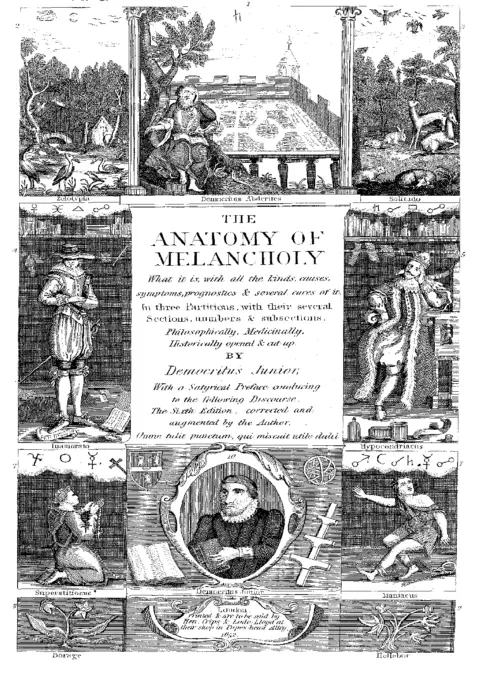
The Anatomy of Melancholy — digital edition cover

THE CLASSIC COLLECTION · 1617

The Anatomy of Melancholy

"The Anatomy of Melancholy" by Robert Burton is a medical treatise first published in 1621. This massive work explores depression and its causes, symptoms, and cures, but ranges far beyond medicine into history, astronomy, geography, and literature. Written under the pseudonym Democritus Junior, Burton blends scientific analysis with humor and satire across over 500,000 words. Drawing from ancient authorities and medieval sources, he examines melancholy as both a passing mood and a serious ailment, creating a unique work that inspired generations of writers.

Introduction adapted from the source catalogue; source summaries may be automatically generated.

Start reading ↓

Free to read · English · 529,097 words · No account needed

MAKE TIME FOR A GOOD BOOK

The Anatomy of Melancholy

On by default. Untick to stop anonymous reading totals. Each page counts after 10 seconds in view. How this works.

Anonymous counting is on unless you have switched it off.

The Anatomy of Melancholy

Because Lodovicus Mercatus in his second book de mulier. affect. cap. 4. and Rodericus a Castro de morb. mulier. cap. 3. lib. 2. two famous physicians in Spain, Daniel Sennertus of Wittenberg lib. 1. part 2. cap. 13. with others, have vouchsafed in their works not long since published, to write two just treatises de Melancholia virginum, Monialium et Viduarum, as a particular species of melancholy (which I have already specified) distinct from the rest; [2650](for it much differs from that which commonly befalls men and other women, as having one only cause proper to women alone) I may not omit in this general survey of melancholy symptoms, to set down the particular signs of such parties so misaffected. The causes are assigned out of Hippocrates, Cleopatra, Moschion, and those old Gynaeciorum Scriptores, of this feral malady, in more ancient maids, widows, and barren women, ob septum transversum violatum, saith Mercatus, by reason of the midriff or Diaphragma, heart and brain offended with those vicious vapours which come from menstruous blood, inflammationem arteriae circa dorsum, Rodericus adds, an inflammation of the back, which with the rest is offended by [2651]that fuliginous exhalation of corrupt seed, troubling the brain, heart and mind; the brain, I say, not in essence, but by consent, Universa enim hujus affectus causa ab utero pendet, et a sanguinis menstrui malitia, for in a word, the whole malady proceeds from that inflammation, putridity, black smoky vapours, &c., from thence comes care, sorrow, and anxiety, obfuscation of spirits, agony, desperation, and the like, which are intended or remitted; si amatorius accesserit ardor, or any other violent object or perturbation of mind. This melancholy may happen to widows, with much care and sorrow, as frequently it doth, by reason of a sudden alteration of their accustomed course of life, &c. To such as lie in childbed ob suppressam purgationem; but to nuns and more ancient maids, and some barren women for the causes abovesaid, 'tis more familiar, crebrius his quam reliquis accidit, inquit Rodericus, the rest are not altogether excluded. Out of these causes Rodericus defines it with Areteus, to be angorem animi, a vexation of the mind, a sudden sorrow from a small, light, or no occasion, [2652]with a kind of still dotage and grief of some part or other, head, heart, breasts, sides, back, belly, &c., with much solitariness, weeping, distraction, &c., from which they are sometimes suddenly delivered, because it comes and goes by fits, and is not so permanent as other melancholy. But to leave this brief description, the most ordinary symptoms be these, pulsatio juxta dorsum, a beating about the back, which is almost perpetual, the skin is many times rough, squalid, especially, as Areteus observes, about the arms, knees, and knuckles. The midriff and heart-strings do burn and beat very fearfully, and when this vapour or fume is stirred, flieth upward, the heart itself beats, is sore grieved, and faints, fauces siccitate praecluduntur, ut difficulter possit ab uteri strangulatione decerni, like fits of the mother, Alvus plerisque nil reddit, aliis exiguum, acre, biliosum, lotium flavum. They complain many times, saith Mercatus, of a great pain in their heads, about their hearts, and hypochondries, and so likewise in their breasts, which are often sore, sometimes ready to swoon, their faces are inflamed, and red, they are dry, thirsty, suddenly hot, much troubled with wind, cannot sleep, &c. And from hence proceed ferina deliramenta, a brutish kind of dotage, troublesome sleep, terrible dreams in the night, subrusticus pudor et verecundia ignava, a foolish kind of bashfulness to some, perverse conceits and opinions, [2653]dejection of mind, much discontent, preposterous judgment. They are apt to loath, dislike, disdain, to be weary of every object, &c., each thing almost is tedious to them, they pine away, void of counsel, apt to weep, and tremble, timorous, fearful, sad, and out of all hope of better fortunes. They take delight in nothing for the time, but love to be alone and solitary, though that do them more harm: and thus they are affected so long as this vapour lasteth; but by-and-by, as pleasant and merry as ever they were in their lives, they sing, discourse, and laugh in any good company, upon all occasions, and so by fits it takes them now and then, except the malady be inveterate, and then 'tis more frequent, vehement, and continuate. Many of them cannot tell how to express themselves in words, or how it holds them, what ails them, you cannot understand them, or well tell what to make of their sayings; so far gone sometimes, so stupefied and distracted, they think themselves bewitched, they are in despair, aptae ad fletum, desperationem, dolores mammis et hypocondriis. Mercatus therefore adds, now their breasts, now their hypochondries, belly and sides, then their heart and head aches, now heat, then wind, now this, now that offends, they are weary of all; [2654]and yet will not, cannot again tell how, where or what offends them, though they be in great pain, agony, and frequently complain, grieving, sighing, weeping, and discontented still, sine causa manifesta, most part, yet I say they will complain, grudge, lament, and not be persuaded, but that they are troubled with an evil spirit, which is frequent in Germany, saith Rodericus, amongst the common sort: and to such as are most grievously affected, (for he makes three degrees of this disease in women,) they are in despair, surely forespoken or bewitched, and in extremity of their dotage, (weary of their lives,) some of them will attempt to make away themselves. Some think they see visions, confer with spirits and devils, they shall surely be damned, are afraid of some treachery, imminent danger, and the like, they will not speak, make answer to any question, but are almost distracted, mad, or stupid for the time, and by fits: and thus it holds them, as they are more or less affected, and as the inner humour is intended or remitted, or by outward objects and perturbations aggravated, solitariness, idleness, &c. Many other maladies there are incident to young women, out of that one and only cause above specified, many feral diseases. I will not so much as mention their names, melancholy alone is the subject of my present discourse, from which I will not swerve. The several cures of this infirmity, concerning diet, which must be very sparing, phlebotomy, physic, internal, external remedies, are at large in great variety in [2655] Rodericus a Castro, Sennertus, and Mercatus, which whoso will, as occasion serves, may make use of. But the best and surest remedy of all, is to see them well placed, and married to good husbands in due time, hinc illae, lachrymae, that is the primary cause, and this the ready cure, to give them content to their desires. I write not this to patronise any wanton, idle flirt, lascivious or light housewives, which are too forward many times, unruly, and apt to cast away themselves on him that comes next, without all care, counsel, circumspection, and judgment. If religion, good discipline, honest education, wholesome exhortation, fair promises, fame and loss of good name cannot inhibit and deter such, (which to chaste and sober maids cannot choose but avail much,) labour and exercise, strict diet, rigour and threats may more opportunely be used, and are able of themselves to qualify and divert an ill-disposed temperament. For seldom should you see an hired servant, a poor handmaid, though ancient, that is kept hard to her work, and bodily labour, a coarse country wench troubled in this kind, but noble virgins, nice gentlewomen, such as are solitary and idle, live at ease, lead a life out of action and employment, that fare well, in great houses and jovial companies, ill-disposed peradventure of themselves, and not willing to make any resistance, discontented otherwise, of weak judgment, able bodies, and subject to passions, (grandiores virgines, saith Mercatus, steriles et viduae plerumque melancholicae,) such for the most part are misaffected, and prone to this disease. I do not so much pity them that may otherwise be eased, but those alone that out of a strong temperament, innate constitution, are violently carried away with this torrent of inward humours, and though very modest of themselves, sober, religious, virtuous, and well given, (as many so distressed maids are,) yet cannot make resistance, these grievances will appear, this malady will take place, and now manifestly show itself, and may not otherwise be helped. But where am I? Into what subject have I rushed? What have I to do with nuns, maids, virgins, widows? I am a bachelor myself, and lead a monastic life in a college, nae ego sane ineptus qui haec dixerim,) I confess 'tis an indecorum, and as Pallas a virgin blushed, when Jupiter by chance spake of love matters in her presence, and turned away her face; me reprimam though my subject necessarily require it, I will say no more. And yet I must and will say something more, add a word or two in gratiam virginum et viduarum, in favour of all such distressed parties, in commiseration of their present estate. And as I cannot choose but condole their mishap that labour of this infirmity, and are destitute of help in this case, so must I needs inveigh against them that are in fault, more than manifest causes, and as bitterly tax those tyrannising pseudopoliticians, superstitious orders, rash vows, hard-hearted parents, guardians, unnatural friends, allies, (call them how you will,) those careless and stupid overseers, that out of worldly respects, covetousness, supine negligence, their own private ends (cum sibi sit interim bene) can so severely reject, stubbornly neglect, and impiously contemn, without all remorse and pity, the tears, sighs, groans, and grievous miseries of such poor souls committed to their charge. How odious and abominable are those superstitious and rash vows of Popish monasteries, so to bind and enforce men and women to vow virginity, to lead a single life, against the laws of nature, opposite to religion, policy, and humanity, so to starve, to offer violence, to suppress the vigour of youth, by rigorous statutes, severe laws, vain persuasions, to debar them of that to which by their innate temperature they are so furiously inclined, urgently carried, and sometimes precipitated, even irresistibly led, to the prejudice of their soul's health, and good estate of body and mind: and all for base and private respects, to maintain their gross superstition, to enrich themselves and their territories as they falsely suppose, by hindering some marriages, that the world be not full of beggars, and their parishes pestered with orphans; stupid politicians; haeccine fieri flagilia? ought these things so to be carried? better marry than burn, saith the Apostle, but they are otherwise persuaded. They will by all means quench their neighbour's house if it be on fire, but that fire of lust which breaks out into such lamentable flames, they will not take notice of, their own bowels oftentimes, flesh and blood shall so rage and burn, and they will not see it: miserum est, saith Austin, seipsum non miserescere, and they are miserable in the meantime that cannot pity themselves, the common good of all, and per consequens their own estates. For let them but consider what fearful maladies, feral diseases, gross inconveniences, come to both sexes by this enforced temperance, it troubles me to think of, much more to relate those frequent abortions and murdering of infants in their nunneries (read [2656]Kemnitius and others), and notorious fornications, those Spintrias, Tribadas, Ambubeias, &c., those rapes, incests, adulteries, mastuprations, sodomies, buggeries of monks and friars. See Bale's visitation of abbeys, [2657]Mercurialis, Rodericus a Castro, Peter Forestus, and divers physicians; I know their ordinary apologies and excuses for these things, sed viderint Politici, Medici, Theologi, I shall more opportunely meet with them [2658]elsewhere. [2659]Illius viduae, aut patronum Virginis hujus, Ne me forte putes, verbum non amplius addam.

Your reading position is saved on this browser. Take it to another device with a library code. Reading pages adapt to text, rather than matching a printed edition.

BEHIND THE WORDS

About Robert Burton

Robert Burton (1577–1640). Explore The Anatomy of Melancholy in this collection. These books span philosophy.

Explore this author’s books →

THE READERS’ VERDICT

How did this story stay with you?

Not rated yet
Your rating for The Anatomy of Melancholy

Be the first to share your verdict.

One rating per browser, which you can change or remove. A necessary browser identifier remembers your vote. How ratings work

A GOOD STORY DESERVES COMPANY

Pass this book along.

A great read is even better when it’s shared.

SEND A LITTLE INSPIRATION

Share this book

BEHIND THE BOOK

Edition & source details.

Title
The Anatomy of Melancholy
Author
Robert Burton
Publication year
1617
Digital edition publisher
Project Gutenberg
Gutenberg release date
2004-01-01
Language
English
Source edition imprint
Not stated in source catalogue
Source identifier
Project Gutenberg #10800
Contributors
No additional named contributors in source metadata

Public-domain source & licence

This eBook is for the use of anyone anywhere in the United States and most other parts of the world at no cost and with almost no restrictions whatsoever. You may copy it, give it away or re-use it under the terms of the Project Gutenberg License included with this eBook or online at www.gutenberg.org. If you are not located in the United States, you will have to check the laws of the country where you are located before using this eBook. Read the source licence.

Full source licence and obtaining an original copy

The original source file, including credits and licence, is retained by this library. Request an original-format copy at no charge. Please include the book title and Project Gutenberg identifier #10800.

the full Project Gutenberg License must appear
prominently whenever any copy of a Project Gutenberg work (any work
on which the phrase “Project Gutenberg” appears, or with which the
phrase “Project Gutenberg” is associated) is accessed, displayed,
performed, viewed, copied or distributed:

This eBook is for the use of anyone anywhere in the United States and most
other parts of the world at no cost and with almost no restrictions
whatsoever. You may copy it, give it away or re-use it under the terms
of the Project Gutenberg™ License included with this eBook or online
at www.gutenberg.org. If you
are not located in the United States, you will have to check the laws
of the country where you are located before using this eBook.

1.E.2. If an individual Project Gutenberg electronic work is
derived from texts not protected by U.S. copyright law (does not
contain a notice indicating that it is posted with permission of the
copyright holder), the work can be copied and distributed to anyone in
the United States without paying any fees or charges. If you are
redistributing or providing access to a work with the phrase “Project
Gutenberg” associated with or appearing on the work, you must comply
either with the requirements of paragraphs 1.E.1 through 1.E.7 or
obtain permission for the use of the work and the Project Gutenberg
trademark as set forth in paragraphs 1.E.8 or 1.E.9.

1.E.3. If an individual Project Gutenberg electronic work is posted
with the permission of the copyright holder, your use and distribution
must comply with both paragraphs 1.E.1 through 1.E.7 and any
additional terms imposed by the copyright holder. Additional terms
will be linked to the Project Gutenberg License for all works
posted with the permission of the copyright holder found at the
beginning of this work.

1.E.4. Do not unlink or detach or remove the full Project Gutenberg
License terms from this work, or any files containing a part of this
work or any other work associated with Project Gutenberg.

1.E.5. Do not copy, display, perform, distribute or redistribute this
electronic work, or any part of this electronic work, without
prominently displaying the sentence set forth in paragraph 1.E.1 with
active links or immediate access to the full terms of the Project
Gutenberg License.

1.E.6. You may convert to and distribute this work in any binary,
compressed, marked up, nonproprietary or proprietary form, including
any word processing or hypertext form. However, if you provide access
to or distribute copies of a Project Gutenberg work in a format
other than “Plain Vanilla ASCII” or other format used in the official
version posted on the official Project Gutenberg website
(www.gutenberg.org), you must, at no additional cost, fee or expense
to the user, provide a copy, a means of exporting a copy, or a means
of obtaining a copy upon request, of the work in its original “Plain
Vanilla ASCII” or other form. Any alternate format must include the
full Project Gutenberg License as specified in paragraph 1.E.1.

1.E.7. Do not charge a fee for access to, viewing, displaying,
performing, copying or distributing any Project Gutenberg works
unless you comply with paragraph 1.E.8 or 1.E.9.

1.E.8. You may charge a reasonable fee for copies of or providing
access to or distributing Project Gutenberg electronic works
provided that:

• You pay a royalty fee of 20% of the gross profits you derive from
the use of Project Gutenberg works calculated using the method
you already use to calculate your applicable taxes. The fee is owed
to the owner of the Project Gutenberg trademark, but he has
agreed to donate royalties under this paragraph to the Project
Gutenberg Literary Archive Foundation. Royalty payments must be paid
within 60 days following each date on which you prepare (or are
legally required to prepare) your periodic tax returns. Royalty
payments should be clearly marked as such and sent to the Project
Gutenberg Literary Archive Foundation at the address specified in
Section 4, “Information about donations to the Project Gutenberg
Literary Archive Foundation.”

• You provide a full refund of any money paid by a user who notifies
you in writing (or by e-mail) within 30 days of receipt that s/he
does not agree to the terms of the full Project Gutenberg™
License. You must require such a user to return or destroy all
copies of the works possessed in a physical medium and discontinue
all use of and all access to other copies of Project Gutenberg™
works.

• You provide, in accordance with paragraph 1.F.3, a full refund of
any money paid for a work or a replacement copy, if a defect in the
electronic work is discovered and reported to you within 90 days of
receipt of the work.

• You comply with all other terms of this agreement for free
distribution of Project Gutenberg™ works.


1.E.9. If you wish to charge a fee or distribute a Project
Gutenberg™ electronic work or group of works on different terms than
are set forth in this agreement, you must obtain permission in writing
from the Project Gutenberg Literary Archive Foundation, the manager of
the Project Gutenberg™ trademark. Contact the Foundation as set
forth in Section 3 below.

1.F.

1.F.1. Project Gutenberg volunteers and employees expend considerable
effort to identify, do copyright research on, transcribe and proofread
works not protected by U.S. copyright law in creating the Project
Gutenberg™ collection. Despite these efforts, Project Gutenberg™
electronic works, and the medium on which they may be stored, may
contain “Defects,” such as, but not limited to, incomplete, inaccurate
or corrupt data, transcription errors, a copyright or other
intellectual property infringement, a defective or damaged disk or
other medium, a computer virus, or computer codes that damage or
cannot be read by your equipment.

1.F.2. LIMITED WARRANTY, DISCLAIMER OF DAMAGES - Except for the “Right
of Replacement or Refund” described in paragraph 1.F.3, the Project
Gutenberg Literary Archive Foundation, the owner of the Project
Gutenberg™ trademark, and any other party distributing a Project
Gutenberg™ electronic work under this agreement, disclaim all
liability to you for damages, costs and expenses, including legal
fees. YOU AGREE THAT YOU HAVE NO REMEDIES FOR NEGLIGENCE, STRICT
LIABILITY, BREACH OF WARRANTY OR BREACH OF CONTRACT EXCEPT THOSE
PROVIDED IN PARAGRAPH 1.F.3. YOU AGREE THAT THE FOUNDATION, THE
TRADEMARK OWNER, AND ANY DISTRIBUTOR UNDER THIS AGREEMENT WILL NOT BE
LIABLE TO YOU FOR ACTUAL, DIRECT, INDIRECT, CONSEQUENTIAL, PUNITIVE OR
INCIDENTAL DAMAGES EVEN IF YOU GIVE NOTICE OF THE POSSIBILITY OF SUCH
DAMAGE.

1.F.3. LIMITED RIGHT OF REPLACEMENT OR REFUND - If you discover a
defect in this electronic work within 90 days of receiving it, you can
receive a refund of the money (if any) you paid for it by sending a
written explanation to the person you received the work from. If you
received the work on a physical medium, you must return the medium
with your written explanation. The person or entity that provided you
with the defective work may elect to provide a replacement copy in
lieu of a refund. If you received the work electronically, the person
or entity providing it to you may choose to give you a second
opportunity to receive the work electronically in lieu of a refund. If
the second copy is also defective, you may demand a refund in writing
without further opportunities to fix the problem.

1.F.4. Except for the limited right of replacement or refund set forth
in paragraph 1.F.3, this work is provided to you ‘AS-IS’, WITH NO
OTHER WARRANTIES OF ANY KIND, EXPRESS OR IMPLIED, INCLUDING BUT NOT
LIMITED TO WARRANTIES OF MERCHANTABILITY OR FITNESS FOR ANY PURPOSE.

1.F.5. Some states do not allow disclaimers of certain implied
warranties or the exclusion or limitation of certain types of
damages. If any disclaimer or limitation set forth in this agreement
violates the law of the state applicable to this agreement, the
agreement shall be interpreted to make the maximum disclaimer or
limitation permitted by the applicable state law. The invalidity or
unenforceability of any provision of this agreement shall not void the
remaining provisions.

1.F.6. INDEMNITY - You agree to indemnify and hold the Foundation, the
trademark owner, any agent or employee of the Foundation, anyone
providing copies of Project Gutenberg™ electronic works in
accordance with this agreement, and any volunteers associated with the
production, promotion and distribution of Project Gutenberg™
electronic works, harmless from all liability, costs and expenses,
including legal fees, that arise directly or indirectly from any of
the following which you do or cause to occur: (a) distribution of this
or any Project Gutenberg work, (b) alteration, modification, or
additions or deletions to any Project Gutenberg work, and (c) any
Defect you cause.

Section 2. Information about the Mission of Project Gutenberg

Project Gutenberg is synonymous with the free distribution of
electronic works in formats readable by the widest variety of
computers including obsolete, old, middle-aged and new computers. It
exists because of the efforts of hundreds of volunteers and donations
from people in all walks of life.

Volunteers and financial support to provide volunteers with the
assistance they need are critical to reaching Project Gutenberg’s
goals and ensuring that the Project Gutenberg collection will
remain freely available for generations to come. In 2001, the Project
Gutenberg Literary Archive Foundation was created to provide a secure
and permanent future for Project Gutenberg and future
generations. To learn more about the Project Gutenberg Literary
Archive Foundation and how your efforts and donations can help, see
Sections 3 and 4 and the Foundation information page at www.gutenberg.org.

Section 3. Information about the Project Gutenberg Literary Archive Foundation

The Project Gutenberg Literary Archive Foundation is a non-profit
501(c)(3) educational corporation organized under the laws of the
state of Mississippi and granted tax exempt status by the Internal
Revenue Service. The Foundation’s EIN or federal tax identification
number is 64-6221541. Contributions to the Project Gutenberg Literary
Archive Foundation are tax deductible to the full extent permitted by
U.S. federal laws and your state’s laws.

The Foundation’s business office is located at 41 Watchung Plaza #516,
Montclair NJ 07042, USA, +1 (862) 621-9288. Email contact links and up
to date contact information can be found at the Foundation’s website
and official page at www.gutenberg.org/contact

Section 4. Information about Donations to the Project Gutenberg
Literary Archive Foundation

Project Gutenberg™ depends upon and cannot survive without widespread
public support and donations to carry out its mission of
increasing the number of public domain and licensed works that can be
freely distributed in machine-readable form accessible by the widest
array of equipment including outdated equipment. Many small donations
($1 to $5,000) are particularly important to maintaining tax exempt
status with the IRS.

The Foundation is committed to complying with the laws regulating
charities and charitable donations in all 50 states of the United
States. Compliance requirements are not uniform and it takes a
considerable effort, much paperwork and many fees to meet and keep up
with these requirements. We do not solicit donations in locations
where we have not received written confirmation of compliance. To SEND
DONATIONS or determine the status of compliance for any particular state
visit www.gutenberg.org/donate.

While we cannot and do not solicit contributions from states where we
have not met the solicitation requirements, we know of no prohibition
against accepting unsolicited donations from donors in such states who
approach us with offers to donate.

International donations are gratefully accepted, but we cannot make
any statements concerning tax treatment of donations received from
outside the United States. U.S. laws alone swamp our small staff.

Please check the Project Gutenberg web pages for current donation
methods and addresses. Donations are accepted in a number of other
ways including checks, online payments and credit card donations. To
donate, please visit: www.gutenberg.org/donate.

Section 5. General Information About Project Gutenberg electronic works

Professor Michael S. Hart was the originator of the Project
Gutenberg concept of a library of electronic works that could be
freely shared with anyone. For forty years, he produced and
distributed Project Gutenberg eBooks with only a loose network of
volunteer support.

Project Gutenberg eBooks are often created from several printed
editions, all of which are confirmed as not protected by copyright in
the U.S. unless a copyright notice is included. Thus, we do not
necessarily keep eBooks in compliance with any particular paper
edition.

Most people start at our website which has the main PG search
facility: www.gutenberg.org.

This website includes information about Project Gutenberg,
including how to make donations to the Project Gutenberg Literary
Archive Foundation, how to help produce our new eBooks, and how to
subscribe to our email newsletter to hear about new eBooks.


KEEP YOUR CURIOSITY GOING

Your next chapter awaits.

Your privacy choices

Reading is always free. You can change these settings at any time.

Book banners link to our books on simonward.net. They do not use advertising cookies or tracking.

Privacy & cookie policy · Reading data and privacy controls