
Last letters from the living dead man
David Patterson (Spirit) Hatch
THE CLASSIC COLLECTION · 1753
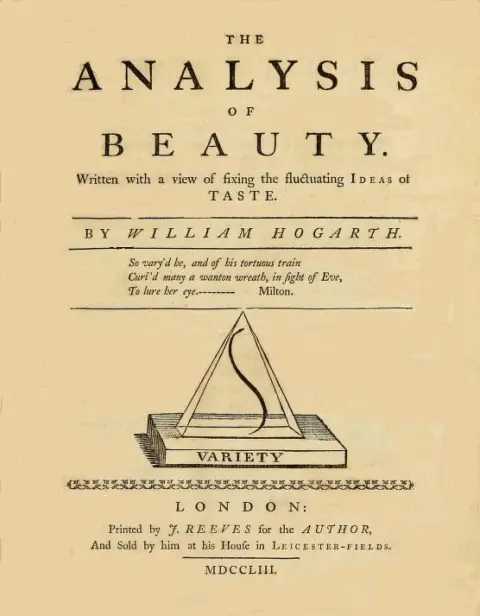
"The Analysis of Beauty" by William Hogarth is a book published in 1753 that describes theories of visual beauty accessible to common readers. Hogarth introduces his celebrated "Line of Beauty"—a serpentine S-curve that evokes liveliness and movement. He outlines six principles affecting beauty: fitness, variety, regularity, simplicity, intricacy, and quantity. Written as part of his campaign against fashionable taste, the work challenges conventional artistic wisdom and invites readers into a systematic exploration of what makes objects visually appealing.
Introduction adapted from the source catalogue; source summaries may be automatically generated.
Free to read · English · 45,078 words · No account needed
MAKE TIME FOR A GOOD BOOK
On by default. Untick to stop anonymous reading totals. Each page counts after 10 seconds in view. How this works.
Anonymous counting is on unless you have switched it off.
In doing which, it will be found, that, by their correspondency with, and conformity to objects, either composed of straight, curved, waving, or serpentine lines, they of course take such appearances of variety as are adequate to the variety made by those lines; and by this conformity of shades we have the same ideas of any of the objects composed of the above lines in their front aspects, as we have of them by their profiles; which otherwise could not be without feeling them.
Now instead of giving engraved examples of each species of shade, as I have done of lines, I have found that they may be more satisfactorily pointed out and described by having recourse to the life.
But in order to the better and more precisely fixing upon what may be there seen, as the distinct species, of which all the shades of the retiring kind in nature partake, in some degree or other, the following scheme is offered, and intended as an additional means of making such simple impressions in the mind, as may be thought adequate to the four species of lines described in Chapter VII. Wherein we are to suppose imperceptible degrees of shade gradating from one figure to another.
The first species to be represented by, 1, 2, 3, 4, 5. the second by, 5, 4, 3, 2, 1, 2, 3, 4, 5. and the third by, 5, 4, 3, 2, 1, 2, 3, 4, 5, 4, 3, 2, 1, 2, 3, 4, 5. gradating from the dots underneath, repeated either way.
As the first species varies or gradates but one way, it is therefore least ornamental, and equal only to straight lines.
The second gradating contrary ways, doubling the others variety, is consequently twice as pleasing, and thereby equal to curved lines.
The third species gradating doubly contrary ways, is thereby still more pleasing in proportion to that quadruple variety which makes it become capable of conveying to the mind an equivalent in shade, which expresses the beauty of the waving line, when it cannot be seen as a line.
The retiring shade, adequate to the serpentine line, now should follow; but as the line itself could not be expressed on paper, without the figure of a cone [Fig. 26 p. I], so neither can this shade be described without the assistance of a proper form, and therefore must be deferred a little longer.
When only the ornamental quality of shades is spoken of, for the sake of distinguishing them from retiring shades, let them be considered as pencilings only; whence another advantage will arise, which is, that then all the intervening mixtures, with their degrees of beauty between each species, may be as easily conceived, as those have been between each class of lines.
Your reading position is saved on this browser. Take it to another device with a library code. Reading pages adapt to text, rather than matching a printed edition.
BEHIND THE BOOK
This eBook is for the use of anyone anywhere in the United States and most other parts of the world at no cost and with almost no restrictions whatsoever. You may copy it, give it away or re-use it under the terms of the Project Gutenberg License included with this eBook or online at www.gutenberg.org. If you are not located in the United States, you will have to check the laws of the country where you are located before using this eBook. Read the source licence.
The original source file, including credits and licence, is retained by this library. Request an original-format copy at no charge. Please include the book title and Project Gutenberg identifier #51459.
KEEP YOUR CURIOSITY GOING
David Patterson (Spirit) Hatch
Coulson Kernahan

Ralph Waldo Emerson
Frances Wright

Edwin Abbott Abbott

Joseph Droz