
Last letters from the living dead man
David Patterson (Spirit) Hatch
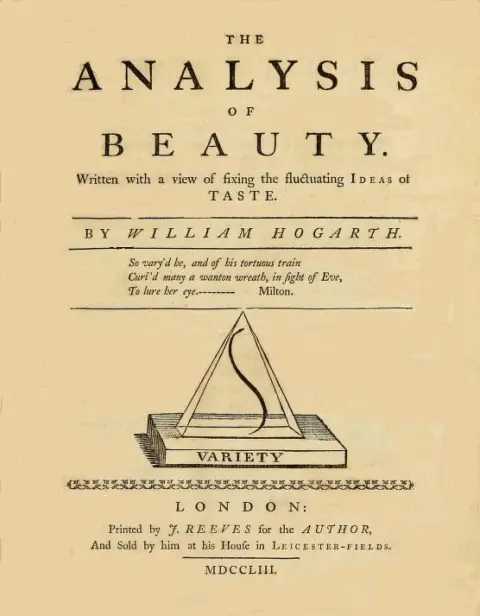
THE CLASSIC COLLECTION · 1753
"The Analysis of Beauty" by William Hogarth is a book published in 1753 that describes theories of visual beauty accessible to common readers. Hogarth introduces his celebrated "Line of Beauty"—a serpentine S-curve that evokes liveliness and movement. He outlines six principles affecting beauty: fitness, variety, regularity, simplicity, intricacy, and quantity. Written as part of his campaign against fashionable taste, the work challenges conventional artistic wisdom and invites readers into a systematic exploration of what makes objects visually appealing.
Introduction adapted from the source catalogue; source summaries may be automatically generated.
Free to read · English · 45,078 words · No account needed
MAKE TIME FOR A GOOD BOOK
On by default. Untick to stop anonymous reading totals. Each page counts after 10 seconds in view. How this works.
Anonymous counting is on unless you have switched it off.
It may be remember'd that in the introduction, the reader is desired to consider the surfaces of objects as so many shells of lines, closely connected together, which idea of them it will now be proper to call to mind, for the better comprehending not only this, but all the following chapters on composition.
The constant use made of lines by mathematicians, as well as painters, in describing things upon paper, hath establish'd a conception of them, as if actually existing on the real forms themselves. This likewise we suppose, and shall set out with saying in general--That the straight line, and the circular line, together with their different combinations, and variations, &c. bound, and circumscribe all visible objects whatsoever, thereby producing such endless variety of forms, as lays us under the necessity of dividing, and distinguishing them into general classes; leaving the intervening mixtures of appearances to the reader's own farther observation.
First, [Fig. 23 T p. I] objects composed of straight lines only, as the cube, or of circular lines, as the sphere, or of both together, as cylinders and cones, &c.
Secondly, [Fig. 24 T p. I] those composed of straight lines, circular lines, and of lines partly straight, and partly circular, as the capitals of columns, and vases, &c.
Thirdly, [Fig. 25 T p. I] those composed of all the former together with an addition of the waving line, which is a line more productive of beauty than any of the former, as in flowers, and other forms of the ornamental kind: for which reason we shall call it the line of beauty.
Fourthly, [Fig. 26 T p. I] those composed of all the former together with the serpentine line, as the human form, which line hath the power of super-adding grace to beauty. Note, forms of most grace have least of the straight line in them.
It is to be observed, that straight lines vary only in length, and therefore are least ornamental.
That curved lines as they can be varied in their degrees of curvature as well as in their lengths, begin on that account to be ornamental.
That straight and curv'd lines join'd, being a compound line, vary more than curves alone, and so become somewhat more ornamental.
That the waving line, or line of beauty, varying still more, being composed of two curves contrasted, becomes still more ornamental and pleasing, insomuch that the hand takes a lively movement in making it with pen or pencil.
Your reading position is saved on this browser. Take it to another device with a library code. Reading pages adapt to text, rather than matching a printed edition.
BEHIND THE BOOK
This eBook is for the use of anyone anywhere in the United States and most other parts of the world at no cost and with almost no restrictions whatsoever. You may copy it, give it away or re-use it under the terms of the Project Gutenberg License included with this eBook or online at www.gutenberg.org. If you are not located in the United States, you will have to check the laws of the country where you are located before using this eBook. Read the source licence.
The original source file, including credits and licence, is retained by this library. Request an original-format copy at no charge. Please include the book title and Project Gutenberg identifier #51459.
KEEP YOUR CURIOSITY GOING
David Patterson (Spirit) Hatch
Coulson Kernahan

Ralph Waldo Emerson
Frances Wright

Edwin Abbott Abbott

Joseph Droz