THE CLASSIC COLLECTION✦Hawthorne (English Men of Letters Series)CLASSIC FREE BOOKS
Hawthorne (English Men of Letters Series)
Henry James
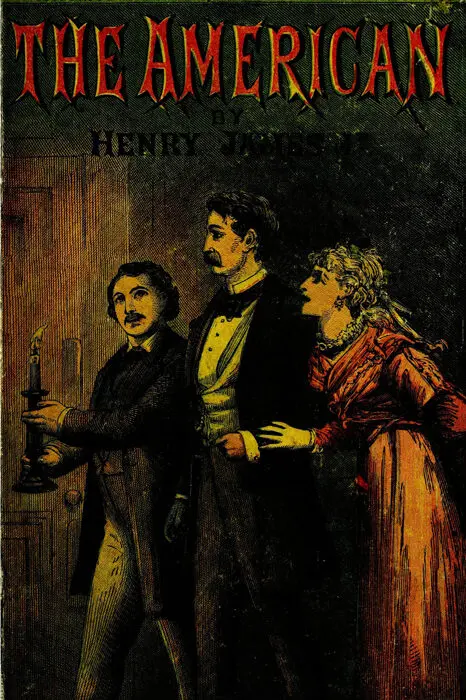
THE CLASSIC COLLECTION · 1877
"The American" by Henry James is a novel published in 1877. Christopher Newman, a wealthy American businessman, travels to Europe seeking culture and a refined wife. He falls for Claire de Cintré, a young widow from an aristocratic Parisian family. But Newman's honest American spirit collides with Old World class prejudices and dark family secrets. As romance blooms and complications mount, he must navigate the treacherous divide between New World optimism and European sophistication in this tale of international manners and mismatched worlds.
Introduction adapted from the source catalogue; source summaries may be automatically generated.
Free to read · English · 136,560 words · No account needed
MAKE TIME FOR A GOOD BOOK
On by default. Untick to stop anonymous reading totals. Each page counts after 10 seconds in view. How this works.
Anonymous counting is on unless you have switched it off.
Newman, at this juncture, fell to admiring the duchess for her fine manners. He felt, most accurately, that she was not a grain less urbane than she would have been if his marriage were still in prospect; but he felt also that she was not a particle more urbane. He had come, so reasoned the duchess—Heaven knew why he had come, after what had happened; and for the half hour, therefore, she would be charmante. But she would never see him again. Finding no ready-made opportunity to tell his story, Newman pondered these things more dispassionately than might have been expected; he stretched his legs, as usual, and even chuckled a little, appreciatively and noiselessly. And then as the duchess went on relating a mot with which her mother had snubbed the great Napoleon, it occurred to Newman that her evasion of a chapter of French history more interesting to himself might possibly be the result of an extreme consideration for his feelings. Perhaps it was delicacy on the duchess’s part—not policy. He was on the point of saying something himself, to make the chance which he had determined to give her still better, when the servant announced another visitor. The duchess, on hearing the name—it was that of an Italian prince—gave a little imperceptible pout, and said to Newman, rapidly: “I beg you to remain; I desire this visit to be short.” Newman said to himself, at this, that Madame d’Outreville intended, after all, that they should discuss the Bellegardes together.
The prince was a short, stout man, with a head disproportionately large. He had a dusky complexion and a bushy eyebrow, beneath which his eye wore a fixed and somewhat defiant expression; he seemed to be challenging you to insinuate that he was top-heavy. The duchess, judging from her charge to Newman, regarded him as a bore; but this was not apparent from the unchecked flow of her conversation. She made a fresh series of mots, characterized with great felicity the Italian intellect and the taste of the figs at Sorrento, predicted the ultimate future of the Italian kingdom (disgust with the brutal Sardinian rule and complete reversion, throughout the peninsula, to the sacred sway of the Holy Father), and, finally, gave a history of the love affairs of the Princess X——. This narrative provoked some rectifications on the part of the prince, who, as he said, pretended to know something about that matter; and having satisfied himself that Newman was in no laughing mood, either with regard to the size of his head or anything else, he entered into the controversy with an animation for which the duchess, when she set him down as a bore, could not have been prepared. The sentimental vicissitudes of the Princess X—— led to a discussion of the heart history of Florentine nobility in general; the duchess had spent five weeks in Florence and had gathered much information on the subject. This was merged, in turn, in an examination of the Italian heart per se. The duchess took a brilliantly heterodox view—thought it the least susceptible organ of its kind that she had ever encountered, related examples of its want of susceptibility, and at last declared that for her the Italians were a people of ice. The prince became flame to refute her, and his visit really proved charming. Newman was naturally out of the conversation; he sat with his head a little on one side, watching the interlocutors. The duchess, as she talked, frequently looked at him with a smile, as if to intimate, in the charming manner of her nation, that it lay only with him to say something very much to the point. But he said nothing at all, and at last his thoughts began to wander. A singular feeling came over him—a sudden sense of the folly of his errand. What under the sun had he to say to the duchess, after all? Wherein would it profit him to tell her that the Bellegardes were traitors and that the old lady, into the bargain was a murderess? He seemed morally to have turned a sort of somersault, and to find things looking differently in consequence. He felt a sudden stiffening of his will and quickening of his reserve. What in the world had he been thinking of when he fancied the duchess could help him, and that it would conduce to his comfort to make her think ill of the Bellegardes? What did her opinion of the Bellegardes matter to him? It was only a shade more important than the opinion the Bellegardes entertained of her. The duchess help him—that cold, stout, soft, artificial woman help him?—she who in the last twenty minutes had built up between them a wall of polite conversation in which she evidently flattered herself that he would never find a gate. Had it come to that—that he was asking favors of conceited people, and appealing for sympathy where he had no sympathy to give? He rested his arms on his knees, and sat for some minutes staring into his hat. As he did so his ears tingled—he had come very near being an ass. Whether or no the duchess would hear his story, he wouldn’t tell it. Was he to sit there another half hour for the sake of exposing the Bellegardes? The Bellegardes be hanged! He got up abruptly, and advanced to shake hands with his hostess.
Your reading position is saved on this browser. Take it to another device with a library code. Reading pages adapt to text, rather than matching a printed edition.
Henry James
Henry James
Henry James

Henry James
BEHIND THE BOOK
This eBook is for the use of anyone anywhere in the United States and most other parts of the world at no cost and with almost no restrictions whatsoever. You may copy it, give it away or re-use it under the terms of the Project Gutenberg License included with this eBook or online at www.gutenberg.org. If you are not located in the United States, you will have to check the laws of the country where you are located before using this eBook. Read the source licence.
The original source file, including credits and licence, is retained by this library. Request an original-format copy at no charge. Please include the book title and Project Gutenberg identifier #177.
KEEP YOUR CURIOSITY GOING
Coulson Kernahan

Maurice Baring
Frances Wright
Cécile Tormay

Frederic Jesup Stimson

W. H. P. (William Henry Pope) Jarvis