THE CLASSIC COLLECTION✦Hawthorne (English Men of Letters Series)CLASSIC FREE BOOKS
Hawthorne (English Men of Letters Series)
Henry James
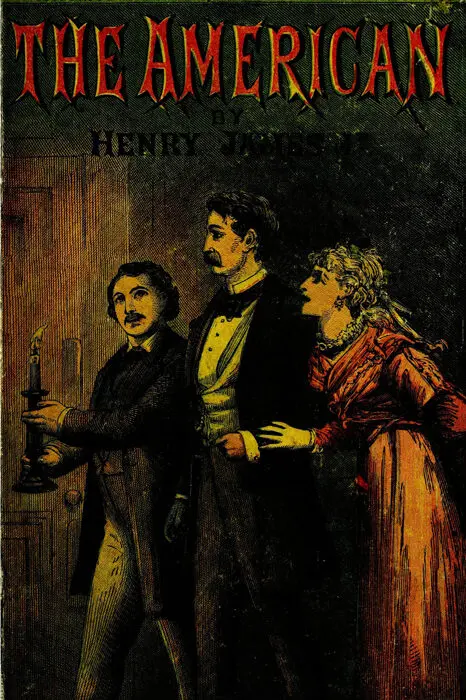
THE CLASSIC COLLECTION · 1877
"The American" by Henry James is a novel published in 1877. Christopher Newman, a wealthy American businessman, travels to Europe seeking culture and a refined wife. He falls for Claire de Cintré, a young widow from an aristocratic Parisian family. But Newman's honest American spirit collides with Old World class prejudices and dark family secrets. As romance blooms and complications mount, he must navigate the treacherous divide between New World optimism and European sophistication in this tale of international manners and mismatched worlds.
Introduction adapted from the source catalogue; source summaries may be automatically generated.
Free to read · English · 136,560 words · No account needed
MAKE TIME FOR A GOOD BOOK
On by default. Untick to stop anonymous reading totals. Each page counts after 10 seconds in view. How this works.
Anonymous counting is on unless you have switched it off.
He performed this ceremony on the following day, when, by appointment, Christopher Newman went to dine with him. Mr. and Mrs. Tristram lived behind one of those chalk-colored façades which decorate with their pompous sameness the broad avenues manufactured by Baron Haussmann in the neighborhood of the Arc de Triomphe. Their apartment was rich in the modern conveniences, and Tristram lost no time in calling his visitor’s attention to their principal household treasures, the gas-lamps and the furnace-holes. “Whenever you feel homesick,” he said, “you must come up here. We’ll stick you down before a register, under a good big burner, and—”
“And you will soon get over your homesickness,” said Mrs. Tristram.
Her husband stared; his wife often had a tone which he found inscrutable he could not tell for his life whether she was in jest or in earnest. The truth is that circumstances had done much to cultivate in Mrs. Tristram a marked tendency to irony. Her taste on many points differed from that of her husband, and though she made frequent concessions it must be confessed that her concessions were not always graceful. They were founded upon a vague project she had of some day doing something very positive, something a trifle passionate. What she meant to do she could by no means have told you; but meanwhile, nevertheless, she was buying a good conscience, by instalments.
It should be added, without delay, to anticipate misconception, that her little scheme of independence did not definitely involve the assistance of another person, of the opposite sex; she was not saving up virtue to cover the expenses of a flirtation. For this there were various reasons. To begin with, she had a very plain face and she was entirely without illusions as to her appearance. She had taken its measure to a hair’s breadth, she knew the worst and the best, she had accepted herself. It had not been, indeed, without a struggle. As a young girl she had spent hours with her back to her mirror, crying her eyes out; and later she had from desperation and bravado adopted the habit of proclaiming herself the most ill-favored of women, in order that she might—as in common politeness was inevitable—be contradicted and reassured. It was since she had come to live in Europe that she had begun to take the matter philosophically. Her observation, acutely exercised here, had suggested to her that a woman’s first duty is not to be beautiful, but to be pleasing, and she encountered so many women who pleased without beauty that she began to feel that she had discovered her mission. She had once heard an enthusiastic musician, out of patience with a gifted bungler, declare that a fine voice is really an obstacle to singing properly; and it occurred to her that it might perhaps be equally true that a beautiful face is an obstacle to the acquisition of charming manners. Mrs. Tristram, then, undertook to be exquisitely agreeable, and she brought to the task a really touching devotion. How well she would have succeeded I am unable to say; unfortunately she broke off in the middle. Her own excuse was the want of encouragement in her immediate circle. But I am inclined to think that she had not a real genius for the matter, or she would have pursued the charming art for itself. The poor lady was very incomplete. She fell back upon the harmonies of the toilet, which she thoroughly understood, and contented herself with dressing in perfection. She lived in Paris, which she pretended to detest, because it was only in Paris that one could find things to exactly suit one’s complexion. Besides out of Paris it was always more or less of a trouble to get ten-button gloves. When she railed at this serviceable city and you asked her where she would prefer to reside, she returned some very unexpected answer. She would say in Copenhagen, or in Barcelona; having, while making the tour of Europe, spent a couple of days at each of these places. On the whole, with her poetic furbelows and her misshapen, intelligent little face, she was, when you knew her, a decidedly interesting woman. She was naturally shy, and if she had been born a beauty, she would (having no vanity) probably have remained shy. Now, she was both diffident and importunate; extremely reserved sometimes with her friends, and strangely expansive with strangers. She despised her husband; despised him too much, for she had been perfectly at liberty not to marry him. She had been in love with a clever man who had slighted her, and she had married a fool in the hope that this thankless wit, reflecting on it, would conclude that she had no appreciation of merit, and that he had flattered himself in supposing that she cared for his own. Restless, discontented, visionary, without personal ambitions, but with a certain avidity of imagination, she was, as I have said before, eminently incomplete. She was full—both for good and for ill—of beginnings that came to nothing; but she had nevertheless, morally, a spark of the sacred fire.
Your reading position is saved on this browser. Take it to another device with a library code. Reading pages adapt to text, rather than matching a printed edition.
Henry James
Henry James
Henry James

Henry James
BEHIND THE BOOK
This eBook is for the use of anyone anywhere in the United States and most other parts of the world at no cost and with almost no restrictions whatsoever. You may copy it, give it away or re-use it under the terms of the Project Gutenberg License included with this eBook or online at www.gutenberg.org. If you are not located in the United States, you will have to check the laws of the country where you are located before using this eBook. Read the source licence.
The original source file, including credits and licence, is retained by this library. Request an original-format copy at no charge. Please include the book title and Project Gutenberg identifier #177.
KEEP YOUR CURIOSITY GOING
Coulson Kernahan

Maurice Baring
Frances Wright
Cécile Tormay

Frederic Jesup Stimson

W. H. P. (William Henry Pope) Jarvis