THE CLASSIC COLLECTION✦An outlaw’s diary: the CommuneCLASSIC FREE BOOKS
An outlaw’s diary: the Commune
Cécile Tormay
THE CLASSIC COLLECTION · 1866
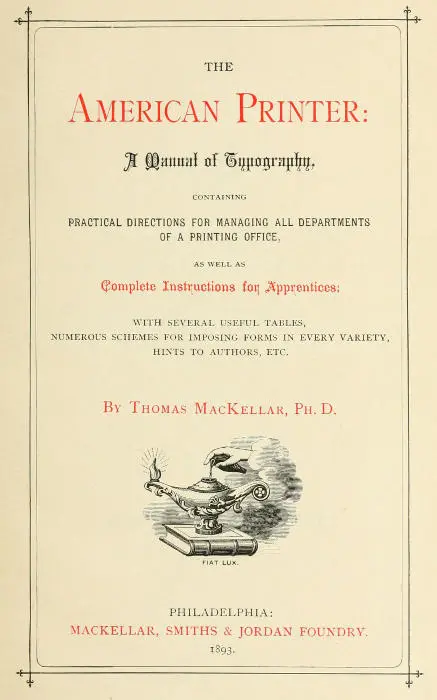
"The American Printer: A Manual of Typography" by Thomas MacKellar is a manual focused on the art and craft of typography, likely written in the late 19th century. This comprehensive guide serves not only as a resource for printers and publishing professionals but also provides historical context for the development of printing techniques and technologies. It encompasses practical directions for managing various departments of a printing office, along with useful instructions for apprentices. The opening of the manual establishes its purpose and utilizes a preface to set the tone for the comprehensive coverage of the printing profession. It outlines the book's intent to provide practical information based on personal experience and industry best practices while referencing a variety of typographical works. The text begins with a historical overview of the discovery of printing, mentioning notable figures such as Laurentius Koster and Johannes Gutenberg, and it lays the groundwork for understanding the evolution of printing methods. This context aims to equip readers with essential knowledge regarding the art of typography and the operations of printing offices, making the manual valuable for authors, publishers, and aspiring printers.
Introduction adapted from the source catalogue; source summaries may be automatically generated.
Free to read · English · 108,321 words · No account needed
MAKE TIME FOR A GOOD BOOK
On by default. Untick to stop anonymous reading totals. Each page counts after 10 seconds in view. How this works.
Anonymous counting is on unless you have switched it off.
Е has three different sounds: 1. In Russian words, and in all syllables in which it is preceded by a vowel, е has a sound like that of yai, when the y is nearly sunk in the pronunciation, as in ему́, to him; read yaimoò. 2. At the beginning of words from foreign languages, and at the middle and end of a word when preceded by a consonant, it has the sound of e in met, as in берегу́, I guard; read bayregoò. 3. In the termination екъ of diminutives, in all the characteristic inflections of cases in the nouns, and of persons in the verbs, in fact, in almost all words, this letter when accented has a sound nearly like that of short yo or o; as in куле́къ, a little sack; веде́шь, thou leadest; медъ, the honey; read koolyòk, vaidyòsh, myod. This sound yo or o of the letter е is commonly distinguished by a diæresis over the vowel, as кулёкъ, ведёшь, мёлъ.
Л has a guttural sound nearly analogous to the English w. Писарлъ, he wrote, read pisaw or pisou.
Ль has a soft sound, as in the French word bouillon.
Х corresponds to the German ~ch~. It is a strong aspiration that nearly resembles the sound k when pronounced hastily from the throat; as in хвала́, the praise; read khvahlàh.
Щ unites the sound of ш and ч, as in щитъ, the shield; read shtcheet.
Ъ. This letter has no sound; the preceding consonant, the last letter of the word, ought to be pronounced a little hollow, as in боо́ъ, a bean; read bop.
Ы has a sound nearly like we when the w is pronounced rapidly; as in бу́квьшы, the letters, read boòkwe. It has this sound after the consonants б, в, м, п, ф; but after another consonant it is a thick e, as in сынъ, the son; read seen.
Ь. This letter at the end of a word has a sound nearly like that of the very short e. When followed by a consonant in the middle of a word it is mute, but is pronounced when followed by a vowel; as in знатъ, to know; read znaht.
Ѣ at the beginning of a word has the sound of yai; as in Ѣсть, to eat; read yaist. In the middle of a word it is pronounced yai, the sound of y being almost sunk; as in нѣтъ, no; read nyaitt. At the end of a word it is sounded ay.
Я when accented has the sound of the diphthong yah; as in я́ма, a pit; read yàhmah. But if not accented it is pronounced yai, as in ядро́, a ball; read yaidrò. The pronoun ея́, of her, is pronounced yaiyò, and the syllable ся of pronominal verbs is pronounced sah, as in стара́ться, to exert one’s self; read stahràhtsah.
Your reading position is saved on this browser. Take it to another device with a library code. Reading pages adapt to text, rather than matching a printed edition.
BEHIND THE BOOK
This eBook is for the use of anyone anywhere in the United States and most other parts of the world at no cost and with almost no restrictions whatsoever. You may copy it, give it away or re-use it under the terms of the Project Gutenberg License included with this eBook or online at www.gutenberg.org. If you are not located in the United States, you will have to check the laws of the country where you are located before using this eBook. Read the source licence.
The original source file, including credits and licence, is retained by this library. Request an original-format copy at no charge. Please include the book title and Project Gutenberg identifier #56817.
KEEP YOUR CURIOSITY GOING
Cécile Tormay

Moritz Busch
John L. Ransom
Frances Wright
Cécile Tormay

Mabel Potter Daggett