THE CLASSIC COLLECTION✦An outlaw’s diary: the CommuneCLASSIC FREE BOOKS
An outlaw’s diary: the Commune
Cécile Tormay
THE CLASSIC COLLECTION · 1866
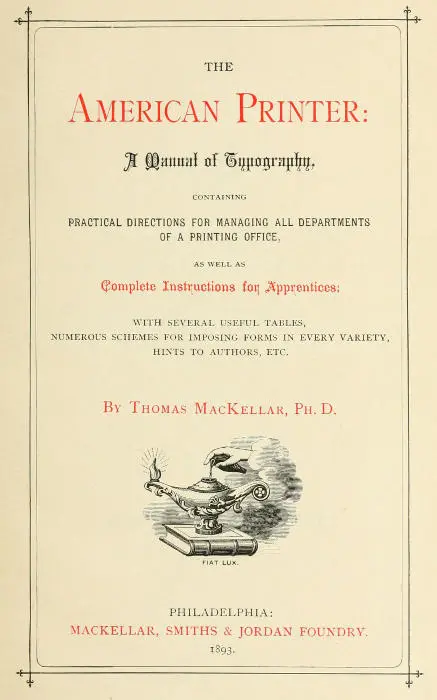
"The American Printer: A Manual of Typography" by Thomas MacKellar is a manual focused on the art and craft of typography, likely written in the late 19th century. This comprehensive guide serves not only as a resource for printers and publishing professionals but also provides historical context for the development of printing techniques and technologies. It encompasses practical directions for managing various departments of a printing office, along with useful instructions for apprentices. The opening of the manual establishes its purpose and utilizes a preface to set the tone for the comprehensive coverage of the printing profession. It outlines the book's intent to provide practical information based on personal experience and industry best practices while referencing a variety of typographical works. The text begins with a historical overview of the discovery of printing, mentioning notable figures such as Laurentius Koster and Johannes Gutenberg, and it lays the groundwork for understanding the evolution of printing methods. This context aims to equip readers with essential knowledge regarding the art of typography and the operations of printing offices, making the manual valuable for authors, publishers, and aspiring printers.
Introduction adapted from the source catalogue; source summaries may be automatically generated.
Free to read · English · 108,321 words · No account needed
MAKE TIME FOR A GOOD BOOK
On by default. Untick to stop anonymous reading totals. Each page counts after 10 seconds in view. How this works.
Anonymous counting is on unless you have switched it off.
By these symbols, only numbers under 1000 could be expressed; but, by putting a mark called iota under any symbol, its value was increased a thousand-fold: thus, ᾳ = 1000, κͅ = 20,000; or, by subscribing the letter Μ, the value of a symbol was raised ten thousand-fold. For these two marks, single and double dots were afterward substituted. This improvement enabled them to express with facility all numbers as high as 9,990,000,—a range sufficient for all ordinary purposes.
It has been supposed that the Romans used M to denote 1000 because it is the first letter of Mille, which is Latin for 1000; and C to denote 100, it being the first letter of Centum, the Latin term for 100. Some also suppose that D, being formed by dividing the old M in the middle, was therefore appointed to stand for 500,—that is, half as much as the M stood for when it was whole; and that L being half a C, was, for the same reason, used to denominate 50. But the most natural account of the matter appears to be this:—
The Romans probably put down a single stroke, Ⅰ, for one, as is still the practice of those who score on a slate, or with chalk; this stroke they doubled, trebled, and quadrupled, to express two, three, and four: thus, ⅠⅠ, ⅠⅠⅠ, ⅠⅠⅠⅠ. So far they could easily number the strokes with a glance of the eye; but they found that if more were added it would be necessary to count the strokes one by one: for this reason, when they came to five, it was expressed by joining two strokes together in an acute angle, thus, Ⅴ.
After they had made this acute angle, Ⅴ, for five, they then added single strokes to the number of four, thus, ⅤⅠ, ⅤⅠⅠ, ⅤⅠⅠⅠ, ⅤⅠⅠⅠ, and then, as the strokes could not be further multiplied without confusion, they doubled their acute angle by prolonging the two lines beyond their intersection, thus, Ⅹ, to denote two fives, or ten. After they had doubled, trebled, and quadrupled this double acute angle, thus, ⅩⅩ, ⅩⅩⅩ, ⅩⅩⅩⅩ, they then, for the same reason which induced them to make a single angle first, and then to double it, joined two single strokes in another form, and, instead of an acute angle, made a right angle, Ⅼ, to denote fifty. When this was doubled, they then doubled the right angle, thus, ⊏, to denote one hundred, and, having numbered this double right angle four times, thus, ⊏⊏, ⊏⊏⊏, ⊏⊏⊏⊏, when they came to the fifth number, as before, they reverted it, and put a single stroke before it, thus, Ⅰ⊐, to denote five hundred; and, when this five hundred was doubled, then they also doubled their double right angle, setting two double right angles opposite to each other, with a single stroke between them, thus, ⊏Ⅰ⊐, to denote one thousand: when this note for one thousand had been repeated four times, they then put down Ⅰ⊐⊐ for five thousand, ⊏⊏Ⅰ⊐⊐ for ten thousand, and Ⅰ⊐⊐⊐ for fifty thousand.
Your reading position is saved on this browser. Take it to another device with a library code. Reading pages adapt to text, rather than matching a printed edition.
BEHIND THE BOOK
This eBook is for the use of anyone anywhere in the United States and most other parts of the world at no cost and with almost no restrictions whatsoever. You may copy it, give it away or re-use it under the terms of the Project Gutenberg License included with this eBook or online at www.gutenberg.org. If you are not located in the United States, you will have to check the laws of the country where you are located before using this eBook. Read the source licence.
The original source file, including credits and licence, is retained by this library. Request an original-format copy at no charge. Please include the book title and Project Gutenberg identifier #56817.
KEEP YOUR CURIOSITY GOING
Cécile Tormay

Moritz Busch
John L. Ransom
Frances Wright
Cécile Tormay

Mabel Potter Daggett