THE CLASSIC COLLECTION✦An outlaw’s diary: the CommuneCLASSIC FREE BOOKS
An outlaw’s diary: the Commune
Cécile Tormay
THE CLASSIC COLLECTION · 1866
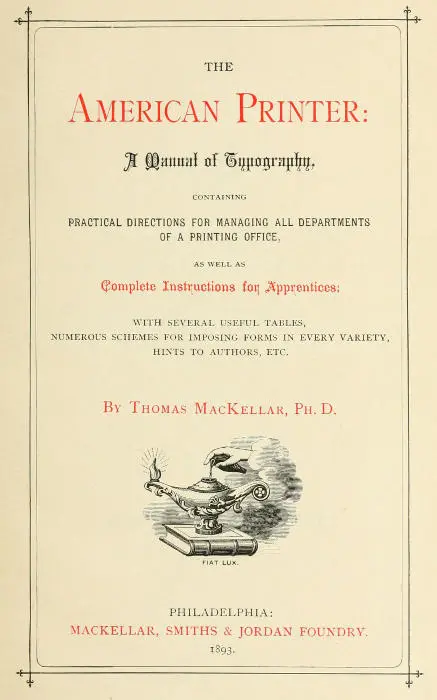
"The American Printer: A Manual of Typography" by Thomas MacKellar is a manual focused on the art and craft of typography, likely written in the late 19th century. This comprehensive guide serves not only as a resource for printers and publishing professionals but also provides historical context for the development of printing techniques and technologies. It encompasses practical directions for managing various departments of a printing office, along with useful instructions for apprentices. The opening of the manual establishes its purpose and utilizes a preface to set the tone for the comprehensive coverage of the printing profession. It outlines the book's intent to provide practical information based on personal experience and industry best practices while referencing a variety of typographical works. The text begins with a historical overview of the discovery of printing, mentioning notable figures such as Laurentius Koster and Johannes Gutenberg, and it lays the groundwork for understanding the evolution of printing methods. This context aims to equip readers with essential knowledge regarding the art of typography and the operations of printing offices, making the manual valuable for authors, publishers, and aspiring printers.
Introduction adapted from the source catalogue; source summaries may be automatically generated.
Free to read · English · 108,321 words · No account needed
MAKE TIME FOR A GOOD BOOK
On by default. Untick to stop anonymous reading totals. Each page counts after 10 seconds in view. How this works.
Anonymous counting is on unless you have switched it off.
Full-points are sometimes used as leaders in tables of contents, figure-work, &c.; but dotted rules or leaders are more economical for this purpose, as they save considerable time in the composition.
The sign of INTERROGATION [?] is used to denote a question. Every interrogation or question should begin with a capital letter, (unless several questions follow one another in connected succession,) according to the method observed in the Bible, where questions and responses, and the beginning of sayings, &c. are denoted by a capital letter.
The sign of ADMIRATION or EXCLAMATION [!] denotes surprise, astonishment, rapture, and other sudden emotions of the mind, whether of joy or sorrow. This sign is put after the interjections Ah! Alas! Oh! &c.; but there are exceptional cases, as, Ah me! Alas the day! &c.
All the points, except the comma and the period, should be preceded by a hair-space; the comma and full-point do not require any space to bear them off.
The em dash [—], though not ranked as a point, is often used by careless writers as a substitute for a comma or semicolon. It may be properly employed in parenthetical sentences, and in rhapsodical writing abounding in disconnected sentences.
A dash stands for a sign of repetition in catalogues of goods, where it implies ditto; and in catalogues of books, where a dash signifies ejusdem, instead of repeating the author’s name with the title of every separate treatise of his writing. A sign of repetition should never appear at the top of a page, but the name of the author, or of the merchandise, should be set out again at length.
A dash likewise stands for to; as, chap. xvi. 3-17; that is, from the third to the seventeenth verse inclusive. At other times it serves for an index, to give notice that what follows it is a corollary of what has preceded; thus:—
The apostrophe [’] is a comma cast on the upper edge of a type, and is used as a sign of contraction or abbreviation of words in poetry or familiar conversation, as We’re, o’er, don’t, &c. In poetry, it should not be employed where the verb ends with e, as love, change, &c., but only in cases where the verb concludes with a consonant, as, reign, obtain, &c. It also marks the elision of a vowel at the beginning of words, as, ’scape, or of a syllable, as, ’prentice.
The monosyllables though and through are sometimes shortened to tho’ and thro’, but very improperly, as they retain the same sound, and the abbreviation cannot in the slightest degree assist the versification.
Words in the possessive case are generally known by having ’s for their
termination.
Your reading position is saved on this browser. Take it to another device with a library code. Reading pages adapt to text, rather than matching a printed edition.
BEHIND THE BOOK
This eBook is for the use of anyone anywhere in the United States and most other parts of the world at no cost and with almost no restrictions whatsoever. You may copy it, give it away or re-use it under the terms of the Project Gutenberg License included with this eBook or online at www.gutenberg.org. If you are not located in the United States, you will have to check the laws of the country where you are located before using this eBook. Read the source licence.
The original source file, including credits and licence, is retained by this library. Request an original-format copy at no charge. Please include the book title and Project Gutenberg identifier #56817.
KEEP YOUR CURIOSITY GOING
Cécile Tormay

Moritz Busch
John L. Ransom
Frances Wright
Cécile Tormay

Mabel Potter Daggett