THE CLASSIC COLLECTION✦An outlaw’s diary: the CommuneCLASSIC FREE BOOKS
An outlaw’s diary: the Commune
Cécile Tormay
THE CLASSIC COLLECTION · 1866
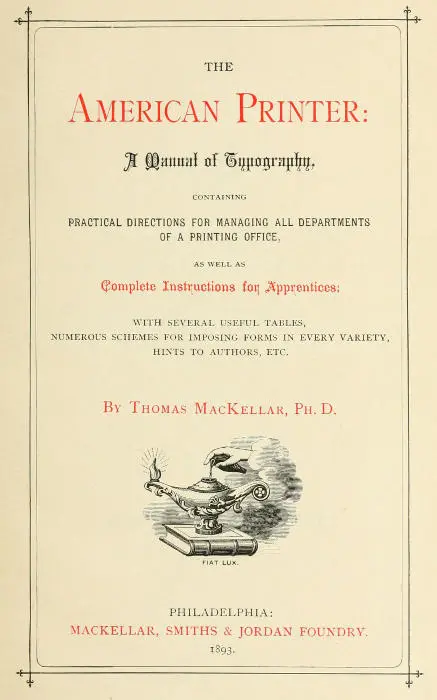
"The American Printer: A Manual of Typography" by Thomas MacKellar is a manual focused on the art and craft of typography, likely written in the late 19th century. This comprehensive guide serves not only as a resource for printers and publishing professionals but also provides historical context for the development of printing techniques and technologies. It encompasses practical directions for managing various departments of a printing office, along with useful instructions for apprentices. The opening of the manual establishes its purpose and utilizes a preface to set the tone for the comprehensive coverage of the printing profession. It outlines the book's intent to provide practical information based on personal experience and industry best practices while referencing a variety of typographical works. The text begins with a historical overview of the discovery of printing, mentioning notable figures such as Laurentius Koster and Johannes Gutenberg, and it lays the groundwork for understanding the evolution of printing methods. This context aims to equip readers with essential knowledge regarding the art of typography and the operations of printing offices, making the manual valuable for authors, publishers, and aspiring printers.
Introduction adapted from the source catalogue; source summaries may be automatically generated.
Free to read · English · 108,321 words · No account needed
MAKE TIME FOR A GOOD BOOK
On by default. Untick to stop anonymous reading totals. Each page counts after 10 seconds in view. How this works.
Anonymous counting is on unless you have switched it off.
Mappa, Adam G., one of the early American type-founders, 19.
Margin, how to make, 145-147.
on cylinder presses, 268.
Masoretic points, 106.
Mathematical signs, 71, 72.
Matrices, copper, 40.
electrotyped, 23.
Matrix, illustrated, 40.
Mazarin Bibles, 11.
Measure of stick, how to make by ems, 129.
Mecom, Benjamin, 24.
Medium paper, size of, 298.
Melting-kettle, description of, 252.
Metal rules, 75.
Metric system, 336, 337.
Minerva cutting machine, illustrated, 309.
Minion type, specimen of, 54.
Mitering machine, illustrated, 307.
Mittel, German name for English type, 53.
Modern conveniences, 120.
Mucilage, directions for making, 312, 313.
Mud process in stereotyping, 26.
Music, comparative table of bodies, 115.
directions for composing, 116.
plan of cases for, 117-119.
specimens of, 114.
New Hampshire Gazette, oldest living paper of the United States, 17.
Newspapers, number of, printed in the United States in 1801 and 1810, 20.
New types, how to prevent them from adhering together, 127.
New York Gazette, first newspaper published there, 17.
Nicks, position of, 58.
Nicholson, William, suggester of the cylinder press, 238.
Ninety-sixes, to impose half-sheet, 198.
Nonpareil press, illustrated, 247.
type, specimen of, 54.
Norse-Runic alphabet, 87, 88.
North American and United States Gazette, of Philadelphia, oldest daily newspaper in the United States, 17.
Note paper, size of, 298.
Notes, proper size of type for, 131.
cut in, how arranged, 132.
Numeral letters, Gothic, 68, 69.
Greek, 67.
Roman, 68, 69.
Numerical value of Greek letters, 67, 98.
Hebrew letters, 104.
Octavo, scheme for imposing sheet of, 157, 158.
sheet of, the broad way, 157, 158.
two half-sheets, together, 159, 160.
sheet mixed, 161, 162.
half-sheet, 159.
two quarters, together, 160.
sheet of Hebrew, 161, 162.
sheet of, from the centre, 163, 164.
half-sheet of, do., 163.
two quarter-sheets, do., 164.
Oiling a press, 292.
Old English letter used by the early printers, 49.
Old-style figures, advantages of, 70.
Old works, no license of alteration allowable in reprinting, 202.
One hundred and twenty-eights, scheme for imposing half-sheet of, 199.
Ornaments, ancient, exquisite and curious, 15, 16.
Orthography, hints on, 318-332.
uniformity in, 202.
Overlaying on cylinder presses, 272, 273.
on hand-presses, 277.
Overrunning, proper method of, 210.
Overseer, duties of, 218-232.
Over-sheets, rules for giving out, 294.
Packet note paper, size of, 298.
post paper, size of, 298.
Pages, how to tie up, 142, 143.
how to lift, 143.
how to lay, 143.
Palmaert, Lambert, printed at Valencia, 1479, 14.
Paper-bank, how to be placed, 259.
Paper for jobs, rule for giving out, 294.
cutters, 309.
instructions for wetting, 255-257.
qualities of good, 276.
quantity required for a book, 299.
sizes of, 298.
suitable for fine printing, 257.
Papier-maché moulds, 242.
Paragon type, so called by printers in all countries, 52.
Paragraph mark, how used, 66.
Paragraphs, authors’ irregularities in making, 132, 133.
rule for indenting, 132.
Parchment tympans, 254.
Parenthesis, use of, 65, 66.
Pasteboard tympan for a cylinder press, advantages of, 265.
Paste, directions for making, 312.
Pearl type, specimen of, 54.
Peerless press, illustrated, 248.
Penn, William, promotes printing in Pennsylvania, 17.
Perforating machine for round holes, illustrated, 308.
rule, illustrated, 308.
Perforator, Ames’s Patent, 308.
Period, use of, 62.
Petit and Jungfer, German names of Brevier, 54.
Petit Romain, French name of Long Primer, 54.
Petri Hispani Tractatibus Logicis, one of the first printed books, 10.
Phœnician alphabetic system, 83.
Photo-engraving, 35-38.
Phrases, foreign, translated, 357-372.
Your reading position is saved on this browser. Take it to another device with a library code. Reading pages adapt to text, rather than matching a printed edition.
BEHIND THE BOOK
This eBook is for the use of anyone anywhere in the United States and most other parts of the world at no cost and with almost no restrictions whatsoever. You may copy it, give it away or re-use it under the terms of the Project Gutenberg License included with this eBook or online at www.gutenberg.org. If you are not located in the United States, you will have to check the laws of the country where you are located before using this eBook. Read the source licence.
The original source file, including credits and licence, is retained by this library. Request an original-format copy at no charge. Please include the book title and Project Gutenberg identifier #56817.
KEEP YOUR CURIOSITY GOING
Cécile Tormay

Moritz Busch
John L. Ransom
Frances Wright
Cécile Tormay

Mabel Potter Daggett