THE CLASSIC COLLECTION✦An outlaw’s diary: the CommuneCLASSIC FREE BOOKS
An outlaw’s diary: the Commune
Cécile Tormay
THE CLASSIC COLLECTION · 1866
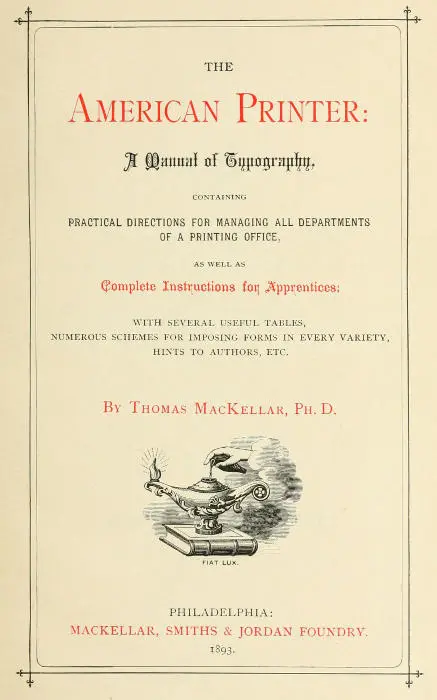
"The American Printer: A Manual of Typography" by Thomas MacKellar is a manual focused on the art and craft of typography, likely written in the late 19th century. This comprehensive guide serves not only as a resource for printers and publishing professionals but also provides historical context for the development of printing techniques and technologies. It encompasses practical directions for managing various departments of a printing office, along with useful instructions for apprentices. The opening of the manual establishes its purpose and utilizes a preface to set the tone for the comprehensive coverage of the printing profession. It outlines the book's intent to provide practical information based on personal experience and industry best practices while referencing a variety of typographical works. The text begins with a historical overview of the discovery of printing, mentioning notable figures such as Laurentius Koster and Johannes Gutenberg, and it lays the groundwork for understanding the evolution of printing methods. This context aims to equip readers with essential knowledge regarding the art of typography and the operations of printing offices, making the manual valuable for authors, publishers, and aspiring printers.
Introduction adapted from the source catalogue; source summaries may be automatically generated.
Free to read · English · 108,321 words · No account needed
MAKE TIME FOR A GOOD BOOK
On by default. Untick to stop anonymous reading totals. Each page counts after 10 seconds in view. How this works.
Anonymous counting is on unless you have switched it off.
Biblia Pauperum, attributed to Koster, 10.
Bill of type, 57.
Binny, Archibald, first successful founder in Philadelphia, 19, 20. improver of the type-mould, 19, 42.
Black letter, when used, 51.
Blades, William, 14.
Blaeu, Willem Jansen, early inventor of a press, 235.
Blankets for wood-cut printing, 282.
India-rubber, 266.
thick paper, 266.
Welsh flannel, 266.
when to be used, 257, 266.
Blanking, remarks concerning, 259.
Bleaching powders deleterious, 276.
Block books, 10.
Blue ink, how to make, 287, 288.
Bodkin, how to use the, 208, 209.
illustrated, 209, 210.
Books, cheapening of, due to steam-presses, 240.
early, printed in Gothic character, 16.
first, printed on one side of the leaf only, 10.
how to preserve, 317.
Book-folding machine, illustrated, 249.
Borders, 80, 120.
Boston Gazette, second newspaper published in America, 17. News-Letter, first newspaper published in America, 17.
Bourgeois, specimen of, 54.
Boxwood, description of good, 36.
liable to warp, 282, 283.
quoin, 306.
Braces, use of, 75.
Bracket, how used, 65.
Bradford, William, first printer in the Middle Colonies, 16, 17.
Brass rules, remarks concerning, 80.
slotted corners, description of, 44.
Break-lines improperly driven over, 133.
should never begin a page, 133.
Brevier, specimen of, 54.
Brilliant, smallest type in America, 52.
specimen of, 54.
Brinley’s collection of Bibles, 11.
British founders reject American casting-machines, 23.
Bronze printing, how executed, 284, 285.
Brown ink, how to produce, 288.
Bruce, David and George, type-founders in New York, 21, 22. David, Jr., type-casting machine invented by, 22.
Bullock, William, inventor of the first perfecting press, 242-244. chain-running press, 244. self-feeding perfecting press, illustrated, 243.
Bundle of paper described, 294.
Cabinet for chases, illustrated, 231.
with galley-top, illustrated, 304.
Cabinets, job cases should be kept in, 304. of cases, for sorts, quads, etc., illustrated, 219-221. should be kept in perfect order, 221.
Cambridge, first press in North America at, 16.
Campbell’s cylinder presses, 239, 246.
self-feeding perfecting press, 246.
Cancelled figures, 70.
Capital, good character is, 138.
letters, 58-60.
letters, how to use, 59, 60.
Card-cutters, 309.
printing, directions for, 283, 284.
sheets, chart for cutting, (Le Blond,) 302.
Carey, Mathew, 26.
Cases, American plan of Roman, 124, 125.
blank, 303.
German, 96, 97.
Greek, 102, 103.
Hebrew, 109, 111.
how to label job, 304.
job, 302.
labour-saving lead, 303.
labour-saving rule, 82, 302.
labour-saving slug, 303.
music, 117-119.
number of, to a fount, 128.
proposed improvement in, 126.
quotation furniture, 303.
Saxon, 92, 93.
triple job, 302.
Caslon, William, 18.
Cassie quires, why so called, 294.
Casting off copy, methods of, 223-226.
Catch-words, first used at Venice, 16.
in titles, how to be set, 134.
Caxton, William, introduces printing into England, 14. his first types not cast or founded, 13.
Centennial Exhibition, 1876, presses exhibited at, 244-246.
fast printing at, 245.
Chalcography, inventor of, 34.
Chromo-lithography, 29.
Chromos, printed on cylinder presses, 31.
Chronicle of Cologne, 9.
Cicero, French and German name for Pica, 53.
Circular quadrates, 78.
Clicker, or maker-up, duties of, 226-228.
Clymer, George, inventor of the Columbian press, 236, 237.
Colon, use of, 62.
Colorito, Abraham, printer at Soncino, 1488, 14.
Colour, uniformity in, 263, 278, 279.
Coloured inks, how to make, 286-288.
printing, instructions for, 285-287.
Colours, contrast of, 289-292.
how to multiply, 288.
how to use dry, 287, 288.
Columbian press, illustrated, 236.
introduced into England, 237.
Combination borders, 80, 120.
Comma, use of, 62.
Commercial post paper, size of, 298.
signs, 71.
Companionships, how managed, 228-232.
misunderstandings in, 228.
Your reading position is saved on this browser. Take it to another device with a library code. Reading pages adapt to text, rather than matching a printed edition.
BEHIND THE BOOK
This eBook is for the use of anyone anywhere in the United States and most other parts of the world at no cost and with almost no restrictions whatsoever. You may copy it, give it away or re-use it under the terms of the Project Gutenberg License included with this eBook or online at www.gutenberg.org. If you are not located in the United States, you will have to check the laws of the country where you are located before using this eBook. Read the source licence.
The original source file, including credits and licence, is retained by this library. Request an original-format copy at no charge. Please include the book title and Project Gutenberg identifier #56817.
KEEP YOUR CURIOSITY GOING
Cécile Tormay

Moritz Busch
John L. Ransom
Frances Wright
Cécile Tormay

Mabel Potter Daggett