THE CLASSIC COLLECTION✦An outlaw’s diary: the CommuneCLASSIC FREE BOOKS
An outlaw’s diary: the Commune
Cécile Tormay
THE CLASSIC COLLECTION · 1866
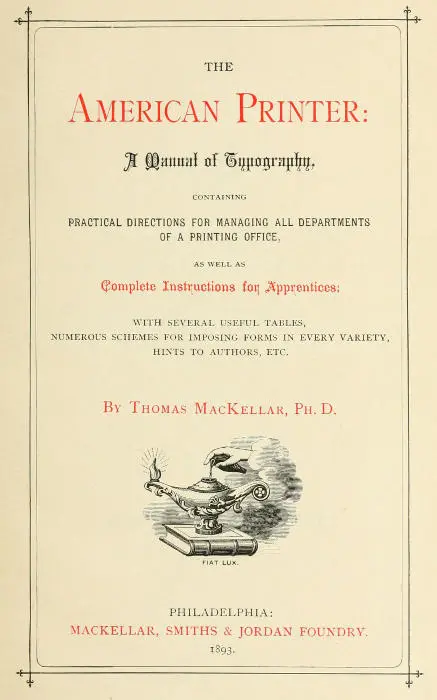
"The American Printer: A Manual of Typography" by Thomas MacKellar is a manual focused on the art and craft of typography, likely written in the late 19th century. This comprehensive guide serves not only as a resource for printers and publishing professionals but also provides historical context for the development of printing techniques and technologies. It encompasses practical directions for managing various departments of a printing office, along with useful instructions for apprentices. The opening of the manual establishes its purpose and utilizes a preface to set the tone for the comprehensive coverage of the printing profession. It outlines the book's intent to provide practical information based on personal experience and industry best practices while referencing a variety of typographical works. The text begins with a historical overview of the discovery of printing, mentioning notable figures such as Laurentius Koster and Johannes Gutenberg, and it lays the groundwork for understanding the evolution of printing methods. This context aims to equip readers with essential knowledge regarding the art of typography and the operations of printing offices, making the manual valuable for authors, publishers, and aspiring printers.
Introduction adapted from the source catalogue; source summaries may be automatically generated.
Free to read · English · 108,321 words · No account needed
MAKE TIME FOR A GOOD BOOK
On by default. Untick to stop anonymous reading totals. Each page counts after 10 seconds in view. How this works.
Anonymous counting is on unless you have switched it off.
Inter alia.—Among other things.
Inter arma leges silent.—In the midst of arms the laws are
silent.
Inter nos.—Between ourselves.
Inter se.—Among themselves.
Ipse dixit.—He himself said it; dogmatic assertion.
Ipsissima verba.—The very words.
Ipso facto.—By the fact itself; actually.
Ipso jure.—By the law itself.
Ira furor brevis est.—Anger is brief madness.
Ita lex scripta est.—Thus the law is written.
Item.—Also.
Jacta est alea.—The die is cast.
Jamais arrière.—Never behind.
Je ne sais quoi.—I know not what.
Jet d’eau.—A jet of water.
Jeu de mots.—Play upon words; a pun.
Jeu d’esprit.—A witticism.
Judicium Dei.—The judgment of God.
Juniores ad labores.—Young men for labours.
Jure divino.—By divine law.
Jure gentium.—By the law of nations.
Jure humano.—By human law.
Jus civile.—Civil law.
Jus gladii.—Right of the sword.
Juste milieu.—The golden mean; a just medium.
Justitiæ soror fides.—Faith is the sister of justice.
La critique est aisée, et l’art est difficile.—Criticism is easy, but art is difficult.
Labor ipse voluptas.—Labour itself is pleasure.
Labor omnia vincit.—Labour conquers all things.
Laissez-nous faire.—Let us alone.
Lapsus calami.—A slip of the pen; an error in writing.
Lapsus linguæ.—A slip of the tongue.
Lapsus memoriæ.—A slip of memory.
Lares et penâtes.—Household gods.
L’argent.—Money, or silver.
Laudator temporis acti.—A praiser of time past.
Laus Deo.—Praise to God.
Laus propria sordet.—Praise of one’s own self defiles.
Le beau monde.—The fashionable world.
Le bon temps viendra.—The good time will come.
Le grand œuvre.—The great work; the philosopher’s stone.
Le pas.—Precedence in place or rank.
Le savoir-faire.—The knowledge how to act; address.
Le tout ensemble.—All together.
Lege.—Read.
Leges legum.—The law of laws.
Lèse majesté.—High treason.
L’étoile du nord.—The north star.
Lettre de cachet.—A sealed letter; a royal warrant.
Levari facias.—That you cause to be levied; a writ of
execution.
Levée.—A morning visit or reception.
Lex loci.—The law of the place.
Lex magna est, et prævalebit.—The law is great, and will
prevail.
Lex non scripta.—The unwritten or common law.
Lex scripta.—Statute law.
Lex talionis.—The law of retaliation.
Lex terræ, lex patriæ.—The law of the land.
L’homme propose, et Dieu dispose.—Man proposes, and God
disposes.
Libretto.—A little book or pamphlet.
Licentia vatûm.—A poetical license.
Lingua Franca.—The mixed language spoken by Europeans in the
East.
Liqueur.—A cordial.
Lis litem generat.—Strife begets strife.
Your reading position is saved on this browser. Take it to another device with a library code. Reading pages adapt to text, rather than matching a printed edition.
BEHIND THE BOOK
This eBook is for the use of anyone anywhere in the United States and most other parts of the world at no cost and with almost no restrictions whatsoever. You may copy it, give it away or re-use it under the terms of the Project Gutenberg License included with this eBook or online at www.gutenberg.org. If you are not located in the United States, you will have to check the laws of the country where you are located before using this eBook. Read the source licence.
The original source file, including credits and licence, is retained by this library. Request an original-format copy at no charge. Please include the book title and Project Gutenberg identifier #56817.
KEEP YOUR CURIOSITY GOING
Cécile Tormay

Moritz Busch
John L. Ransom
Frances Wright
Cécile Tormay

Mabel Potter Daggett