THE CLASSIC COLLECTION✦An outlaw’s diary: the CommuneCLASSIC FREE BOOKS
An outlaw’s diary: the Commune
Cécile Tormay
THE CLASSIC COLLECTION · 1866
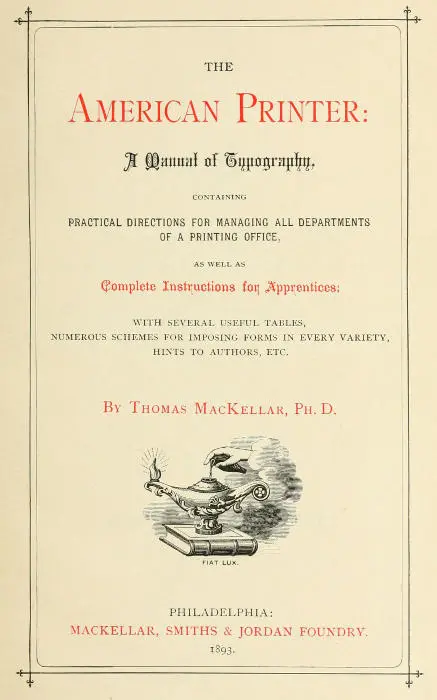
"The American Printer: A Manual of Typography" by Thomas MacKellar is a manual focused on the art and craft of typography, likely written in the late 19th century. This comprehensive guide serves not only as a resource for printers and publishing professionals but also provides historical context for the development of printing techniques and technologies. It encompasses practical directions for managing various departments of a printing office, along with useful instructions for apprentices. The opening of the manual establishes its purpose and utilizes a preface to set the tone for the comprehensive coverage of the printing profession. It outlines the book's intent to provide practical information based on personal experience and industry best practices while referencing a variety of typographical works. The text begins with a historical overview of the discovery of printing, mentioning notable figures such as Laurentius Koster and Johannes Gutenberg, and it lays the groundwork for understanding the evolution of printing methods. This context aims to equip readers with essential knowledge regarding the art of typography and the operations of printing offices, making the manual valuable for authors, publishers, and aspiring printers.
Introduction adapted from the source catalogue; source summaries may be automatically generated.
Free to read · English · 108,321 words · No account needed
MAKE TIME FOR A GOOD BOOK
On by default. Untick to stop anonymous reading totals. Each page counts after 10 seconds in view. How this works.
Anonymous counting is on unless you have switched it off.
Feuilleton.—A small leaf; a supplement to a newspaper; a
pamphlet.
Fiat.—Let it be done.
Fiat justitia, ruat cœlum.—Let justice be done, though the
heavens should fall.
Fiat lux.—Let there be light.
Fide, non armis.—By faith, not by arms.
Fide, sed cui vide.—Trust, but see whom.
Fides et justitia.—-Fidelity and justice.
Fidus Achates.—Faithful Achates (that is, a true friend.)
Fieri facias.—Cause it to be done (a kind of writ.)
Filius nullius.—A son of nobody.
Fille-de-chambre.—A chambermaid.
Finale.—To close or end.
Finem respice.—Look to the end.
Finis.—The end.
Finis coronat opus.—The end crowns the work.
Flagrante bello.—While the war is raging.
Flagrante delicto.—In the commission of the crime.
Flâneur.—A lounger.
Flecti, non frangi.—To be bent, not to be broken.
Fleur-de-lis.—The flower of the lily (pl. fleurs-de-lis.)
Forte.—In music, a direction to sing or play with force or
spirit.
Fortes fortuna juvat.—Fortune assists the brave.
Fortissimo.—Very loud.
Fortiter in re.—Resolute in deed.
Fracas.—Bustle; a slight quarrel; more ado about the thing
than it is worth.
Fruges consumere nati.—Born merely to consume the fruits of
the earth.
Fugam fecit.—He has taken to flight.
Fuit Ilium.—Troy has been.
Functus officio.—Out of office.
Furore.—Excitement.
Gaieté de cœur.—Gayety of heart.
Gallicè.—In French.
Gardez bien.—Take good care.
Gardez la foi.—Keep the faith.
Gaucherie.—Awkwardness.
Gaudeamus igitur.—So let us be joyful.
Gendarme.—A military policeman.
Gendarmerie.—The body of the gendarmes.
Genius loci.—The genius of the place.
Genus irritabile vatum.—Irritable tribe of poets.
Gloria in excelsis.—Glory to God in the highest.
Gratis.—Free of cost.
Gratis dictum.—Mere assertion.
Gravamen.—The thing complained of.
Grisette.—Dressed in gray (a term applied to French
shop-girls, &c.)
Gusto.—Great relish.
Habeas corpus.—You are to have the body; a writ of right, by virtue of which every citizen can, when imprisoned, demand to be put on his trial.
Habitué.—A frequenter.
Hæc olim meminisse juvabit.—It will be pleasant hereafter to
remember these things.
Haricot.—A kind of ragout; a kidney-bean.
Haud passibus æquis.—Not with equal steps. [Wrongly quoted:
see Non, &c.]
Haut gout.—High flavour.
Hauteur.—Haughtiness.
Helluo librorum.—A book-worm.
Hic et ubique.—Here, there, and everywhere.
Hic jacet.—Here lies.
Hinc illæ lacrymæ.—Hence proceed these tears.
Hoc age.—Do this; attend to what you are doing.
Homme d’esprit.—A man of talent, or of wit.
Homo multarum literarum.—A man of much learning.
Honi soit qui mal y pense.—Evil be to him that evil thinks.
Your reading position is saved on this browser. Take it to another device with a library code. Reading pages adapt to text, rather than matching a printed edition.
BEHIND THE BOOK
This eBook is for the use of anyone anywhere in the United States and most other parts of the world at no cost and with almost no restrictions whatsoever. You may copy it, give it away or re-use it under the terms of the Project Gutenberg License included with this eBook or online at www.gutenberg.org. If you are not located in the United States, you will have to check the laws of the country where you are located before using this eBook. Read the source licence.
The original source file, including credits and licence, is retained by this library. Request an original-format copy at no charge. Please include the book title and Project Gutenberg identifier #56817.
KEEP YOUR CURIOSITY GOING
Cécile Tormay

Moritz Busch
John L. Ransom
Frances Wright
Cécile Tormay

Mabel Potter Daggett