THE CLASSIC COLLECTION✦An outlaw’s diary: the CommuneCLASSIC FREE BOOKS
An outlaw’s diary: the Commune
Cécile Tormay
THE CLASSIC COLLECTION · 1866
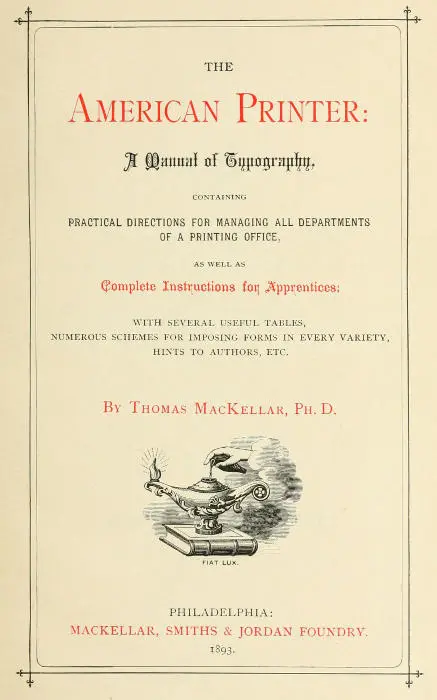
"The American Printer: A Manual of Typography" by Thomas MacKellar is a manual focused on the art and craft of typography, likely written in the late 19th century. This comprehensive guide serves not only as a resource for printers and publishing professionals but also provides historical context for the development of printing techniques and technologies. It encompasses practical directions for managing various departments of a printing office, along with useful instructions for apprentices. The opening of the manual establishes its purpose and utilizes a preface to set the tone for the comprehensive coverage of the printing profession. It outlines the book's intent to provide practical information based on personal experience and industry best practices while referencing a variety of typographical works. The text begins with a historical overview of the discovery of printing, mentioning notable figures such as Laurentius Koster and Johannes Gutenberg, and it lays the groundwork for understanding the evolution of printing methods. This context aims to equip readers with essential knowledge regarding the art of typography and the operations of printing offices, making the manual valuable for authors, publishers, and aspiring printers.
Introduction adapted from the source catalogue; source summaries may be automatically generated.
Free to read · English · 108,321 words · No account needed
MAKE TIME FOR A GOOD BOOK
On by default. Untick to stop anonymous reading totals. Each page counts after 10 seconds in view. How this works.
Anonymous counting is on unless you have switched it off.
Deus ex machinâ.—A god from the clouds; unexpected aid in an
emergency.
Devastavit.—He wasted.
Devoir.—Duty.
Dexter.—The right hand.
Dictum.—A positive assertion (pl. dicta.)
Dictum de dicto.—Report upon hearsay.
Dies faustus.—A lucky day.
Dies iræ.—Day of wrath.
Dies non.—A day on which judges do not sit.
Dieu et mon droit.—God and my right.
Dieu vous garde.—God protect you.
Dii majorum gentium.—The gods of the superior class; the
twelve superior gods.
Dii penates.—Household gods.
Dilettanti.—Persons who devote themselves to science merely for amusement or relaxation. (Sing. Dilettante.)
Diluvium.—A deposit of superficial loam, sand, &c. caused by
a deluge.
Dirigo.—I direct or guide.
Disjecta membra.—Scattered parts, limbs, or writings.
Distrait.—Absent in thought; absent-minded.
Distringas.—A writ for distraining.
Divide et impera.—Divide and govern.
Doce ut discas.—Teach, that you may learn.
Docendo dicimus.—We learn by teaching.
Dolce.—Soft and agreeable. (Music.)
Dolce far niente.—Sweet idleness.
Doli incapax.—Incapable of mischief.
Doloroso.—Soft and pathetic. (Music.)
Domicile (L. domicilium.)—An abode.
Domine dirige nos.—O Lord, direct us.
Dominus vobiscum.—The Lord be with you.
Double entendre.—Double meaning (correctly written double
entente.)
Douceur.—A present or bribe; sweetness.
Draco.—A dragon; a constellation.
Dramatis personæ.—The characters in a play.
Duet (Ital. duetto.)—A song for two performers.
Dulce est desipere in loco.—It is pleasant to jest, or revel,
at the proper time.
Dulce et decorum est pro patriâ mori.—It is sweet and pleasant to die for one’s country.
Dulia.—An inferior kind of worship.
Dum spiro, spero.—Whilst I breathe, I hope.
Dum vivimus, vivamus.—While we live, let us live.
Duo.—Two; a two-part song.
Duodecimo.—A book having twelve leaves to a sheet.
Durante placito, or durante beneplacito.—During pleasure.
Durante vitâ.—During life.
Dux fœmina facti.—A woman was the leader to the deed.
E pluribus unum.—One out of many; one composed of many: the
motto of the United States.
Eau de vie.—Brandy; water of life.
Ecce homo.—Behold the man.
Ecce signum.—Behold the sign.
Eclaircissement.—The clearing-up of an affair.
Eclat.—Splendour; applause.
Editio princeps.—The first edition.
Eheu!—Ah, alas!
Elan.—Buoyancy; dash.
Elegit.—He hath elected; a writ of execution.
Elève.—A pupil.
Elite.—The best part.
Embonpoint.—Roundness; good condition.
Emeritus.—One retired from active official duties.
Emeute.—Insurrection; uproar.
Empressement.—Eagerness; ardour.
En ami.—As a friend.
En avant!—Forward!
En flûte.—Carrying guns on the upper deck only.
En grande tenue.—In full dress.
En masse.—In a mass; in a body.
En passant.—By the way; in passing.
En rapport.—In communication.
Your reading position is saved on this browser. Take it to another device with a library code. Reading pages adapt to text, rather than matching a printed edition.
BEHIND THE BOOK
This eBook is for the use of anyone anywhere in the United States and most other parts of the world at no cost and with almost no restrictions whatsoever. You may copy it, give it away or re-use it under the terms of the Project Gutenberg License included with this eBook or online at www.gutenberg.org. If you are not located in the United States, you will have to check the laws of the country where you are located before using this eBook. Read the source licence.
The original source file, including credits and licence, is retained by this library. Request an original-format copy at no charge. Please include the book title and Project Gutenberg identifier #56817.
KEEP YOUR CURIOSITY GOING
Cécile Tormay

Moritz Busch
John L. Ransom
Frances Wright
Cécile Tormay

Mabel Potter Daggett