THE CLASSIC COLLECTION✦An outlaw’s diary: the CommuneCLASSIC FREE BOOKS
An outlaw’s diary: the Commune
Cécile Tormay
THE CLASSIC COLLECTION · 1866
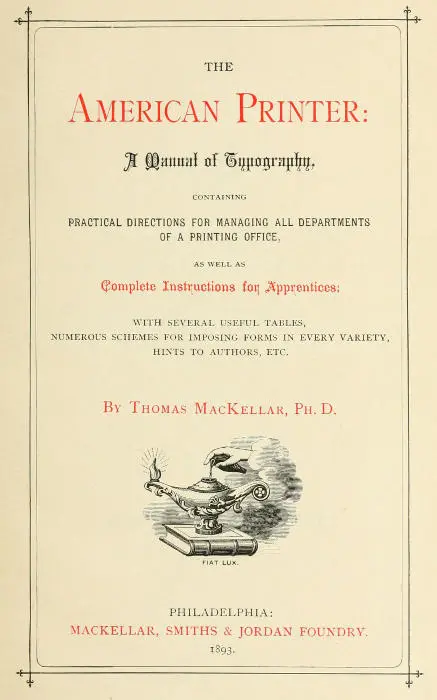
"The American Printer: A Manual of Typography" by Thomas MacKellar is a manual focused on the art and craft of typography, likely written in the late 19th century. This comprehensive guide serves not only as a resource for printers and publishing professionals but also provides historical context for the development of printing techniques and technologies. It encompasses practical directions for managing various departments of a printing office, along with useful instructions for apprentices. The opening of the manual establishes its purpose and utilizes a preface to set the tone for the comprehensive coverage of the printing profession. It outlines the book's intent to provide practical information based on personal experience and industry best practices while referencing a variety of typographical works. The text begins with a historical overview of the discovery of printing, mentioning notable figures such as Laurentius Koster and Johannes Gutenberg, and it lays the groundwork for understanding the evolution of printing methods. This context aims to equip readers with essential knowledge regarding the art of typography and the operations of printing offices, making the manual valuable for authors, publishers, and aspiring printers.
Introduction adapted from the source catalogue; source summaries may be automatically generated.
Free to read · English · 108,321 words · No account needed
MAKE TIME FOR A GOOD BOOK
On by default. Untick to stop anonymous reading totals. Each page counts after 10 seconds in view. How this works.
Anonymous counting is on unless you have switched it off.
Au pied de la lettre.—Literally.
Au pis aller.—At the worst.
Au revoir.—Farewell.
Audi alteram partem.—Hear the other side.
Aura popularis.—The gale of popular favour.
Auri sacra fames.—The accursed thirst for gold.
Auter droit.—Another’s right
Auter foit.—Another time.
Auter vie.—Another’s life.
Aut vincere aut mori.—Victory or death.
Auto-da-fé, Auto-de-fe.—An act of faith; burning of
heretics.
Auxilium ab alto.—Help from on high.
Avant-coureur.—A forerunner.
Ave, Maria.—Hail, Mary.
Badinage.—Light or playful discourse.
Bagatelle.—A trifle.
Bas bleu.—A blue-stocking; a literary woman.
Basso-continuo.—Thorough bass.
Basso-relievo.—Figures in low relief.
Bateau.—A long light boat.
Beau-idéal.—A model of ideal perfection.
Beau monde.—The fashionable world.
Bel esprit.—A brilliant mind.
Bella-donna.—The deadly nightshade; fair lady.
Belles-lettres.—Polite literature.
Bellum internecinum.—A war of extermination.
Bellum lethale.—A deadly war.
Bene placito.—At pleasure. (Music.)
Benigno numine.—-By the favour of Providence.
Ben trovato.—Well found; an ingenious solution.
Billet-doux.—A love-letter.
Bis dat qui citò dat.—He gives twice who gives promptly.
Bis peccare in bello non licet.—To blunder twice is not
allowed in war.
Bis vincit, qui se vincit in victoriâ.—He conquers a second time, who controls himself in victory.
Bizarre.—Odd; fantastic.
Blasé.—Surfeited.
Bon gré mal gré.—Willing or unwilling.
Bon jour.—Good-day; good-morning.
Bon mot.—A witty saying; a jest; a quibble.
Bon soir.—Good-evening.
Bon ton.—High fashion; first-class society.
Bon vivant.—A high liver.
Bona fide.—In good faith.
Bon-bon.—A sweetmeat; confectionery.
Bonhomie.—Good-natured simplicity.
Bonis nocet quisquis pepercerit malis.—He hurts the good who
spares the bad.
Bonne bouche.—A delicious morsel.
Bonus.—An extra payment for a service rendered or a thing
received.
Boreas.—The north wind.
Boudoir.—A small private apartment.
Bourgeois.—A citizen of the trading class; a printing type.
Bourgeoisie.—The body of citizens.
Bravura.—A song of difficult execution.
Breveté.—Patented.
Brutum fulmen.—A harmless thunderbolt; unreasoning bluster.
Burletta.—A musical farce.
Cachet.—A seal.
Cacoethes.—A bad habit or custom.
Cacoethes carpendi.—A rage for finding fault.
Cacoethes loquendi.—An itch for speaking.
Cacoethes scribendi.—A passion for writing.
Cadenza.—The fall or modulation of the voice, in music.
Cæca est invidia.—Envy is blind.
Cætera desunt.—The remainder is wanting.
Cæteris paribus.—Other things being equal.
Calibre.—Capacity or compass; mental power; a term in gunnery.
Camera obscura.—A dark chamber used by artists.
Campus Martius.—The field of Mars; a place of military
exercise.
Canaille.—The rabble.
Candida Pax.—White-robed Peace.
Cantata.—A poem set to music.
Cantate Domino.—Sing to the Lord.
Cap-à-pie.—From head to foot.
Your reading position is saved on this browser. Take it to another device with a library code. Reading pages adapt to text, rather than matching a printed edition.
BEHIND THE BOOK
This eBook is for the use of anyone anywhere in the United States and most other parts of the world at no cost and with almost no restrictions whatsoever. You may copy it, give it away or re-use it under the terms of the Project Gutenberg License included with this eBook or online at www.gutenberg.org. If you are not located in the United States, you will have to check the laws of the country where you are located before using this eBook. Read the source licence.
The original source file, including credits and licence, is retained by this library. Request an original-format copy at no charge. Please include the book title and Project Gutenberg identifier #56817.
KEEP YOUR CURIOSITY GOING
Cécile Tormay

Moritz Busch
John L. Ransom
Frances Wright
Cécile Tormay

Mabel Potter Daggett