THE CLASSIC COLLECTION✦An outlaw’s diary: the CommuneCLASSIC FREE BOOKS
An outlaw’s diary: the Commune
Cécile Tormay
THE CLASSIC COLLECTION · 1866
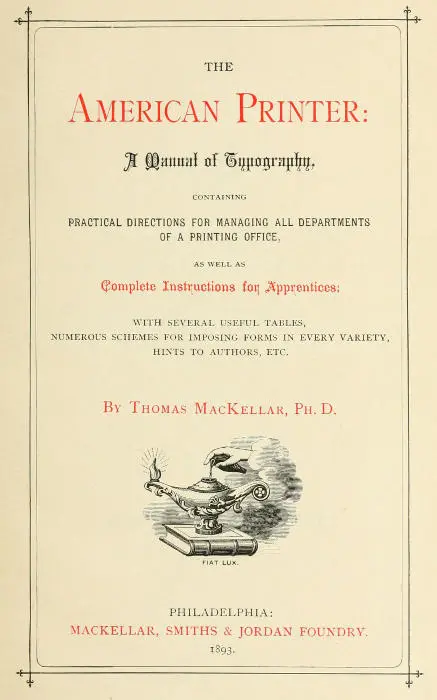
"The American Printer: A Manual of Typography" by Thomas MacKellar is a manual focused on the art and craft of typography, likely written in the late 19th century. This comprehensive guide serves not only as a resource for printers and publishing professionals but also provides historical context for the development of printing techniques and technologies. It encompasses practical directions for managing various departments of a printing office, along with useful instructions for apprentices. The opening of the manual establishes its purpose and utilizes a preface to set the tone for the comprehensive coverage of the printing profession. It outlines the book's intent to provide practical information based on personal experience and industry best practices while referencing a variety of typographical works. The text begins with a historical overview of the discovery of printing, mentioning notable figures such as Laurentius Koster and Johannes Gutenberg, and it lays the groundwork for understanding the evolution of printing methods. This context aims to equip readers with essential knowledge regarding the art of typography and the operations of printing offices, making the manual valuable for authors, publishers, and aspiring printers.
Introduction adapted from the source catalogue; source summaries may be automatically generated.
Free to read · English · 108,321 words · No account needed
MAKE TIME FOR A GOOD BOOK
On by default. Untick to stop anonymous reading totals. Each page counts after 10 seconds in view. How this works.
Anonymous counting is on unless you have switched it off.
Quarters.—Octavos and twelves are said to be imposed in quarters, not from their equal divisions, but because they are imposed and locked up in four parts.
Quarto, or 4to.—Four pages to a form.
Quire.—Twenty-four sheets of paper.
Quoins.—Small wedges for locking up a form.
Quotation furniture.—Quotations cast of various sizes in length and width, used for blanking and as furniture.
Quotations.—Large hollowed quadrates.
Rack.—Receptacle for cases.
Ratchet.—An instrument for turning the screws of stereotype
blocks.
Ratting.—Working at less than the established prices.
Ream.—Twenty quires of paper.
Recto.—Right-hand page.
References.—Letters or characters serving to direct the reader’s attention to notes at the foot of a page.
Register.—To cause the pages in a sheet to print precisely
back to back.
Register sheet.—The sheet used to make register.
Reglet.—Thin furniture, of an equal thickness all its length. It is made to match the depth of type.
Reiteration.—The form printed on the second side.
Revise.—The last proof of a form before working it off.
Riding.—One colour falling on another. Type at the end of a line catching against a lead.
Rise.—A form is said to rise when, in raising it from the correcting stone, no letters drop out.
Roller.—A wooden cylinder covered with composition, which,
set in an iron frame, revolves upon a rod, and is used for
inking type.
Rounce.—The handle for running in and out the carriage of a
hand-press.
Round pick.—A dot in a letter in a stereotype plate caused by
an air-bubble.
Running title.—The title of the book or subject placed at the
top of the pages.
Runs on sorts.— Requiring an inordinate proportion of
particular letters.
Saw-block.—A box similar to a carpenter’s mitre-block, to guide in cutting furniture, &c.
Schedule.—A sheet of paper passed with the make-up, containing folios, on which the compositor marks his name opposite to the pages set by him.
Set off.—When sheets that are newly worked off soil those that come in contact with them, they are said to set off.
Shank.—The metal body upon which the face of a letter stands.
Sheep’s-foot.—An iron hammer with a claw-end.
Sheetwise.—When the pages of a sheet are imposed in two forms, which are backed in printing.
Shooting-stick.—A wedge-shaped instrument for locking up a
form.
Short cross.—The short bar which, crossing the long bar, divides the chase into quarters.
Shoulder.—The surface of the shank of a type not covered by
the letter.
Side sorts.—Types in the side and upper boxes of a case, consisting of letters not frequently used.
Your reading position is saved on this browser. Take it to another device with a library code. Reading pages adapt to text, rather than matching a printed edition.
BEHIND THE BOOK
This eBook is for the use of anyone anywhere in the United States and most other parts of the world at no cost and with almost no restrictions whatsoever. You may copy it, give it away or re-use it under the terms of the Project Gutenberg License included with this eBook or online at www.gutenberg.org. If you are not located in the United States, you will have to check the laws of the country where you are located before using this eBook. Read the source licence.
The original source file, including credits and licence, is retained by this library. Request an original-format copy at no charge. Please include the book title and Project Gutenberg identifier #56817.
KEEP YOUR CURIOSITY GOING
Cécile Tormay

Moritz Busch
John L. Ransom
Frances Wright
Cécile Tormay

Mabel Potter Daggett