THE CLASSIC COLLECTION✦An outlaw’s diary: the CommuneCLASSIC FREE BOOKS
An outlaw’s diary: the Commune
Cécile Tormay
THE CLASSIC COLLECTION · 1866
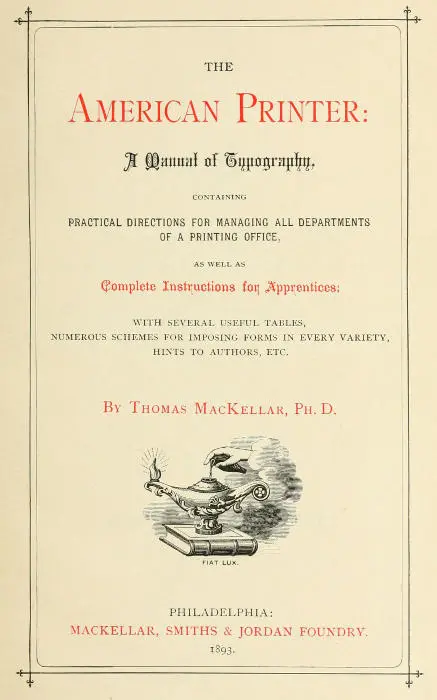
"The American Printer: A Manual of Typography" by Thomas MacKellar is a manual focused on the art and craft of typography, likely written in the late 19th century. This comprehensive guide serves not only as a resource for printers and publishing professionals but also provides historical context for the development of printing techniques and technologies. It encompasses practical directions for managing various departments of a printing office, along with useful instructions for apprentices. The opening of the manual establishes its purpose and utilizes a preface to set the tone for the comprehensive coverage of the printing profession. It outlines the book's intent to provide practical information based on personal experience and industry best practices while referencing a variety of typographical works. The text begins with a historical overview of the discovery of printing, mentioning notable figures such as Laurentius Koster and Johannes Gutenberg, and it lays the groundwork for understanding the evolution of printing methods. This context aims to equip readers with essential knowledge regarding the art of typography and the operations of printing offices, making the manual valuable for authors, publishers, and aspiring printers.
Introduction adapted from the source catalogue; source summaries may be automatically generated.
Free to read · English · 108,321 words · No account needed
MAKE TIME FOR A GOOD BOOK
On by default. Untick to stop anonymous reading totals. Each page counts after 10 seconds in view. How this works.
Anonymous counting is on unless you have switched it off.
Double.—Among compositors, repetition of words; among pressmen, a sheet that is twice pulled and mackled.
Dressing a chase or form.—Fitting the pages and chase with
furniture and quoins.
Drive out.—To space widely.
Duck’s-bill.—A tongue cut in a piece of stout paper and pasted on the tympan at the bottom of the tympan-sheet, to support the paper when laid on the tympan.
Duodecimo, or 12mo.—Twelve pages to a form.
Em.—The square of the body of a type.
En.—Half the dimensions of the preceding.
Even page.—The 2d, 4th, 6th, or any even-numbered page of a
book.
Fat.—Poetry and leaded matter.
Fat face, or Fat letter.—Broad stemmed letter.
Father of the chapel.—President or chairman of a composing-room or press-room chosen by the hands.
Feed guide.—An implement attached to a press to aid in
correct feeding.
Feeding.—Supplying the press with sheets.
First form.—The form first printed, which generally contains
the first page of a sheet.
Fly.—The person or apparatus that takes off the sheets from
the press.
Folio.—Two pages to a form.
Foot-sticks.—Sloping pieces of furniture placed at the bottom of pages, between which and the chase the quoins are driven to fasten the pages.
Form.—The pages when imposed in a chase.
Foul proof.—A proof with many faults marked in it.
Fount.—A complete assortment of type, of the same nick, body, and face, put up by type-founders in accordance with an ascertained ratio.
Fountain.—Reservoir for ink, attached to printing-presses.
Friar.—A light patch in a printed sheet, caused by defective
rolling.
Frisket.—An iron frame fastened by a hinge to the upper part of the tympan, to hold the sheet of paper fast as it goes in and comes from the press.
Fudge.—To contrive without proper materials.
Full press.—When two men work at the press with hand rollers.
Furniture.—Strips of wood or metal placed around and between pages to make the proper margin.
Galley.—A wooden or brass flat oblong tray, with side and head ledges, for holding type when composed.
Galley-slaves.—An ancient term of derision applied by
pressmen to compositors.
Gauge.—A strip of reglet with a notch in it, passed with the make-up, to denote the length of the pages.
Gauge-pin.—An instrument to aid in feeding job presses
correctly.
Get in.—To set close.
Good colour.—Sheets printed neither too black nor too light.
Guide.—A strip of metal frequently used to denote the last
line of copy set.
Gutter-sticks.—Furniture used in imposition to separate the
pages.
Half press.—When but one person works at the press.
Your reading position is saved on this browser. Take it to another device with a library code. Reading pages adapt to text, rather than matching a printed edition.
BEHIND THE BOOK
This eBook is for the use of anyone anywhere in the United States and most other parts of the world at no cost and with almost no restrictions whatsoever. You may copy it, give it away or re-use it under the terms of the Project Gutenberg License included with this eBook or online at www.gutenberg.org. If you are not located in the United States, you will have to check the laws of the country where you are located before using this eBook. Read the source licence.
The original source file, including credits and licence, is retained by this library. Request an original-format copy at no charge. Please include the book title and Project Gutenberg identifier #56817.
KEEP YOUR CURIOSITY GOING
Cécile Tormay

Moritz Busch
John L. Ransom
Frances Wright
Cécile Tormay

Mabel Potter Daggett