THE CLASSIC COLLECTION✦An outlaw’s diary: the CommuneCLASSIC FREE BOOKS
An outlaw’s diary: the Commune
Cécile Tormay
THE CLASSIC COLLECTION · 1866
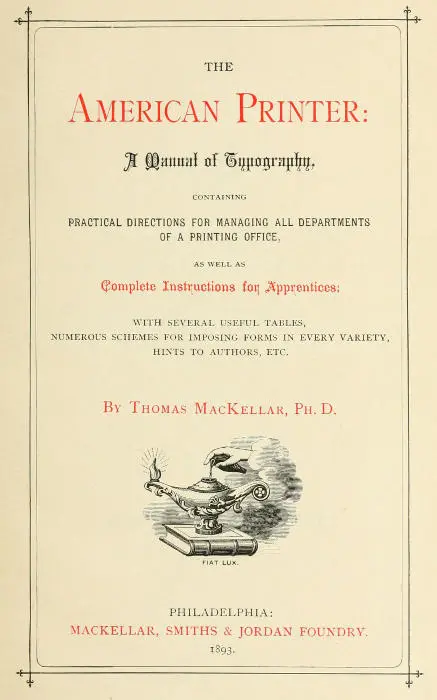
"The American Printer: A Manual of Typography" by Thomas MacKellar is a manual focused on the art and craft of typography, likely written in the late 19th century. This comprehensive guide serves not only as a resource for printers and publishing professionals but also provides historical context for the development of printing techniques and technologies. It encompasses practical directions for managing various departments of a printing office, along with useful instructions for apprentices. The opening of the manual establishes its purpose and utilizes a preface to set the tone for the comprehensive coverage of the printing profession. It outlines the book's intent to provide practical information based on personal experience and industry best practices while referencing a variety of typographical works. The text begins with a historical overview of the discovery of printing, mentioning notable figures such as Laurentius Koster and Johannes Gutenberg, and it lays the groundwork for understanding the evolution of printing methods. This context aims to equip readers with essential knowledge regarding the art of typography and the operations of printing offices, making the manual valuable for authors, publishers, and aspiring printers.
Introduction adapted from the source catalogue; source summaries may be automatically generated.
Free to read · English · 108,321 words · No account needed
MAKE TIME FOR A GOOD BOOK
On by default. Untick to stop anonymous reading totals. Each page counts after 10 seconds in view. How this works.
Anonymous counting is on unless you have switched it off.
rollic
rollicking
rollicked
traffic
trafficking
trafficked
trafficker
talc
talcky
zinc
zinckiferous
(zinciferous)
zincky
Words ending in a double letter preserve it double after a prefix or before a termination beginning with a different letter; as, op-press, mis-spell, in-thrall, oversee; see-ing, op-pressive, stiff-ness, woo-ed, still-ness, assess-ment.
Remark I.—Annul, until, twibil, and the conservative fulfil, or the Websterian fulfill, are the only exceptions to the first part of this rule extensively recognized by present usage. The conservative distil and instil are at variance; but the Websterian distill and instill, and also twibill, as written by Reid, are in harmony with the rule.
Remark II.—Pontific, and all other derivatives of pontiff, are exceptions to the latter part of this rule, unless an f is discarded in the primitive word, as Webster suggests and the derivation warrants. The derivatives of dull, full, skill, and will, are disputed exceptions: if spelled as Webster writes them, dullness, fullness, skillful, willful, they conform to the rule.
The plural is usually formed from the singular by adding s; as, brave, braves; night, nights; hymn, hymns.
Nouns ending in o preceded by a vowel accept of s in the plural; as, cameo, cameos; studio, studios.
agios
bagnios
bamboos
braggadocios
cameos
cuckoos
curculios
embryos
folios
imbroglios
intaglios
internuncios
koodoos
nuncios
olios
oratorios
pistachios
port-folios
punctilios
ratios
seraglios
solfeggios
studios
trios
Nouns ending in y preceded by a vowel accept of s in the plural; as, money, moneys; attorney, attorneys; valley, valleys.
Nouns ending in o preceded by a consonant usually accept of es in the plural; as, echo, echoes; embargo, embargoes.
Remark.—There are more than fifty words that conform to this rule, and about thirty that accept of s only.
archipelagoes
armadilloes
bilboes
bravadoes
bravoes
buffaloes
buffoes
calicoes
cargoes
desperadoes
echoes
embargoes
farragoes
frescoes
grottoes
gustoes
heroes
innuendoes
juntoes
lazarettoes
lingoes
lumbagoes
mangoes
manifestoes
mottoes
mulattoes
negroes
palmettoes
passadoes
peccadilloes
potatoes
prunelloes
punchinelloes
punctoes
ranchoes
recitativoes
relievoes
renegadoes
ritornelloes
rotundoes
stilettoes
supercargoes
testudoes
tomatoes
tornadoes
torpedoes
umboes
vetoes
violoncelloes
viragoes
volcanoes
zeroes
albinos
cantos
centos
dominos
duodecimos
halos
hidalgos
inamoratos
lassos
limbos
major-domos
mementos
merinos
mosquitos
octavos
pianos
porticos
provisos
quartos
rancheros
ridottos
rondos
salvos
set-tos
sirocos
solos
torsos
tyros
It would be well if all words ending in o were made to
conform to Rules XI. and XIII.
Nouns ending in ss, z, x, ch soft, and sh, accept of es in the plural; as, dress, dresses; buzz, buzzes; box, boxes; peach, peaches; dish, dishes.
Nouns ending in y after a consonant change y into ies in the plural; as, city, cities; daisy, daisies.
Your reading position is saved on this browser. Take it to another device with a library code. Reading pages adapt to text, rather than matching a printed edition.
BEHIND THE BOOK
This eBook is for the use of anyone anywhere in the United States and most other parts of the world at no cost and with almost no restrictions whatsoever. You may copy it, give it away or re-use it under the terms of the Project Gutenberg License included with this eBook or online at www.gutenberg.org. If you are not located in the United States, you will have to check the laws of the country where you are located before using this eBook. Read the source licence.
The original source file, including credits and licence, is retained by this library. Request an original-format copy at no charge. Please include the book title and Project Gutenberg identifier #56817.
KEEP YOUR CURIOSITY GOING
Cécile Tormay

Moritz Busch
John L. Ransom
Frances Wright
Cécile Tormay

Mabel Potter Daggett