THE CLASSIC COLLECTION✦An outlaw’s diary: the CommuneCLASSIC FREE BOOKS
An outlaw’s diary: the Commune
Cécile Tormay
THE CLASSIC COLLECTION · 1866
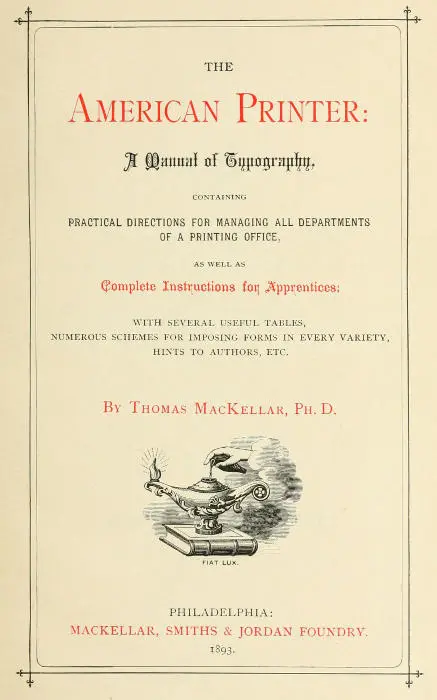
"The American Printer: A Manual of Typography" by Thomas MacKellar is a manual focused on the art and craft of typography, likely written in the late 19th century. This comprehensive guide serves not only as a resource for printers and publishing professionals but also provides historical context for the development of printing techniques and technologies. It encompasses practical directions for managing various departments of a printing office, along with useful instructions for apprentices. The opening of the manual establishes its purpose and utilizes a preface to set the tone for the comprehensive coverage of the printing profession. It outlines the book's intent to provide practical information based on personal experience and industry best practices while referencing a variety of typographical works. The text begins with a historical overview of the discovery of printing, mentioning notable figures such as Laurentius Koster and Johannes Gutenberg, and it lays the groundwork for understanding the evolution of printing methods. This context aims to equip readers with essential knowledge regarding the art of typography and the operations of printing offices, making the manual valuable for authors, publishers, and aspiring printers.
Introduction adapted from the source catalogue; source summaries may be automatically generated.
Free to read · English · 108,321 words · No account needed
MAKE TIME FOR A GOOD BOOK
On by default. Untick to stop anonymous reading totals. Each page counts after 10 seconds in view. How this works.
Anonymous counting is on unless you have switched it off.
When the sheets are taken out, the warehouseman knocks them up, and, after counting them into quires, ties them up in wrappers, marking the name of the work and signature on each bundle. Two or three sheets of each signature should be laid aside, in case the author, bookseller, or employer should want a copy of the work or a specimen of as many sheets as are finished.
(Furnished by A. G. Elliot & Co., Philadelphia.)
Medium inches, 19 × 24
Royal 20 × 25
Super Royal 21 × 27
Imperial 22 × 32
Royal and Half, 25 × 30
Double Medium 24 × 38
Imperial and Half 32 × 33
Double Super Royal 27 × 42
Double Imperial, 32 × 44.
Other sizes kept on hand, but without technical names, are as follows:—22 × 28; 24 × 36; 25 × 39; 26 × 40; 28 × 42.
Note inches, 8 × 10
Packet Note 9 × 11½
Letter 10 × 16
Commercial Post 11 × 17
Packet Post 11½ × 18½
Foolscap 13 × 16
Flat Cap 14 × 17
Crown 15 × 19
Demy 16 × 21
Folio 17 × 22
Medium 18 × 23
Royal 19 × 24
Super Royal 20 × 28
Imperial 23 × 31
Elephant 23 × 28
Columbier 23 × 34
Atlas 26 × 33
Double Elephant 27 × 40
Antiquarian 31 × 53
For ascertaining the Number of Forms for a Book of any Size, and the Quantity of Paper necessary to print a thousand copies in any form, from Octavo to 36mo, half-sheetwise.
+-------+------+------+------+------+------+------+------+-------------+ |NO. OF | | | | | | | | PAPER FOR | |FORMS. | 8vo. | 12mo.| 16mo.| 18mo.| 24mo.| 32mo.| 36mo.| 1000 COPIES.| +-------+------+------+------+------+------+------+------+-------------+ | |PAGES.|PAGES.|PAGES.|PAGES.|PAGES.|PAGES.|PAGES.| REAMS. QRS. | | 1 | 8 | 12 | 16 | 18 | 24 | 32 | 36 | 1 2 | | 2 | 16 | 24 | 32 | 36 | 48 | 64 | 72 | 2 4 | | 3 | 24 | 36 | 48 | 54 | 72 | 96 | 108 | 3 6 | | 4 | 32 | 48 | 64 | 72 | 96 | 128 | 144 | 4 8 | | 5 | 40 | 60 | 80 | 90 | 120 | 160 | 180 | 5 10 | | 6 | 48 | 72 | 96 | 108 | 144 | 192 | 216 | 6 12 | | 7 | 56 | 84 | 112 | 126 | 168 | 224 | 252 | 7 14 | | 8 | 64 | 96 | 128 | 144 | 192 | 256 | 288 | 8 16 | | 9 | 72 | 108 | 144 | 162 | 216 | 288 | 324 | 9 18 | | 10 | 80 | 120 | 160 | 180 | 240 | 320 | 360 | 11 | | 11 | 88 | 132 | 176 | 198 | 264 | 352 | 396 | 12 2 | | 12 | 96 | 144 | 192 | 216 | 288 | 384 | 432 | 13 4 | | 13 | 104 | 156 | 208 | 234 | 312 | 416 | 468 | 14 6 | | 14 | 112 | 168 | 224 | 252 | 336 | 448 | 504 | 15 8 | | 15 | 120 | 180 | 240 | 270 | 360 | 480 | ... | 16 10 | | 16 | 128 | 192 | 256 | 288 | 384 | 512 | ... | 17 12 | | 17 | 136 | 204 | 272 | 306 | 408 | ... | ... | 18 14 | | 18 | 144 | 216 | 288 | 324 | 432 | ... | ... | 19 16 | | 19 | 152 | 228 | 304 | 342 | 456 | ... | ... | 20 18 | | 20 | 160 | 240 | 320 | 360 | 480 | ... | ... | 22 | | 21 | 168 | 252 | 336 | 378 | 504 | ... | ... | 23 2 | | 22 | 176 | 264 | 352 | 396 | ... | ... | ... | 24 4 | | 23 | 184 | 276 | 368 | 414 | ... | ... | ... | 25 6 | | 24 | 192 | 288 | 384 | 432 | ... | ... | ... | 26 8 | | 25 | 200 | 300 | 400 | 450 | ... | ... | ... | 27 10 | | 26 | 208 | 312 | 416 | 468 | ... | ... | ... | 28 12 | | 27 | 216 | 324 | 432 | 486 | ... | ... | ... | 29 14 | | 28 | 224 | 336 | 448 | 504 | ... | ... | ... | 30 16 | | 29 | 232 | 348 | 464 | ... | ... | ... | ... | 31 18 | | 30 | 240 | 360 | 480 | ... | ... | ... | ... | 33 | | 31 | 248 | 372 | 496 | ... | ... | ... | ... | 34 2 | | 32 | 256 | 384 | 512 | ... | ... | ... | ... | 35 4 | | 33 | 264 | 396 | 528 | ... | ... | ... | ... | 36 6 | | 34 | 272 | 408 | 544 | ... | ... | ... | ... | 37 8 | | 35 | 280 | 420 | 560 | ... | ... | ... | ... | 38 10 | | 36 | 288 | 432 | 576 | ... | ... | ... | ... | 39 12 | | 37 | 296 | 444 | 592 | ... | ... | ... | ... | 40 14 | | 38 | 304 | 456 | 608 | ... | ... | ... | ... | 41 16 | | 39 | 312 | 468 | ... | ... | ... | ... | ... | 42 18 | | 40 | 320 | 480 | ... | ... | ... | ... | ... | 44 | +-------+------+------+------+------+------+------+------+-------------+
EXAMPLE.—How many reams will be required for a 12mo book containing 408 pages? Find the number of pages (408) in the 12mo column: in the outer column on the left of the table the number of forms is seen, and in the outer column on the right the quantity of paper required is given.
There is no department in the art that is better provided with means for its efficient prosecution than job printing. It is true that an establishment fully provided with all the old and new conveniences will involve a very considerable outlay; yet a beginner in a small way, who has to count the cost carefully, may avail himself of many facilities which were unknown a score of years ago. The smaller the capital, the more need for the exercise of a wise discretion in the selection of material. Regard should be had to the special line of work to be undertaken, and the type and presses adapted to that line should be selected. If the master himself shall work with head and hand, perseveringly and early and late, and shall do good work at fair prices—never cutting-under to secure a job at non-paying rates,—and shall be obliging in manner and punctual in delivery, and shall waste no dimes in drink or other useless expenses, the growth of his business will be only a matter of time; and he will gradually be able to order just what that growth necessitates, until he shall find himself the proprietor of a well-appointed office and a paying business. In his first outlay and in all his additions, the best of every kind should be gotten, if possible, as cheap things always prove dear.
Your reading position is saved on this browser. Take it to another device with a library code. Reading pages adapt to text, rather than matching a printed edition.
BEHIND THE BOOK
This eBook is for the use of anyone anywhere in the United States and most other parts of the world at no cost and with almost no restrictions whatsoever. You may copy it, give it away or re-use it under the terms of the Project Gutenberg License included with this eBook or online at www.gutenberg.org. If you are not located in the United States, you will have to check the laws of the country where you are located before using this eBook. Read the source licence.
The original source file, including credits and licence, is retained by this library. Request an original-format copy at no charge. Please include the book title and Project Gutenberg identifier #56817.
KEEP YOUR CURIOSITY GOING
Cécile Tormay

Moritz Busch
John L. Ransom
Frances Wright
Cécile Tormay

Mabel Potter Daggett