THE CLASSIC COLLECTION✦An outlaw’s diary: the CommuneCLASSIC FREE BOOKS
An outlaw’s diary: the Commune
Cécile Tormay
THE CLASSIC COLLECTION · 1915
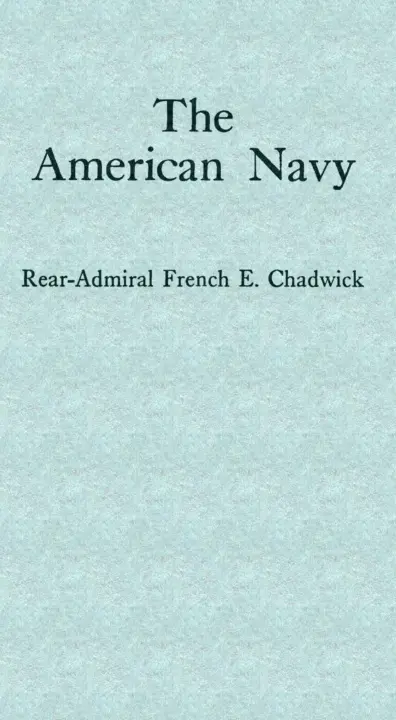
"The American Navy" by Rear-Admiral French Ensor Chadwick is a historical account written in the early 20th century. The work delves into the development and significance of the U.S. Navy, particularly during the American Revolutionary War. The book likely explores the naval battles, strategies, and innovations that shaped the early years of American naval power and examines the contributions of key figures like George Washington and John Paul Jones. The opening of this work sets the stage for a detailed exploration of the early American naval capabilities against the British Empire. It outlines the historical context in which the American colonies evolved a maritime tradition that would play a crucial role in their pursuit of independence. Chadwick discusses the shipbuilding practices in New England and how the colonies adapted to British maritime laws to strengthen their own naval forces, culminating in the creation of the Continental Navy. The text introduces pivotal events leading to the Revolution, establishing a robust framework for understanding the evolution of naval warfare and its impact on the outcome of American independence.
Introduction adapted from the source catalogue; source summaries may be automatically generated.
Free to read · English · 55,721 words · No account needed
MAKE TIME FOR A GOOD BOOK
On by default. Untick to stop anonymous reading totals. Each page counts after 10 seconds in view. How this works.
Anonymous counting is on unless you have switched it off.
[31] The British accounts were often so inaccurate and garbled, and in James’s “Naval History” so frequently glaringly untrue that only little dependence, in some instances, can be placed upon them. For a discussion of this phase, see Roosevelt’s “Naval War of 1812” passim. Part of this account is condensed from this latter.
[32] Roosevelt, 129.
[33] Cited by McMaster, “History of the United States,” IV, 901.
[34] Roosevelt, 178.
[35] Roosevelt, 187.
[36] Condensed from McMaster, IV, 33.
[37] “The Croker Papers,” I, 44.
[38] Roosevelt, 71, where a careful analysis of several pages is given
to this subject.
[39] “The Public Life of Sir George Prevost,” 136, quoted by Mahan, 362.
[40] Report in Canadian Archives, 1896, Lower Canada, p. 31. For some mortifying details in this subject see Mahan, “The War of 1812,” 363-365.
[41] The most complete account of this battle and events connected with it is in Mahan, 377-381, largely drawn on in this account.
[42] Instructions to Peace Commissioners, August 14, 1814.
[43] For a complete account see Mahan, “War of 1812,” II, 391, 396.
[44] Quoted by Maclay, “History of the Navy,” II, 82.
[45] Quoted by Soley, “Admiral Porter,” 41.
[46] Not so young, however, as was, when appointed midshipman, an admiral under whom the author served in 1865, S. W. Godon. He told me that he was appointed at so early an age that for some years he was taken by a servant on quarter day to the navy yard to draw his pay.
[47] Spears, 112.
[48] Chadwick, “The Causes of the Civil War,” American Nation Series,
Vol. XIX, 124, 125.
[49] Spears, “Farragut,” 159, 160.
[50] The inventor of the revolving turret was Mr. T. R. Timby, who took out a patent in 1841 and received a royalty of $5,000 for each turret built by Ericsson.
[51] Spears, 152.
[52] Cable, Century Magazine, April, 1885, p. 922.
[53] Spears, 166.
[54] See Long, “Our New Navy,” Chadwick, “Relations of the United States and Spain,” I, “Diplomacy,” II and III. “The Spanish War.”
[55] By standing close in and going aloft, the usual anchorage in the bay is visible. (Commander Dayton’s report, “Report of Bureau of Navigation,” 1898, 219.)
Italicized text is surrounded by underscores: italics.
Obvious typographical errors have been corrected.
Inconsistencies in hyphenation have been standardized.
Your reading position is saved on this browser. Take it to another device with a library code. Reading pages adapt to text, rather than matching a printed edition.
BEHIND THE BOOK
This eBook is for the use of anyone anywhere in the United States and most other parts of the world at no cost and with almost no restrictions whatsoever. You may copy it, give it away or re-use it under the terms of the Project Gutenberg License included with this eBook or online at www.gutenberg.org. If you are not located in the United States, you will have to check the laws of the country where you are located before using this eBook. Read the source licence.
The original source file, including credits and licence, is retained by this library. Request an original-format copy at no charge. Please include the book title and Project Gutenberg identifier #67270.
KEEP YOUR CURIOSITY GOING
Cécile Tormay

Moritz Busch
John L. Ransom
Frances Wright
Cécile Tormay

Mabel Potter Daggett