
Europe and elsewhere
Mark Twain
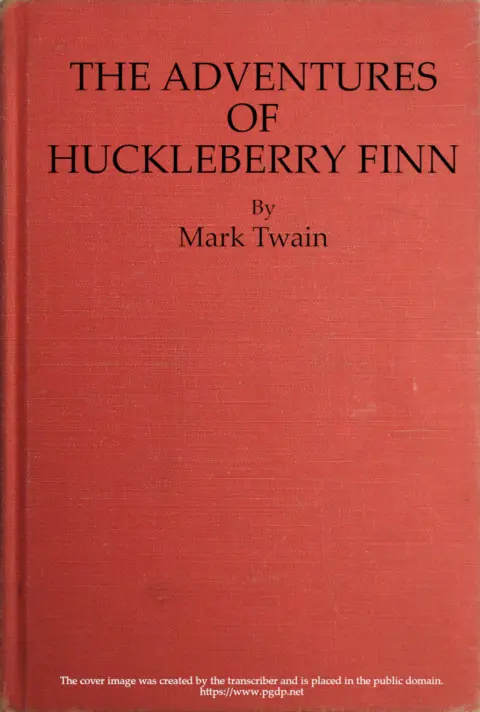
THE CLASSIC COLLECTION · 1884
"The Adventures of Huckleberry Finn (Tom Sawyer's Comrade)" by Mark Twain is a novel first published in 1884-1885. Young Huck Finn escapes his abusive father and flees down the Mississippi River with Jim, an enslaved man seeking freedom. Their journey brings dangerous encounters with con artists, feuding families, and moral dilemmas that force Huck to question society's values. Told in vernacular English, this groundbreaking work satirizes racism and captures both the adventure of boyhood and the complexities of conscience in antebellum America.
Introduction adapted from the source catalogue; source summaries may be automatically generated.
Free to read · English · 115,932 words · No account needed
MAKE TIME FOR A GOOD BOOK
On by default. Untick to stop anonymous reading totals. Each page counts after 10 seconds in view. How this works.
Anonymous counting is on unless you have switched it off.
“You better a blame’ sight give yourself a good cussing, for you’re the one that’s entitled to it most. You hain’t done a thing from the start that had any sense in it, except coming out so cool and cheeky with that imaginary blue-arrow mark. That was bright—it was right down bully; and it was the thing that saved us. For if it hadn’t been for that they’d ’a’ jailed us till them Englishmen’s baggage come—and then—the penitentiary, you bet! But that trick took ’em to the graveyard, and the gold done us a still bigger kindness; for if the excited fools hadn’t let go all holts and made that rush to get a look we’d ’a’ slept in our cravats to-night—cravats warranted to wear, too—longer than we’d need ’em.”
They was still a minute—thinking; then the king says, kind of
absent-minded like:
“Mf! And we reckoned the niggers stole it!”
That made me squirm!
“Yes,” says the duke, kinder slow and deliberate and sarcastic, “we
did.”
After about a half a minute the king drawls out:
“Leastways, I did.”
The duke says, the same way:
“On the contrary, I did.”
The king kind of ruffles up, and says:
“Looky here, Bilgewater, what’r you referrin’ to?” The duke says,
pretty brisk:
“When it comes to that, maybe you’ll let me ask what was you
referring to?”
“Shucks!” says the king, very sarcastic; “but I don’t know—maybe you was asleep, and didn’t know what you was about.”
The duke bristles up now, and says:
“Oh, let up on this cussed nonsense; do you take me for a blame’ fool? Don’t you reckon I know who hid that money in that coffin?”
“Yes, sir! I know you do know, because you done it yourself!”
“It’s a lie!”—and the duke went for him. The king sings out:
“Take y’r hands off!—leggo my throat!—I take it all back!”
The duke says:
“Well, you just own up, first, that you did hide that money there, intending to give me the slip one of these days, and come back and dig it up, and have it all to yourself.”
“Wait jest a minute, duke—answer me this one question, honest and fair; if you didn’t put the money there, say it, and I’ll b’lieve you, and take back everything I said.”
“You old scoundrel, I didn’t, and you know I didn’t. There, now!”
Your reading position is saved on this browser. Take it to another device with a library code. Reading pages adapt to text, rather than matching a printed edition.
BEHIND THE BOOK
This eBook is for the use of anyone anywhere in the United States and most other parts of the world at no cost and with almost no restrictions whatsoever. You may copy it, give it away or re-use it under the terms of the Project Gutenberg License included with this eBook or online at www.gutenberg.org. If you are not located in the United States, you will have to check the laws of the country where you are located before using this eBook. Read the source licence.
The original source file, including credits and licence, is retained by this library. Request an original-format copy at no charge. Please include the book title and Project Gutenberg identifier #32325.
KEEP YOUR CURIOSITY GOING
Coulson Kernahan

Maurice Baring
Frances Wright
Cécile Tormay

Frederic Jesup Stimson

W. H. P. (William Henry Pope) Jarvis


