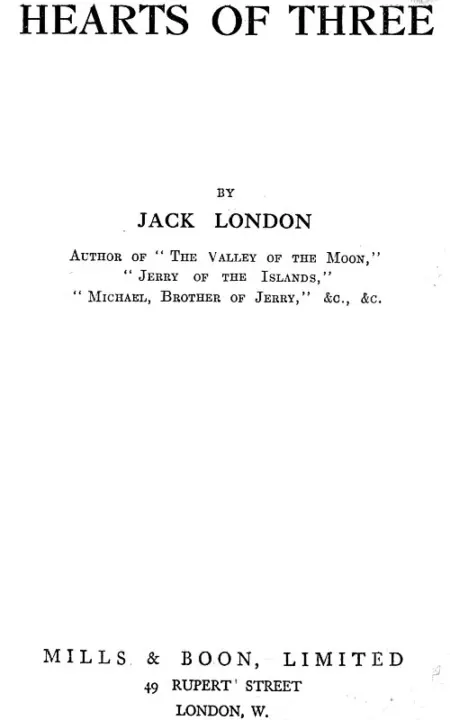
Hearts of three
Jack London
THE CLASSIC COLLECTION · 1916
"The Acorn-Planter" by Jack London is a dramatic play written in the early 20th century, specifically in 1916. This work is categorized as a California forest play, which uses lyrical elements and characters from Native American cultures to explore themes of life, kindness, and the consequences of violence. The play reflects on the nature of humanity and the importance of planting seeds—both literally and metaphorically—while contrasting the philosophies of war and peace. The storyline revolves around Red Cloud, the first man of the Nishinam tribe, who advocates for the ways of the acorn-planter, emphasizing the importance of nurturing life over engaging in conflict. As the narrative unfolds through different time periods, Red Cloud's ideals clash with those of the War Chief, who favors aggression. When a group of European explorers, the "Sun Men," arrives, they are initially met with hostility, resulting in tragedy and death. Ultimately, the themes converge on the necessity for brotherhood and kindness among all people, culminating in a hope for a new day characterized by planting seeds of life rather than death, where all humanity could coexist harmoniously. The play poignantly illustrates the cyclical nature of violence and the eternal struggle between the drive for survival through war and the gentler path of cultivation and peace.
Introduction adapted from the source catalogue; source summaries may be automatically generated.
Free to read · English · 9,624 words · No account needed
MAKE TIME FOR A GOOD BOOK
On by default. Untick to stop anonymous reading totals. Each page counts after 10 seconds in view. How this works.
Anonymous counting is on unless you have switched it off.
{Sun Man}
(Who alone carries a musket, and who is
evidently captain of the wrecked company)
No farther can we go this night. Mayhap
to-morrow we may find the savages and food.
(He glances about.)
This far world grows noble trees. We shall sleep
as in a temple.
{First Sea Cuny}
(Espying Red Cloud, and pointing.)
Look, Captain!
{Sun Man}
(Making the universal peace-sign, arm
raised and out, palm-outward.)
Who are you? Speak. We come in peace.
We kindness seek.
{Red Cloud}
(Advancing out of the shadow.)
Whence do you come?
{Sun Man}
From the great sea.
{Red Cloud}
I do not understand. No one journeys
on the great sea.
{Sun Man}
We have journeyed many moons.
{Red Cloud}
Have you come from the sun?
{Sun Man}
God wot! We have journeyed across the
sun, high and low in the sky, and over the sun
and under the sun the round world 'round.
{Red Cloud}
(With conviction.)
You come from the Sun. Your hair is like
the summer sunburnt grasses. Your eyes are
blue. Your skin is white.
(With absolute conviction.)
You are the Sun Man.
{Sun Man}
(With a shrug of shoulders.)
Have it so. I come from the Sun. I am the
Sun Man.
{Red Cloud}
Do you carry the thunder in your hand?
{Sun Man}
(Nonplussed for the moment, glances at
his musket, then smiles.)
Yes, I carry the thunder in my hand.
(War Chief and the Hunters leap
suddenly from ambush. Sun Man
warns Sea Cunies not to resist. War
Chief captures and holds Sun Man,
and Sea Cunies are similarly captured
and held. Women and boys appear, and
examine prisoners curiously.)
{War Chief}
Hoh! Hoh! Hoh! I have captured the
Sun Man! Like the foxes, I have captured
the Sun Man!--Deer Foot! Elk Man! The
foxes held the Sun Man. I now hold the Sun
Man. Then can you hold the Sun Man.
(Deer Foot and Elk Man seize the Sun
Man.)
{Red Cloud}
(To Shaman.)
He said he came in kindness.
{War Chief}
(Sneering.)
In kindness, with the thunder in his hand.
{Shaman}
(Deflected to partisanship of War Chief
by War Chief's success.)
By his own lips has he said it, with the thunder
in his hand.
{War Chief}
You are the Sun Man.
{Sun Man}
(Shrugging shoulders.)
My names are many as the stars. Call me
White Man.
{Red Cloud}
I am Red Cloud, the first man.
{Sun Man}
Then am I Adam, the first man and your
brother.
(Glancing about.)
And this is Eden, to look upon it.
{Red Cloud}
My father was the Coyote.
{Sun Man}
My father was Jehovah.
Your reading position is saved on this browser. Take it to another device with a library code. Reading pages adapt to text, rather than matching a printed edition.
Jack London
Jack London
Jack London
Jack London
BEHIND THE BOOK
This eBook is for the use of anyone anywhere in the United States and most other parts of the world at no cost and with almost no restrictions whatsoever. You may copy it, give it away or re-use it under the terms of the Project Gutenberg License included with this eBook or online at www.gutenberg.org. If you are not located in the United States, you will have to check the laws of the country where you are located before using this eBook. Read the source licence.
The original source file, including credits and licence, is retained by this library. Request an original-format copy at no charge. Please include the book title and Project Gutenberg identifier #22104.
KEEP YOUR CURIOSITY GOING
Maurice Baring
W. B. (William Butler) Yeats
Edward Martyn

John Brougham & Charlotte Brontë
Marguerite Merington
Leonid Andreyev