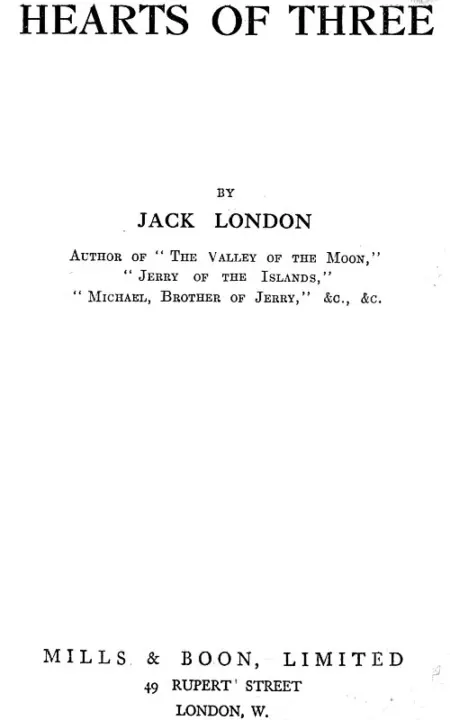
Hearts of three
Jack London
THE CLASSIC COLLECTION · 1916
"The Acorn-Planter" by Jack London is a dramatic play written in the early 20th century, specifically in 1916. This work is categorized as a California forest play, which uses lyrical elements and characters from Native American cultures to explore themes of life, kindness, and the consequences of violence. The play reflects on the nature of humanity and the importance of planting seeds—both literally and metaphorically—while contrasting the philosophies of war and peace. The storyline revolves around Red Cloud, the first man of the Nishinam tribe, who advocates for the ways of the acorn-planter, emphasizing the importance of nurturing life over engaging in conflict. As the narrative unfolds through different time periods, Red Cloud's ideals clash with those of the War Chief, who favors aggression. When a group of European explorers, the "Sun Men," arrives, they are initially met with hostility, resulting in tragedy and death. Ultimately, the themes converge on the necessity for brotherhood and kindness among all people, culminating in a hope for a new day characterized by planting seeds of life rather than death, where all humanity could coexist harmoniously. The play poignantly illustrates the cyclical nature of violence and the eternal struggle between the drive for survival through war and the gentler path of cultivation and peace.
Introduction adapted from the source catalogue; source summaries may be automatically generated.
Free to read · English · 9,624 words · No account needed
MAKE TIME FOR A GOOD BOOK
On by default. Untick to stop anonymous reading totals. Each page counts after 10 seconds in view. How this works.
Anonymous counting is on unless you have switched it off.
(Ten thousand years have passed, and it is
the time of the early voyaging from Europe
to the waters of the Pacific, when the
deserted hillside is again revealed as the
moon rises. The stream no longer flows
from the spring. Since the grove is used
only as a camp for the night when the
Nishinam are on their seasonal migration
there are no signs of previous camps.)
(Enter from right, at end of day's march,
women, old men, and Shaman, the
women bending under their burdens of
camp gear and dunnage)
(Enter from left youths carrying fish-spears
and large fish)
(Appear, coming down the hillside, Red
Cloud and the hunters, many carrying
meat.)
(The various repeated characters, despite
differences of skin garmenting and decoration,
resemble their prototypes of the prologue.)
{Red Cloud}
Good hunting! Good hunting!
{Hunters}
Good hunting! Good hunting!
{Youths}
Good fishing! Good fishing!
{Women}
Good berries! Good acorns!
(The women and youths and hunters, as they
reach the campsite, begin throwing down
their burdens)
{Dew-Woman}
(Discovering the dry spring.)
The water no longer flows!
{Shaman}
(Stilling the excitement that is immediate
on the discovery.)
The word of old time that has come down to
us from all the Shamans who have gone before!
The Sun Man has come back from the Sun.
{Dew-Woman}
(Looking to Red Cloud.)
Let Red Cloud speak. Since the morning of
the world has Red Cloud ever been reborn with
the ancient wisdom to guide us.
{War Chief}
Save in war. In war I command.
(He picks out hunters by name.)
Deer Foot... Elk Man... Antelope. Run
through the forest, climb the hill-tops, seek down
the valleys, for aught you may find of this Sun Man.
(At a wave of the War Chief's hand the
three hunters depart in different directions.)
{Dew-Woman}
Let Red Cloud speak his mind.
{Red Cloud}
(Quietly)
Last night the earth shook and there was a
roaring in the air. Often have I seen, when the
earth shakes and there is a roaring, that springs
in some places dry up, and that in other places
where were no springs, springs burst forth.
{Shaman}
There is a sign.
The Shamans told it of old.
The Sun Man will bear the thunder in his hand.
{People}
There is a sign.
The Sun Man will bear the thunder in his hand.
{Shaman}
The roaring in the air was the thunder of the
Sun Man's return. Now will he destroy the
Nishinam. Such is the word.
{War Chief}
Hoh! Hoh!
(From right Deer Foot runs in.)
{Deer Foot}
(Breathless.)
They come! He comes!
{War Chief}
Who comes?
Your reading position is saved on this browser. Take it to another device with a library code. Reading pages adapt to text, rather than matching a printed edition.
Jack London
Jack London
Jack London
Jack London
BEHIND THE BOOK
This eBook is for the use of anyone anywhere in the United States and most other parts of the world at no cost and with almost no restrictions whatsoever. You may copy it, give it away or re-use it under the terms of the Project Gutenberg License included with this eBook or online at www.gutenberg.org. If you are not located in the United States, you will have to check the laws of the country where you are located before using this eBook. Read the source licence.
The original source file, including credits and licence, is retained by this library. Request an original-format copy at no charge. Please include the book title and Project Gutenberg identifier #22104.
KEEP YOUR CURIOSITY GOING
Maurice Baring
W. B. (William Butler) Yeats
Edward Martyn

John Brougham & Charlotte Brontë
Marguerite Merington
Leonid Andreyev