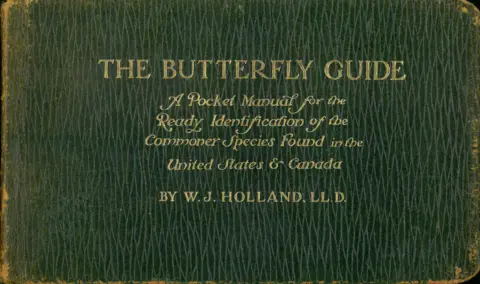
The butterfly guide
W. J. (William Jacob) Holland
THE CLASSIC COLLECTION · 1891
"Taxidermy and Zoological Collecting" by William T. Hornaday and W. J. Holland is a comprehensive handbook on taxidermy and specimen collection written in the late 19th century. The work is aimed at amateur taxidermists, zoological collectors, sportsmen, and naturalists, detailing techniques and methodologies for preserving animal specimens and building zoological collections. The authors emphasize the importance of collecting while species are still abundant, given the alarming rate of wildlife extinction occurring during their time. The opening of the book sets the tone for its instructional content, outlining the urgent need for skilled collectors in light of the rapid decline of various animal species. Hornaday expresses a deep affection for the natural world, highlighting the responsibility of collectors to act ethically and efficiently in capturing specimens. He details the inherent challenges of the task and stresses the necessity of expertise in both collecting and the subsequent preservation of specimens. Whether addressing the need for proper fieldwork or the intricacies of taxidermy, the beginning encourages aspiring collectors to be diligent and informed in a pursuit that is increasingly critical for the preservation of zoological diversity.
Introduction adapted from the source catalogue; source summaries may be automatically generated.
Free to read · English · 129,436 words · No account needed
MAKE TIME FOR A GOOD BOOK
On by default. Untick to stop anonymous reading totals. Each page counts after 10 seconds in view. How this works.
Anonymous counting is on unless you have switched it off.
The next step after the capture of the specimens is to prepare them either for transportation or for the cabinet. If collecting upon a journey, or where facilities for the preparation of specimens for the cabinet are lacking, the insects may be preserved in papers. Common druggists' envelopes are a very convenient resource for the preservation of lepidoptera. They may be purchased by the thousand at about sixty-five cents. If these cannot be had, envelopes may easily be made from pieces of paper, preferably stiff newspaper or common writing-paper upon which ink has not been used. The manner of folding these is illustrated by Figures 94 and 95. Care should be taken to write upon the envelope, before the insect is placed in it, the date and the locality of capture. Beetles, if black and devoid of hairy vestiture, may be preserved in alcohol, and the same course may be taken with many insects of other orders. It is preferable, however, to pack beetles and other hard-bodied insects in layers of cotton batting. A small box may be made to contain an immense number of insects in envelopes or in cotton, and they may thus be safely transported anywhere. In case alcohol is used as a preservative all the specimens of a species should be sorted out and tied together in a small sack made out of thin netting, and to this should be attached a label giving the date and place of capture and a reference to the note-book. In case cotton layers are employed all the specimens of a species, if numerous, should be placed in one layer, and a memorandum to the same purport as the label inserted.
Insects are prepared for the cabinet by being mounted upon pins and "expanded." There are various sorts and sizes of insect-pins, but those made by Klaeger, of Berlin, are generally preferred at the present time by the leading entomologists of the world. The French pins and the so-called "Carlsbader pins" are too long and the points are too fine, and, therefore, too likely to be injured to make them desirable. The English pins are too short, and except in the case of very small insects, are not used by the best collectors. Insects should be mounted high upon the pin, i.e., in such a way that not more than one-fifth or at the most one-fourth of the pin shall be exposed above the body of the specimen. Dr. Staudinger, the celebrated lepidopterist of Germany, makes it his rule to mount all his specimens in such a way that the wings are elevated upon a plane one inch above the tip of the pin. The writer has had the greater part of his collection, of over fifty thousand specimens of lepidoptera, mounted at an average height of seven-eighths of an inch above the points of the pins. The "English method" of mounting low down, and only leaving enough of the pin exposed below to permit of fixing the specimens in the cork at the bottoms of the drawers of the cabinet, is rapidly passing out of vogue, even in England, and is giving place to the "Continental Method." Insect pins are of various sizes; adapted to the size of the insect which they are to carry. The most serviceable sizes and which will be proportioned to the majority of the insects which the collector is likely to take, are Klaeger's No. 3 and No. 5. For very large insects higher numbers may be employed, and for smaller insects lower numbers, though in the case of the latter it is perhaps better to use the short English pins and then to mount the specimens upon the bits of cork or pith which are themselves mounted upon the longer German pins. Such mounts are known as "double mounts" (see Fig. 96). The writer desires to utter a caution against the use of the common black insect-pins so often sold by dealers, and the sole stock in trade of one or two firms of opticians in this country. They are very liable to rust at the point and to bend, and are totally unsuited for use in humid, tropical, and semi-tropical climates, or for collections which are to be transported far over the seas. Beetles should always be pinned through the right elytron. Bugs should be pinned through the scutellum, as the small triangular piece between the elytra is called. All other insects should be pinned in the middle of the thorax, and care should always be taken to set the pins perpendicularly.
Your reading position is saved on this browser. Take it to another device with a library code. Reading pages adapt to text, rather than matching a printed edition.
W. J. (William Jacob) Holland
William T. (William Temple) Hornaday
William T. (William Temple) Hornaday
W. J. (William Jacob) Holland
BEHIND THE BOOK
This eBook is for the use of anyone anywhere in the United States and most other parts of the world at no cost and with almost no restrictions whatsoever. You may copy it, give it away or re-use it under the terms of the Project Gutenberg License included with this eBook or online at www.gutenberg.org. If you are not located in the United States, you will have to check the laws of the country where you are located before using this eBook. Read the source licence.
The original source file, including credits and licence, is retained by this library. Request an original-format copy at no charge. Please include the book title and Project Gutenberg identifier #40109.
KEEP YOUR CURIOSITY GOING

Charles G. (Charles Griffith) Ross
Hannah Webster Foster

Emily Lawless
Edwin Hamlin Carr

Charles De Lano Hine
Andrew Ure