
Playwrights on playmaking
Brander Matthews
THE CLASSIC COLLECTION · 1896
"Tales of Fantasy and Fact" by Brander Matthews is a collection of imaginative short stories written in the late 19th century. These tales blend elements of fantasy and reality, exploring themes of adventure and the peculiarities of human experience. The stories within are likely to feature intriguing characters and fantastical scenarios that challenge the boundaries of perception and understanding. At the start of the collection, the reader is introduced to a character aboard a mysterious vessel led by Captain Vanderdecken, also known as the Flying Dutchman. The protagonist finds himself engaged in a profound conversation with Vanderdecken, who muses about his extensive travels and the extraordinary sights he has seen. As they discuss various mythical lands and legendary figures, such as the Wandering Jew and Rip Van Winkle, the narrative delves into themes of time, memory, and the intersection of reality with mythic imagination. This opening section sets the stage for an enchanting exploration of whimsical geography and the nature of storytelling itself.
Introduction adapted from the source catalogue; source summaries may be automatically generated.
Free to read · English · 37,389 words · No account needed
MAKE TIME FOR A GOOD BOOK
On by default. Untick to stop anonymous reading totals. Each page counts after 10 seconds in view. How this works.
Anonymous counting is on unless you have switched it off.
The telegraph messenger looked again at the address on the envelope in his hand, and then scanned the house before which he was standing. It was an old-fashioned building of brick, two stories high, with an attic above; and it stood in an old-fashioned part of lower New York, not far from the East River. Over the wide archway there was a small weather-worn sign, "Ramapo Steel and Iron Works;" and over the smaller door alongside was a still smaller sign, "Whittier, Wheatcroft & Co."
When the messenger-boy had made out the name, he opened this smaller door and entered the long, narrow store. Its sides and walls were covered with bins and racks containing sample steel rails and iron beams, and coils of wire of various sizes. Down at the end of the store were desks where several clerks and book-keepers were at work.
As the messenger drew near, a red-headed office-boy blocked the passage, saying, somewhat aggressively, "Well?"
"Got a telegram for Whittier, Wheatcroft & Co.," the messenger explained, pugnaciously thrusting himself forward.
"In there!" the office-boy returned, jerking his thumb over his shoulder towards the extreme end of the building, an extension, roofed with glass and separated by a glass screen from the space where the clerks were at work.
The messenger pushed open the glazed door of this private office, a
bell jingled over his head, and the three occupants of the room looked
up.
"Whittier, Wheatcroft & Co.?" said the messenger, interrogatively, holding out the yellow envelope.
"Yes," responded Mr. Whittier, a tall, handsome old gentleman, taking the telegram. "You sign, Paul."
The youngest of the three, looking like his father, took the messenger's book, and, glancing at an old-fashioned clock which stood in the corner, he wrote the name of the firm and the hour of delivery. He was watching the messenger go out. His attention was suddenly called to subjects of more importance by a sharp exclamation from his father.
"Well, well, well," said the elder Whittier with his eyes fixed on the telegram he had just read. "This is very strange--very strange indeed!"
"What's strange?" asked the third occupant of the office, Mr.
Wheatcroft, a short, stout, irascible-looking man with a shock of
grizzly hair.
For all answer Mr. Whittier handed to Mr. Wheatcroft the thin slip of
paper.
No sooner had the junior partner read the paper than he seemed angrier
than was usual with him.
"Strange!" he cried. "I should think it was strange! confoundedly strange--and deuced unpleasant, too."
"May I see what it is that's so very strange?" asked Paul, picking up
the despatch.
Your reading position is saved on this browser. Take it to another device with a library code. Reading pages adapt to text, rather than matching a printed edition.
Brander Matthews
Brander Matthews
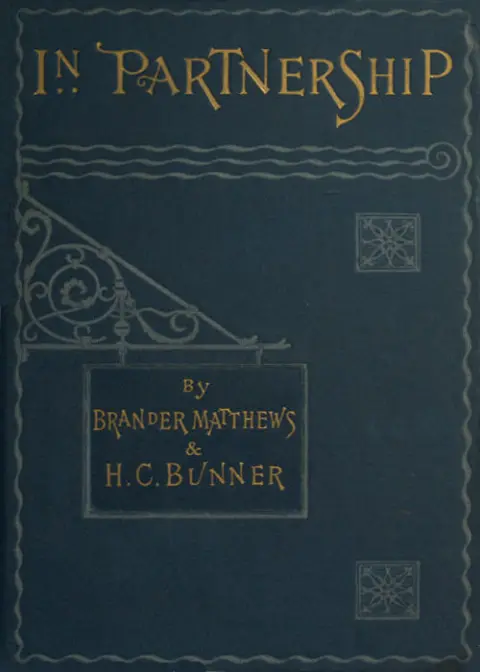
Brander Matthews & H. C. (Henry Cuyler) Bunner

Brander Matthews
BEHIND THE BOOK
This eBook is for the use of anyone anywhere in the United States and most other parts of the world at no cost and with almost no restrictions whatsoever. You may copy it, give it away or re-use it under the terms of the Project Gutenberg License included with this eBook or online at www.gutenberg.org. If you are not located in the United States, you will have to check the laws of the country where you are located before using this eBook. Read the source licence.
The original source file, including credits and licence, is retained by this library. Request an original-format copy at no charge. Please include the book title and Project Gutenberg identifier #23678.
KEEP YOUR CURIOSITY GOING
Coulson Kernahan

Maurice Baring
Frances Wright
Cécile Tormay
Francis Greenleaf Allinson & Anne C. E. (Anne Crosby Emery) Allinson

Frederic Jesup Stimson