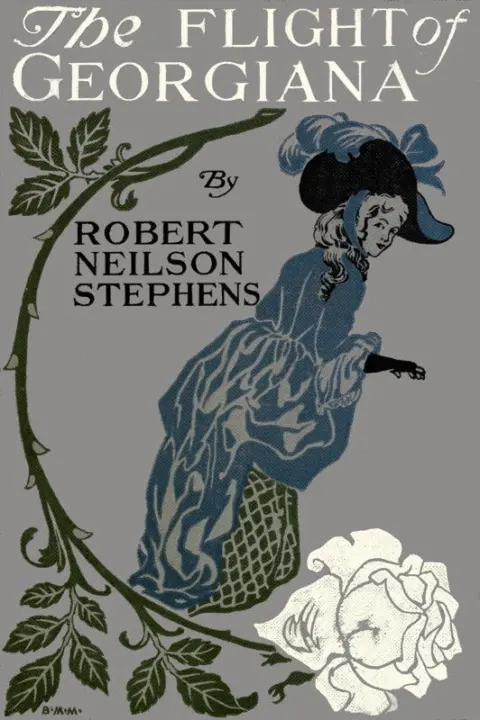
The Flight of Georgiana: A Story of Love and Peril in England in 1746
Robert Neilson Stephens
THE CLASSIC COLLECTION · 1908
"Tales from Bohemia" by Robert Neilson Stephens is a collection of short stories written in the late 19th century. The narratives explore the lives, struggles, and friendships of individuals within a close-knit community of aspiring writers and artists, primarily centered around Stephens himself and those he encountered in the literary world. This tapestry of stories captures the spirit of bohemian life, delving into themes of love, ambition, and the hardships of the creative process. The opening portion introduces readers to a pivotal friendship formed between the narrator and Robert Neilson Stephens, a young private secretary with literary aspirations. Their camaraderie develops against the backdrop of a newspaper office where they share their ambitions and thoughts on the literary scene of their time. As they engage in discussions about writers and artistic influences, the narrative hints at the tales to come, drawing on their experiences and the colorful personalities that populate their world. This engaging introduction sets the stage for a journey filled with humor, nostalgia, and the essence of artistic endeavor.
Introduction adapted from the source catalogue; source summaries may be automatically generated.
Free to read · English · 54,865 words · No account needed
MAKE TIME FOR A GOOD BOOK
On by default. Untick to stop anonymous reading totals. Each page counts after 10 seconds in view. How this works.
Anonymous counting is on unless you have switched it off.
Suppose that Ricketts, the marble-cutter, should fail to inscribe the date of his death in the space left vacant for it!
There was almost no likelihood of such an omission, but there was at
least a possibility of it.
He glanced across the cemetery to Jerry Hurley's unmarked mound, and
shuddered.
Then he thought laboriously.
When he left the cemetery in such time as to avoid a delay of his evening meal and a consequent outburst of anger on the part of his old housekeeper, he had taken a resolution.
“Threescore years and ten, says the Bible,” he muttered to himself as he walked homeward. “The scriptural lifetime'll do for me.”
A week thereafter old Tommy gazed proudly upon the finished inscription.
“Died November 11, 1890,” was the newest bit of biography there
engraved.
“But it's two years and more till November 11, 1890,” said a voice at
his side.
Tommy merely cast an indifferent look upon the speaker and walked off
without a word.
The whole village now thought that Tommy had become a monomaniac upon the subject of his tombstone. Perhaps he had. No one has been able to learn from his friend, Billy Skidmore, what thoughts he may have communicated to the latter upon the matter.
Tommy now lived for no other apparent purpose than to visit his tombstone daily. He no longer confined his walks thither to the pleasant days. He went in weather most perilous to so old and frail a man.
One of his prospective heirs took sufficient interest in him to advise
more care of his health.
“I can easily keep alive till the time comes,” returned the antique; “there's only a year left.”
Rapidly his hold upon life relaxed. A week before November 11, 1890, he went to bed and stayed there. People began to speculate as to whether his unique prediction--or I should say, his decree--would be fulfilled to the very day.
Upon the fifth day of his illness Death threatened to come before the time that had been set for receiving him.
“Isn't this the tenth?” the old man mumbled.
“No,” said his housekeeper, who with one of his nieces, the doctor, and Billy Skidmore, attended the ill man, “it's only the 9th.”
“Then I must fight for two days more; the tombstone must not lie.”
And he rallied so well that it seemed as if the tombstone would lie, nevertheless, for Tommy was still alive at eleven-thirty on the night of November 11. Moreover he had been in his senses when last awake, and there was every likelihood that he would look at the clock whenever his eyes should next open.
“He can't live till morning, that's sure,” said the doctor.
Your reading position is saved on this browser. Take it to another device with a library code. Reading pages adapt to text, rather than matching a printed edition.
Robert Neilson Stephens
Robert Neilson Stephens
Robert Neilson Stephens
Robert Neilson Stephens
BEHIND THE BOOK
This eBook is for the use of anyone anywhere in the United States and most other parts of the world at no cost and with almost no restrictions whatsoever. You may copy it, give it away or re-use it under the terms of the Project Gutenberg License included with this eBook or online at www.gutenberg.org. If you are not located in the United States, you will have to check the laws of the country where you are located before using this eBook. Read the source licence.
The original source file, including credits and licence, is retained by this library. Request an original-format copy at no charge. Please include the book title and Project Gutenberg identifier #8869.
KEEP YOUR CURIOSITY GOING
Coulson Kernahan

Maurice Baring
Frances Wright
Cécile Tormay

Frederic Jesup Stimson

W. H. P. (William Henry Pope) Jarvis