
Last letters from the living dead man
David Patterson (Spirit) Hatch
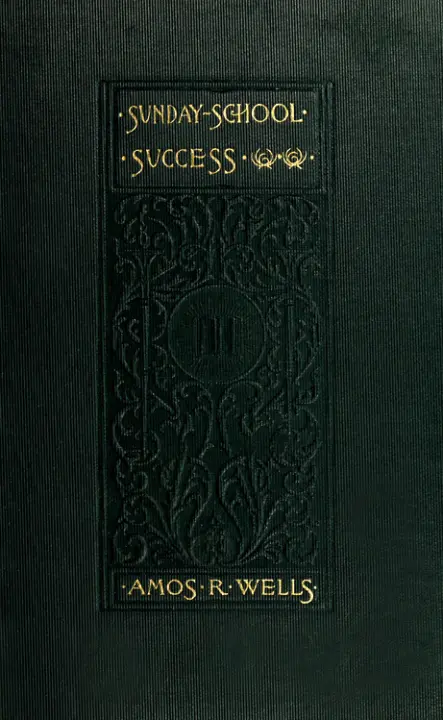
THE CLASSIC COLLECTION · 1897
"Sunday-School Success" by Amos R. Wells is a practical guidebook written in the late 19th century. It offers a collection of methods and insights aimed at Sunday-school teachers and officers, focusing on improving the effectiveness of their teaching and the overall Sunday-school experience. The book emphasizes learning through both successful strategies and the valuable lessons derived from failures, aiming to equip educators with the tools needed to inspire and teach with greater impact. The opening of the work introduces the author’s reflective vision of Sunday-school teachers he has known, depicted in a dreamlike procession, each adorned with symbolic crowns representing their teaching effectiveness. Wells distinguishes between different types of teachers—some who focus on eloquence or thoroughness, while others derive their crowns from the genuine love and care they demonstrate towards their students. In a narrative style, he sets the stage for a deeper exploration of the qualities and approaches required for successful Sunday-school teaching, ultimately prompting readers to consider what kind of "crown" they wish to achieve in their own teaching endeavors.
Introduction adapted from the source catalogue; source summaries may be automatically generated.
Free to read · English · 67,384 words · No account needed
MAKE TIME FOR A GOOD BOOK
On by default. Untick to stop anonymous reading totals. Each page counts after 10 seconds in view. How this works.
Anonymous counting is on unless you have switched it off.
The Lesson Committee often assigns us two or three lessons in a book, and from these few lessons the scholars must get some comprehensive knowledge of the entire book. A book study, therefore, will not be out of place in this series of suggestions to teachers, and I have chosen the Psalms, since they are likely to be most fruitful of hints as to the teaching of other books.
A systematic knowledge of the Psalms is rarely sought after. Only one book of the Bible is more loved: the Gospel of John; only one is read less methodically: the Book of Proverbs.
It is the fault of many teachers that they teach all books of the Bible in the same way. Prophecy, history, poetry, prose, Ruth and Revelation, John and Judges,--it is all one to them. The Psalms, like all other books of the Bible, are unique, and need their own especial mode of treatment. Here are some hints concerning this treatment.
Get first, from the Revised Version, a comprehensive idea of the five Books of Psalms, with their similar endings. Note their length and the total number of psalms. From the Bible dictionary learn what you can about the time when these books were collected, and the probable authors of the anonymous psalms.
Study the psalms by types. We have the First Psalm, which contrasts the good and evil. Psalms of the Good are 1, 26, 41, 72, 94, 101, 126, 127, 128, 144. Psalms of the Evil are 10, 14, 36, 37, 49, 52, 53, 58, 64, 73, 82, 109, 129, 140. The Second is a Psalm of Power. Others are 11, 21, 24, 29, 47, 48, 60, 76, 77, 83, 97, 108, 111, 114, 139. The Nineteenth and the One Hundred and Third are Psalms of Praise. With these study 8, 9, 18, 30, 33, 34, 44, 65, 66, 67, 68, 75, 85, 89, 90, 92, 93, 95, 96, 98, 99, 100, 104, 105, 106, 107, 112, 113, 117, 118, 134, 135, 136, 138, 145, 146, 147, 148, 149, 150. The Second and the Seventy-second are Messianic Psalms. So also are Psalms 45 and 110. The Twenty-third is a Psalm of Trust. Similar psalms are 4, 7, 16, 27, 31, 56, 62, 71, 91, 125, 131. The Fifty-first is a Psalm of Forgiveness. Such, too, are 25, 32, 39, 40, 80, 81. With Psalm 84, a Psalm of Worship, go 15, 42, 50, 57, 63, 87, 115, 122, 132, 133. Besides these, the following may be classified as Psalms of Help: 3, 12, 20, 35, 43, 46, 59, 61, 70, 79, 121, 124; the following as Psalms of Sorrow: 6, 13, 22, 38, 55, 69, 74, 88, 102, 120, 137, 143; and the following as Psalms of Prayer: 5, 17, 28, 54, 86, 116, 123, 130, 141, 142. Psalms 78 and 119 are Psalms of the Law. Of course, this is only a rough classification of the psalms. It will be a pleasant and valuable task for you to classify them more elaborately.
Your reading position is saved on this browser. Take it to another device with a library code. Reading pages adapt to text, rather than matching a printed edition.
BEHIND THE BOOK
This eBook is for the use of anyone anywhere in the United States and most other parts of the world at no cost and with almost no restrictions whatsoever. You may copy it, give it away or re-use it under the terms of the Project Gutenberg License included with this eBook or online at www.gutenberg.org. If you are not located in the United States, you will have to check the laws of the country where you are located before using this eBook. Read the source licence.
The original source file, including credits and licence, is retained by this library. Request an original-format copy at no charge. Please include the book title and Project Gutenberg identifier #38346.
KEEP YOUR CURIOSITY GOING
David Patterson (Spirit) Hatch

David Patterson (Spirit) Hatch

David Patterson (Spirit) Hatch

Edwin Abbott Abbott

Richard Watson
T. G. (Theophilus Gould) Steward