THE CLASSIC COLLECTION✦An outlaw’s diary: the CommuneCLASSIC FREE BOOKS
An outlaw’s diary: the Commune
Cécile Tormay
THE CLASSIC COLLECTION · 1888
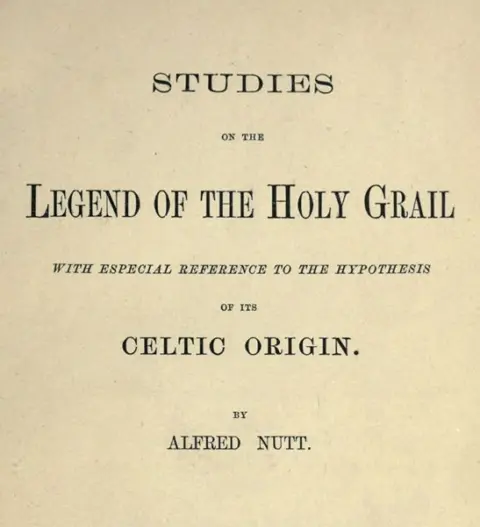
"Studies on the Legend of the Holy Grail" by Alfred Trübner Nutt is a scholarly publication written in the late 19th century. This work examines the various forms and origins of the Holy Grail legend, with a strong emphasis on its connections to Celtic traditions and influences. The book serves as both a study of the Grail Romance cycle and an investigation into the historical, literary, and mythical aspects of the legend. The opening of the scholarly work introduces the author’s intent to explore the different iterations of the Grail legend and their relationships to one another. It begins with a dedication to J. F. Campbell, highlighting the significance of Celtic tradition in Nutt's interpretation. The introduction outlines the structure of the studies, noting that the work does not aim for exhaustiveness but rather focuses on specific aspects of the Grail narrative. Nutt emphasizes the challenges historians face in tracing the origins of the Grail stories, navigating through various manuscripts and forms of the legend, while preparing to delve into the particulars of significant texts that have shaped the legend's evolution.
Introduction adapted from the source catalogue; source summaries may be automatically generated.
Free to read · English · 125,175 words · No account needed
MAKE TIME FOR A GOOD BOOK
On by default. Untick to stop anonymous reading totals. Each page counts after 10 seconds in view. How this works.
Anonymous counting is on unless you have switched it off.
... biaus frère ceste espée
Vous fu jugie et destineé (4,345-6).
After Perceval's first adventure at the Grail Castle it is his "germaine cousine" (4,776) who assails him with her reproaches; she knows all about the sword (4,835-38) and tells him, how, if it be broken he may have it mended (4,847-59). So far Chrestien, who furthermore, be it noted, makes Blanchefleur Perceval's lady-love, likewise his cousin, she being niece to Gonemans (3,805-95). A cousin is thus beloved of him, a cousin procures for him the magic sword, a cousin, as in the Mabinogi, incites him to the fulfilment of the quest, and gives him advice which we cannot doubt would have been turned to account by Chrestien had he finished his poem. Turning now to Gautier, in whose section of the poem are to be found the various adventures growing out of the chessboard incident, this difference between the Mabinogi and himself may be noted. In the former, these adventures caused by Peredur's cousin serve apparently as tests of the hero's strength and courage. The loss of the chessboard is the starting-point of the task, and the cousin reappears as the black maiden. Nothing of the sort is found in Gautier. True, the damsel who reproaches Perceval is in so far supernatural, as she is a kind of water-nix, but it is love for her which induces the hero to perform the task; she it is, too, who lends him the dog, and she is not identified with the "pucelle de malaire" who carries it off (22,604, etc.). But later on Perceval meets a knight who tells him that a daughter of the Fisher King's (thus also a cousin of Perceval) had related to him how a knight had carried off a stag's head and hound to anger another good knight who had been at her father's court, and had not asked as he should concerning the Grail, for which reason she had taken his hound and had refused him help to follow the robber knight (23,163, etc.). This makes the "pucelle de malaire" to be Perceval's cousin, and she plays the same rôle as in the Mabinogi. True, when later on (Incident 13) Perceval finds the damsel, nothing is said as to her being the Fisher King's daughter; on the contrary, as will be seen by the summary, a long story is told about the Knight of the Tomb, brother to her knight, Garalas, and how he lived ten years with a fay. She is here quite distinct from the lady of the chessboard to whom Perceval returns later. The version found in the Didot-Perceval agrees with the Mabinogi as against Gautier in so far that the hero is in love with the mistress of the castle, and not with the damsel who reproaches him for throwing away the chessmen. This reproaching damsel is not in any way identified with the lady who carries off the hound, who is described as "une vieille," and of whom it is afterwards told "elle estoit quand elle voloit une des plus belles damoiselles du monde. Et est cele meismes que mon frère (the brother of the Knight of the Tomb, who here, as in Gautier, is the lover of a fay) amena à la forest," i.e., she is the fay herself, sister to the lady of the Chessboard Castle, who hated her and wished to diminish her and her knight's pride (p. 469). Here, again, a connection can be pieced out between the various personages of the adventure; and it appears that the hero is driven to his fight against the Knight of the Tomb by a fair damsel transformed into a mysterious hag.[72] The Mabinogi thus gives one consistently worked-out conception--transformed hag = Peredur's cousin--which may be recovered partly from that one of the two discordant versions found in Gautier which makes the pucelle de malaire to be the Fisher King's daughter, hence Perceval's cousin, and connects the stag hunt with the Grail incident, partly from the Didot-Perceval, which tells how the same pucelle de malaire is but playing a part, being when she wills one of the fairest maids of the world. Now we have seen that the stag hunt is just one of those portions of the story in which are found the closest verbal similarities between Gautier de Doulens and the Didot-Perceval. It is, therefore, perplexing to find that there is not more likeness in the details of the incident. But the similarities pointed out concern chiefly the first part of the incident, and are less prominent in the latter part (the hero's encounter with the Knight of the Tomb). This, taken together with the difference in the details of the incident just pointed out, strengthens the opinion expressed above, that the Didot-Perceval and Gautier are not connected directly but through the medium of a common source, the influence of which can be seen distinctly in certain portions of either story, and that when this source fails they go widely asunder in their accounts. That such an hypothesis is not unreasonable is shown by the fact that Gautier has two contradictory forms of this very story, one of which, that which makes the hound-stealing damsel a daughter of the Fisher King, is on all fours with the Mabinogi, whilst the other is more akin to, though differing in important respects from, that of the Didot-Perceval. In this case, at least, Gautier must have had two sources, and if two why not more?
Your reading position is saved on this browser. Take it to another device with a library code. Reading pages adapt to text, rather than matching a printed edition.
BEHIND THE BOOK
This eBook is for the use of anyone anywhere in the United States and most other parts of the world at no cost and with almost no restrictions whatsoever. You may copy it, give it away or re-use it under the terms of the Project Gutenberg License included with this eBook or online at www.gutenberg.org. If you are not located in the United States, you will have to check the laws of the country where you are located before using this eBook. Read the source licence.
The original source file, including credits and licence, is retained by this library. Request an original-format copy at no charge. Please include the book title and Project Gutenberg identifier #42205.
KEEP YOUR CURIOSITY GOING
Cécile Tormay

Moritz Busch
John L. Ransom

Maurice Baring
Frances Wright
Cécile Tormay