THE CLASSIC COLLECTION✦An outlaw’s diary: the CommuneCLASSIC FREE BOOKS
An outlaw’s diary: the Commune
Cécile Tormay
THE CLASSIC COLLECTION · 1888
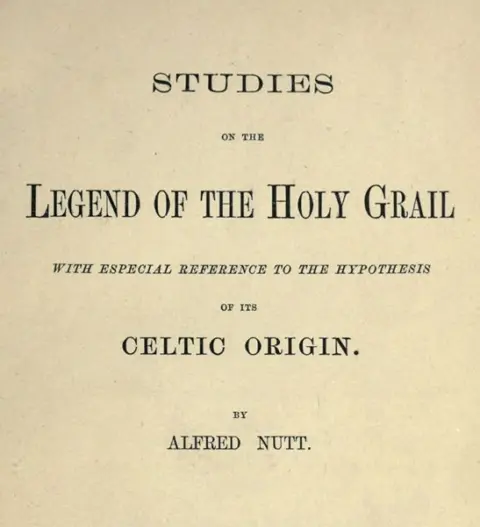
"Studies on the Legend of the Holy Grail" by Alfred Trübner Nutt is a scholarly publication written in the late 19th century. This work examines the various forms and origins of the Holy Grail legend, with a strong emphasis on its connections to Celtic traditions and influences. The book serves as both a study of the Grail Romance cycle and an investigation into the historical, literary, and mythical aspects of the legend. The opening of the scholarly work introduces the author’s intent to explore the different iterations of the Grail legend and their relationships to one another. It begins with a dedication to J. F. Campbell, highlighting the significance of Celtic tradition in Nutt's interpretation. The introduction outlines the structure of the studies, noting that the work does not aim for exhaustiveness but rather focuses on specific aspects of the Grail narrative. Nutt emphasizes the challenges historians face in tracing the origins of the Grail stories, navigating through various manuscripts and forms of the legend, while preparing to delve into the particulars of significant texts that have shaped the legend's evolution.
Introduction adapted from the source catalogue; source summaries may be automatically generated.
Free to read · English · 125,175 words · No account needed
MAKE TIME FOR A GOOD BOOK
On by default. Untick to stop anonymous reading totals. Each page counts after 10 seconds in view. How this works.
Anonymous counting is on unless you have switched it off.
On Perceval threatening to take it away from her by force she answers--
Sire Chevalier, force n'est mie Force à faire n'est mie drois droit et force me poez bien Et force me poés vos faire (22,640). faire (p. 443).
In the subsequent fight with the Knight of the Tomb, he, overcome--
Se torna vers le tonbel grant Que fuiant vait grant aléure aléure et li tombeaux s'enleva Vers l'arket et la sepouture contre moultet chevalier s'en Si est entrés plus tost qu'il pot feri enz (p. 444). (22,723, etc.).
In the description of Rosette (the loathly damsel)--
Ele avoit le col et les mains plus Le col avoit plus noir que fer
noires et le vier, que fer... (25,409).
(p. 453).
When the loathly damsel and her knight come to Arthur's court, Kay jests
as follows:--
Lors pria (i.e., Kay) le chevalier Biaus sire, par la foi que il devoit, le roi, Dites moi, si Dex le vos mire, qui li déist où il l'avoit prise et Si plus en a en vostre terre, si en porroit une autre tele avoir, Une autèle en iroie querre si il l'aloit querre (p. 457). Si jou le quidoie trover (25,691 etc.).
These similarities are too great to be accidental. It will be noticed, however, that they bear chiefly upon two adventures: that of the chessboard and stag hunt, and that of the loathly maiden. As to the latter, it is only necessary to allude to Birch-Hirschfeld's idea that Rosette is the original of the damsel who reproaches Perceval before the court with his conduct at the Grail Castle, a theory to state which is to refute it. The former adventure will be closely examined in the following section. There is no need to suppose direct borrowing on the part of one or the other versions to account for the parallel in these two incidents; a common original closely followed at times by both would meet the requirements of the case. It is difficult to admit that the author of the Didot-Perceval used Gautier's continuation and not Chrestien's original, especially when the following fact, strangely overlooked by both Birch-Hirschfeld and Hucher, is taken into account: Perceval on his first arrival at the Grail Castle keeps silence (as will be seen by a reference to the summary, supra, p. 31), because, "li souvenoit du prodome qui li avoit deffandu que ne fust trop pallier," etc. As a matter of fact, the "prodome" had forbidden nothing of the sort, and this casual sentence is the first allusion to the motive upon which Chrestien lays so much stress as explaining his hero's mysterious conduct at the Grail Castle. Evidently the Didot-Perceval, which, to whoever considers it impartially, is an obvious abridgment and piecing together of material from different sources, found in one of its sources an episode corresponding to that of Gonemans in Chrestien. But its author, influenced probably by the Galahad version of the Quest, substituted for the "childhood" opening of this hypothetical source the one now found in his version, and the Gonemans episode went with the remainder of that part of the story. When the hero comes to the Grail Castle, the author is puzzled; his hero knows beforehand what he has to do, sets out with the distinct purpose of doing it, and yet remains silent. To account for this silence the author uses the motive belonging to a discarded episode, but applies the words to his hermit, forgetting that he had put no such words into his mouth, and that, attributed to him, the injunction to keep silence became simply meaningless. Is the model treated in this way by the Didot-Perceval Chrestien's poem? Hardly, for this reason. After the Good Friday incident occurs the remarkable passage, quoted (supra, p. 31), as to the silence of the trouvères respecting it. Chrestien gives the incident in full, and the author of the Perceval could have had no reason for his stricture, or could not have ventured it had he been using Chrestien's work. Two hypotheses then remain; the unknown source may have been a version akin to that used by Chrestien and Gautier, or it may have been a summary abridgment of the Conte du Graal, in which, inter alia, the Good Friday incident was left out. In either case the presence of the passage in the Perceval is equally hard of explanation; but the first hypothesis is favoured by the primitive character of the incident of the Ford Perillous, and several other features which will be touched upon in their place. The Didot-Perceval would thus be an attempt to provide an ending for Borron's poem by adapting to its central donnée a version of the Perceval sage akin to that which forms the groundwork of the Conte du Graal, its author being largely influenced by the Galahad form of the Quest as found in the Queste. If this view be correct, the testimony of Perceval (wherever not influenced by Borron's poem or the Queste) is of value in determining the original form of the story, the more so from the author's evident want of skill in piecing together his materials. It will, therefore, be used in the following section, which deals with the relationship of the Conte du Graal and the Mabinogi of Peredur ab Evrawc.
Your reading position is saved on this browser. Take it to another device with a library code. Reading pages adapt to text, rather than matching a printed edition.
BEHIND THE BOOK
This eBook is for the use of anyone anywhere in the United States and most other parts of the world at no cost and with almost no restrictions whatsoever. You may copy it, give it away or re-use it under the terms of the Project Gutenberg License included with this eBook or online at www.gutenberg.org. If you are not located in the United States, you will have to check the laws of the country where you are located before using this eBook. Read the source licence.
The original source file, including credits and licence, is retained by this library. Request an original-format copy at no charge. Please include the book title and Project Gutenberg identifier #42205.
KEEP YOUR CURIOSITY GOING
Cécile Tormay

Moritz Busch
John L. Ransom

Maurice Baring
Frances Wright
Cécile Tormay