THE CLASSIC COLLECTION✦An outlaw’s diary: the CommuneCLASSIC FREE BOOKS
An outlaw’s diary: the Commune
Cécile Tormay
THE CLASSIC COLLECTION · 1888
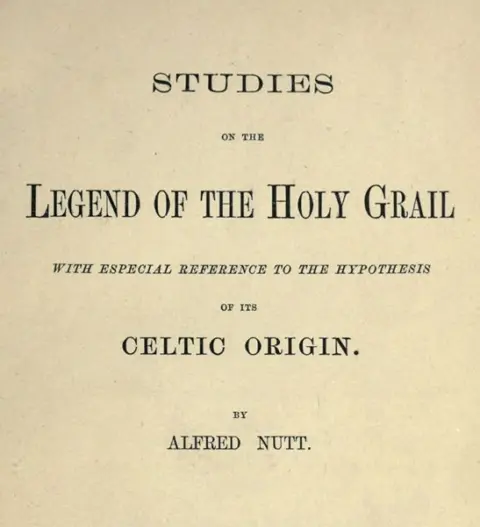
"Studies on the Legend of the Holy Grail" by Alfred Trübner Nutt is a scholarly publication written in the late 19th century. This work examines the various forms and origins of the Holy Grail legend, with a strong emphasis on its connections to Celtic traditions and influences. The book serves as both a study of the Grail Romance cycle and an investigation into the historical, literary, and mythical aspects of the legend. The opening of the scholarly work introduces the author’s intent to explore the different iterations of the Grail legend and their relationships to one another. It begins with a dedication to J. F. Campbell, highlighting the significance of Celtic tradition in Nutt's interpretation. The introduction outlines the structure of the studies, noting that the work does not aim for exhaustiveness but rather focuses on specific aspects of the Grail narrative. Nutt emphasizes the challenges historians face in tracing the origins of the Grail stories, navigating through various manuscripts and forms of the legend, while preparing to delve into the particulars of significant texts that have shaped the legend's evolution.
Introduction adapted from the source catalogue; source summaries may be automatically generated.
Free to read · English · 125,175 words · No account needed
MAKE TIME FOR A GOOD BOOK
On by default. Untick to stop anonymous reading totals. Each page counts after 10 seconds in view. How this works.
Anonymous counting is on unless you have switched it off.
Petrus is to wait for "le fil Alein," Brons is to wait for "le fil sen fil," and when he is come to give him the vessel and Grail (3,363-67). B II, Cangé MS., again makes a characteristic addition to the promise to Alain "et si li di que de lui doit issir un oirs masles, à cui la grace de mon veissel doit repairier" (I, 267).
C, Didot-Perceval, follows the second account of B. Perceval is son to Alain li Gros, grandson to Brons, the rich Fisher King, "et cil rois péchéors est en grant enfermetez, quar il est vieil home et plains de maladies" (I, 418), and nephew to the hermit, "un des fiz Bron et frère Alein" (I, 448), though curiously enough when he tells Brons that he knows him to be father of his father, the latter addresses him as "bieaux niès" (I, 483). In any case whether B and C do or do not afford proof of a nearer relationship than that of grandson and grandfather between the Grail-keeper and the achiever of the Quest, the chronology which bridges over 400 years in two generations is equally fantastic.
In D, Queste, no less than three different accounts are to be distinguished, corresponding certainly to three stages in the development of this version due to the influence of other versions of the legend. The earliest is that preserved in D II, the Welsh translation of a now lost French original. The Promised Knight is Galahad, son of Lancelot, grandson, on the mother's side, of King Pelles (ch. iv). The Grail is kept at the court of King Peleur (ch. lxvii), the name of which is apparently Corbenic (ch. lxiv). The Lame King is mentioned by Perceval's sister (ch. xlix), as a son of King Lambar, who fought with King Urlain and slew him, and in consequence of that blow the country was wasted; afterwards (ch. l.) his lameness is set down to his folly in attempting to draw the magic sword, for which, though there was not in Christendom a better man than he, he was wounded with a spear through the thigh. She also speaks of him here as her uncle. The Grail quest is not connected in any way with the healing of this Lame King. In the text printed by Furnivall, Galahad is first introduced as Lancelot's son and Pelles' grandson, but when he comes to Arthur's court he bids his returning companion, "salues moi tous chiaus del saint hostel et mon oncle le roi pelles et mon aioul le riche peschéour." Guinevere's ladies, according to this version, prophesy that Galahad will heal the Lame King. A long account, missing in D I, is given by the hermit to Lancelot of his ancestry as follows (p. 120):--Celidoine, son of Nasciens, had nine descendants, Warpus, Crestiens, Alain li Gros, Helyas, Jonaans, Lancelot, Ban, Lancelot himself, Galahad, in whom Christ will bathe himself entirely. Perceval is son of a King Pellehem (p. 182). The Lame King is Pelles, "que l'on apièle lo roi mehaignié" (p. 188); he is at Corbenic when Lancelot comes there. When Galahad and his companions arrive at his court a sick man wearing a crown is brought in, who blesses Galahad as his deliverer. After the appearance of the Grail, Galahad heals him by touching his wound with the spear. The third account, from the version of the Queste printed with the Lancelot and the Mort Artur in 1488, at Rouen, by Gaillard le Bourgeois,[51] makes Galahad send greetings to the Fisher King and to his grandfather, King Pelles; it adds to Perceval's sister's account of how Pelles was wounded, the words, "he was Galahad's grandfather;"[52] it adds to the account of Lancelot's visit to the Grail Castle, the words, "this was Castle Corbenic, where the Holy Grail was kept." Before discussing these differences it is advisable to see what the Grand St. Graal says on these points. Here Alain, the Fisher King, son of Brons, is a virgin, and when Josephe commits the Grail to his care he empowers him to leave it to whom he likes (II, 360--39.) In accordance with this Alain leaves the Grail to his brother Josue, with the title of Fisher King. Josue's descendants are Aminadap, Catheloys, Manaal, Lambor (who was wounded by Bruillans with Solomon's sword, whence arose such a fierce war that the whole land was laid desert).[53] Pelleans, wounded in battle in the ankle, whence he had the name Lame King, Pelles, upon whose daughter Lancelot begets Galahad, who is thus, on the mother's side, ninth in descent from Brons, brother to Joseph. Galahad's descent is likewise given from Celidoine, son of Nasciens, as follows: Marpus, Nasciens, Alains li Gros, Ysaies, Jonans, Lancelot, Bans, Lancelot, Galahad, who in thus counting Celidoine is tenth in descent from Nasciens, Joseph's companion, (vol. ii, ch. xxxix.) So far the story is fairly consistent, although there is a difference of one generation between father's and mother's genealogy. But ch. 17, in a very important passage, introduces a different account. The angel is expounding to Josephe and Nasciens the marvels of the lance; to Josephe he says, "de cheste lance dont tu as este ferus; ne sera iamis ferus ke vns seus hom. Et chil sera rois, et descendra de ton lignaige, si serra li daerrains des boins. Chil en sera ferus parmi les cuisses ambedeus," and will not be healed till the Good Knight come, "et chil ... serra li daerrains hom del lignaige nascien. Et tout ausi com nasciens a este li premiers hom qui les meruelles du graal a veues; autresi sera chil li daerrains qui les verra.[54] Car che dist li urais crucefis. 'Au premier home du precieus lignaige, et au daerrain, ai iou deuise à demonstrer mes meruelles.' Et si dist enchore après. 'Sour le premier et sour le daerrain de mes menistres nouuiaus qui sont enoint et sacre a mon plaisir, espanderai iou la venianche de la lanche auentureuse'" (I, 216-17), i.e., the last of Josephe's line shall be the only man wounded by the lance, the last of Nasciens' line shall be the deliverer. But according to Galahad's genealogy, given above, it is not the last of Josephe's line (represented by his cousin Josue) who is the Wounded King, for Galahad himself is as much the last in descent from Josephe as from Nasciens, and even if we take the words to apply only to the direct male descendants of Josue, there is still a discrepancy, as not Pelles, but Pelleant, his father, is the "roi mehaigniés." If the Wounded King were really the last of Josephe's line, i.e., Pelles, Galahad would be his grandson, as Percival is to Brons. Taking the two versions D. and E. together, some idea may be gathered from them of the way in which the legend has grown, and of the shifts to which the later harmonisers were put in their attempts to reconcile divergent accounts. In the first draft of the Queste, Galahad has nothing to do with the Lame King, the latter remains Perceval's uncle, the very relationship obtaining in Chrestien. Galahad has supplanted Perceval, but has not stepped into the place entirely. The second draft of the Queste endeavours to remedy this by clumsily introducing the Lame King and his healing, missing in the first draft, into the great Grail scene at the end, an idea foreign to the original author of the Queste, who, having broken with Perceval as chief hero, also broke with the distinctive Quest incident as far as the chief hero is concerned. But a strange blunder is committed; the second draft, anxious to make Galahad's grandfather both Fisher and Lame King, actually speaks of Pelles as Galahad's uncle, in direct contradiction to its own indication. The third draft corrects this mistake, and tries by different explanatory interpolations to confirm the relationship of Galahad to the Lame King, and the identity of his castle with the Grail Castle. The author of the Grand St. Graal now appears on the scene, appropriates the story about King Lambar, father to the Lame King, Percival's uncle, makes him an ancestor of Galahad, and gives a name to his son, Pelleant (which name creeps back into the second draft of the Queste as that of Perceval's father), and thus derives Galahad on the mother's side from Brons, although it escapes him that he thus gives the lie to the prophecy which he puts in the angel's mouth, that it is the last of Josephe's seed who is to be lamed by the lance, and that he has not given his Lambor fictitious ancestors enough to equalize the genealogies.
Your reading position is saved on this browser. Take it to another device with a library code. Reading pages adapt to text, rather than matching a printed edition.
BEHIND THE BOOK
This eBook is for the use of anyone anywhere in the United States and most other parts of the world at no cost and with almost no restrictions whatsoever. You may copy it, give it away or re-use it under the terms of the Project Gutenberg License included with this eBook or online at www.gutenberg.org. If you are not located in the United States, you will have to check the laws of the country where you are located before using this eBook. Read the source licence.
The original source file, including credits and licence, is retained by this library. Request an original-format copy at no charge. Please include the book title and Project Gutenberg identifier #42205.
KEEP YOUR CURIOSITY GOING
Cécile Tormay

Moritz Busch
John L. Ransom

Maurice Baring
Frances Wright
Cécile Tormay