THE CLASSIC COLLECTION✦An outlaw’s diary: the CommuneCLASSIC FREE BOOKS
An outlaw’s diary: the Commune
Cécile Tormay
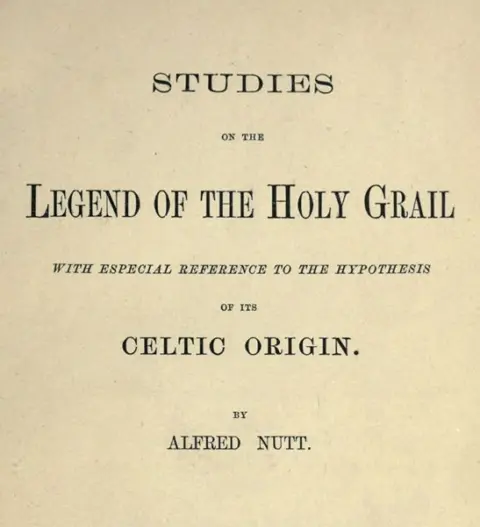
THE CLASSIC COLLECTION · 1888
"Studies on the Legend of the Holy Grail" by Alfred Trübner Nutt is a scholarly publication written in the late 19th century. This work examines the various forms and origins of the Holy Grail legend, with a strong emphasis on its connections to Celtic traditions and influences. The book serves as both a study of the Grail Romance cycle and an investigation into the historical, literary, and mythical aspects of the legend. The opening of the scholarly work introduces the author’s intent to explore the different iterations of the Grail legend and their relationships to one another. It begins with a dedication to J. F. Campbell, highlighting the significance of Celtic tradition in Nutt's interpretation. The introduction outlines the structure of the studies, noting that the work does not aim for exhaustiveness but rather focuses on specific aspects of the Grail narrative. Nutt emphasizes the challenges historians face in tracing the origins of the Grail stories, navigating through various manuscripts and forms of the legend, while preparing to delve into the particulars of significant texts that have shaped the legend's evolution.
Introduction adapted from the source catalogue; source summaries may be automatically generated.
Free to read · English · 125,175 words · No account needed
MAKE TIME FOR A GOOD BOOK
On by default. Untick to stop anonymous reading totals. Each page counts after 10 seconds in view. How this works.
Anonymous counting is on unless you have switched it off.
Effectively we learn (v. 3,262, etc.) that Alain leads his brothers into strange lands. But the Grail remains behind, and in v. 3,353, etc., an angel declares it necessary that all the people should go to the West, that Brons should have the vessel, that he should go straight to the West, and that Petrus, after seeing the Grail safe in Brons' keeping, is to go likewise. Joseph follows the angel's command, and three days after he has committed the Grail to Brons' hands.
Ainsi Joseph se demoura.
Li boens Pescherres s'en ala
(Dont furent puis meintes paroles
Contées, ki ne sunt pas foles)
En la terre lau il fu nez,
Et Joseph si est demourez. (3,455-60)
A puzzling passage, as it is difficult to be sure whether line 3,459 refers to the Fisher or to Joseph, a point of obvious importance, as in the latter case it would indicate that Joseph in this version does not go West. On turning to the prose versions, some remarkable variations are found in the corresponding passages; thus B II, Cangé MS. (I, 265) after relating how Brons finds wives for his children, adds, "Mais ancor estoit la crestientez moult tenue et moult novele en ce païs que l'an apeloit la bloe Bretaigne que Joseph avoit novellement convertie à la créance de Jhésu-Christ," words which would seem to indicate that the writer imagined Joseph and his company already in England. The corresponding passage to v. 3,445-60 runs thus: Ensinc se departirent, si s'en ala li riches peschierres dont maintes paroles furent puis, en la grant Bretaigne et ensinc remest Joseph et fina en la terre et ou païs où il fu envoiez de par Jhésu-Crist (275). B III, Didot MS, accentuates the punning reference to Avalon in the angel's message to Joseph, "Come li monde ... va en avalant covient-il que toute ceste gent se retraie en occident" (p. 330). The final passage runs thus: "Eynsi se despartirent Joseph et Bron: et Joseph s'en ala en la terre et el pais où il fust nez et ampris la terre" (p. 332). Thus the testimony of these versions favours the application of v, 2,459 in Metr. Jos. to Joseph. From C, Didot-Perceval, we obtain an account similar in parts to that of the B versions, the most direct reference being in the speech of the hermit, Perceval's uncle, "Biaus niès, sachès que à la table là où Joseph fist et je meismes oïmes la voiz de saint esperit qui nos comenda venir en loingteines terres en occident, et comenda le riche péchéor mon père que il venist en cestes parties, là ou li soleil avaloit" (449-50), where the punning reference to Avalon is again prominent, and where, apparently, the passage of Joseph himself to England is not indicated. An entirely different form of the legend is found in D and E. In the former (D II, 450) it is briefly stated, "And afterwards it happened to Joseph, and Joseph his father, and a number of his family with them, to set out from the city of Sarras, and they came as far as Great Britain"; again, p. 467, Perceval's aunt relates how when Joseph of Arimathea came, and his son Joseph with him, to Great Britain, there came with them about 4,000 people, all of whom are fed by ten loaves, placed on the table, on the head of which is the Grail. E, Grand St. Graal, dwells specially upon Josephe; he is referred to in I, p. 22, as having passed "le lignage ioseph son père outre mer iusqu'en la bloie bertaigne qui ore a nom engleterre," and II, 123, etc., gives a full account of how the passage is effected; how the Grail-bearers are sent first, and supported through the water by its power; how, when Josephe takes off his shirt, and his father Joseph puts his foot upon it, it swells until it holds 250 persons. These two accounts agree better with that of A IIA, Pseudo-Gautier, than with any of the others; indeed, a passage in the latter (v. 125-29), which tells how Joseph committed the portrait of our Lord, made by Verrine, to the mercy of the sea, may have given the hint for the miraculous shirt story of the Grand St. Graal. In this version, too, as in D, Queste, we first hear of the passage to England, and then the Grail appears at the miraculous feeding of the travellers. The versions thus fall into two clearly-defined groups, Joseph being the Grail-bearer in the one, Brons in the latter. The latter class is represented by the Metrical Joseph and the Didot-Perceval alone, if we except the Berne MS. form of a portion of the Conte du Graal, which, in its finish, has obviously copied the Metrical Joseph. To the former class belong all the other versions. Nay, more, one of the prose forms of Borron's poems is interpolated, so as to countenance the Joseph-account of the bringing of the Grail to England. Moreover, Borron's account of the whole transaction is ambiguous and obscure; at first Alain is the destined hero, long passages being devoted to him, and the keeping of the mystic vessel being expressly reserved to him. Yet he leaves, quite quietly, nothing more being heard of him, and the same machinery of angelic messages is set in motion for Brons, to whom, henceforth, the chief rôle is assigned. Does not this show that there were from the outset two accounts of the evangelisation of Britain, one, attributing it to Joseph, of wider popularity, and followed solely by the majority of the romances, whilst Borron, who gave greater prominence to the other account, has maladroitly tried to fuse the two into one? In any case it would be remarkable were the legend of purely Christian origin, and were the Metrical Joseph its earliest form, and source of the other forms, that its testimony on such an important point should be contradicted by nearly every other version.
Your reading position is saved on this browser. Take it to another device with a library code. Reading pages adapt to text, rather than matching a printed edition.
BEHIND THE BOOK
This eBook is for the use of anyone anywhere in the United States and most other parts of the world at no cost and with almost no restrictions whatsoever. You may copy it, give it away or re-use it under the terms of the Project Gutenberg License included with this eBook or online at www.gutenberg.org. If you are not located in the United States, you will have to check the laws of the country where you are located before using this eBook. Read the source licence.
The original source file, including credits and licence, is retained by this library. Request an original-format copy at no charge. Please include the book title and Project Gutenberg identifier #42205.
KEEP YOUR CURIOSITY GOING
Cécile Tormay

Moritz Busch
John L. Ransom

Maurice Baring
Frances Wright
Cécile Tormay