THE CLASSIC COLLECTION✦An outlaw’s diary: the CommuneCLASSIC FREE BOOKS
An outlaw’s diary: the Commune
Cécile Tormay
THE CLASSIC COLLECTION · 1888
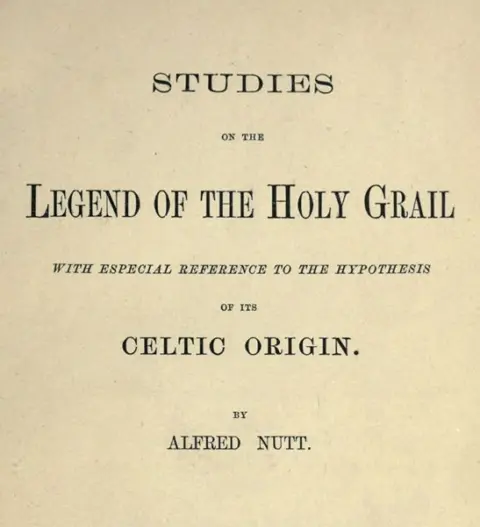
"Studies on the Legend of the Holy Grail" by Alfred Trübner Nutt is a scholarly publication written in the late 19th century. This work examines the various forms and origins of the Holy Grail legend, with a strong emphasis on its connections to Celtic traditions and influences. The book serves as both a study of the Grail Romance cycle and an investigation into the historical, literary, and mythical aspects of the legend. The opening of the scholarly work introduces the author’s intent to explore the different iterations of the Grail legend and their relationships to one another. It begins with a dedication to J. F. Campbell, highlighting the significance of Celtic tradition in Nutt's interpretation. The introduction outlines the structure of the studies, noting that the work does not aim for exhaustiveness but rather focuses on specific aspects of the Grail narrative. Nutt emphasizes the challenges historians face in tracing the origins of the Grail stories, navigating through various manuscripts and forms of the legend, while preparing to delve into the particulars of significant texts that have shaped the legend's evolution.
Introduction adapted from the source catalogue; source summaries may be automatically generated.
Free to read · English · 125,175 words · No account needed
MAKE TIME FOR A GOOD BOOK
On by default. Untick to stop anonymous reading totals. Each page counts after 10 seconds in view. How this works.
Anonymous counting is on unless you have switched it off.
After the adventure with Orgueilleuse, Wolfram continues as follows:--The lord of the magic castle, wherein are kept prisoners Arthur's mother and the other queens, is Clinschor, nephew of Virgilius of Naples, who took to magic after his unmanning at the hands of King Ibert, whose wife, Iblis, he loved. Gawain overcomes the magician, and, both unknowing, fights with Parzival. The latter, after many lesser adventures, meets his half-brother Feirefiz, and sustains with him the hardest of all his fights. At length recognition is brought about, the two embrace, and repair to Arthur's court. Cundrie nears once more, tells Parzival he has been chosen Grail king, that his wife and twin sons, Loherangrin and Kardeiz, have been summoned to the Grail castle, and that the question will now free Amfortas and his land. With Cundrie and Feirefiz, Parzival rides to the Grail castle, meets his wife, together they all behold the talismans, save Feirefiz, to whom as a heathen the sight of the Grail is denied. But he is baptised, weds Repanse de Schoie, the Grail damsel, the two return to India, and from them is born Prester John. Parzival rules over his Grail kingdom. Of his son Loherangrin it is told how he is led to the aid of the Duchess of Brabant by a swan, how he marries her on condition she inquire not as to his origin, and how, on her breaking the command, the swan carries him away from her.
=Heinrich von dem Türlin.=--The Gawain Episodes of Diu Crône.--The parallelism of Heinrich's poem with those of Wolfram and Chrestien begins about verse 17,500 with an adventure of Gawain's corresponding to Inc. 13 in Chrestien (Tournament for the hand of Tiebaut of Tingaguel's daughter, episode of the two sisters, combat with Melians de Lis). In Heinrich the father is named Leigamar, the eldest daughter Fursensephin, (Fleur sans epine ?), the youngest Quebelepluz, where Heinrich has taken a French phrase setting forth the greater fairness of the damsel for a proper name. Inc. 14 in Chrestien then follows with these differences: the name of the castle is Karamphi; Gawain and the facile damsel are surprised by the latter's brother, and it is her father who, to avenge the wrong done his house, makes Gawain swear that within a year he will either seek out the Grail or return as prisoner to Karamphi. Chrestien's Inc. 15 is of course missing, the story going straight on to Inc. 16, meeting with the wounded knight (here Lohenis) and his lady love Emblie, who by treachery deprive Gawain of his steed; then the arrival at the Castle of Wonders, and the night passed in the enchanted bed, where the hero is overwhelmed with crossbolts shot at him by invisible foes. The plucking of the flower from the enchanted garden at the bidding of a damsel (Orgueilleuse in Chrestien and Wolfram, here Mancipicelle), and the meeting with and challenge by Giremelanz follow. Arthur's court comes to the Castle of Wonders to witness the combat. Gawain and Giremelanz are reconciled, the latter marries Gawain's sister, and Gawain himself sets off to search for the Grail. [Adventures then follow which correspond to nothing in Chrestien or Wolfram, in which Gawain wins talismans destined to aid him in his search.] Gawain sets forth on his quest accompanied by Kay, Lancelot, and Calocreant. They part at crossways. Gawain comes to the sister of the magician (anonymous in Chrestien, Klinschor in Wolfram, here Gansguoter) of the Castle of Wonders. She bids him take heed, if he wish to see the Grail, he be not overcome by sleep, and for this that he drink not overmuch; as soon as he saw it and its accompanying damsels, he was to ask about it. If he neglected this, all his past and any future toil would be useless. On his way to the Grail castle, the hero meets with all sorts of dangers, and obstacles, and wonders; amongst others, passing the night in a castle where he is tended by invisible hands. After month-long wanderings he meets with Lancelot and Calocreant, and learns that Kay, in a vain attempt to penetrate to the Grail, has been flung into prison. The three comrades then come to the Grail castle. They are led into a hall which passes in splendour aught earthly eye ever saw. The floor is strewn with roses, on a bed lies an old man in gold-embroidered garments, and watches two youths playing at chess. Towards night the hall fills with knights and dames, a youth enters bearing a sword which he lays before the old man. Gawain is pressed to drink; but refuses, not so his two companions, who straightway fall asleep. Then enter two damsels bearing lights, followed by two knights with a spear, and two more damsels with a "toblier" (? tailleor, plate) of gold and jewels. After them comes the fairest woman ever God created, and with her a maiden weeping. The spear is laid on the table, by it the "toblier" wherein are three drops of blood. In the box borne by the fair lady is a piece of bread, one third part of which she breaks off and gives to the old man. Gawain recognising in her Gansguoter's sister, stays no longer, but asks what these wonders mean. Straightway knights and dames all with mighty shout leap from table, and great joy arises. The old man says what he has seen is the Grail; none saw it before save Parzival, and he asked not. By his question Gawain has delivered from long waiting and suffering both those which are dead and those which live. The old man himself and his companions are really dead, though they seem it not, but the lady and her damsels are living; for their unstained womanhood God has granted them to have the Grail, and therewith yearly to feed the old man. All Gawain's adventures latterly have come from the Grail. Now he has ended all, he is to take as prize of his knighthood the sword which will help him in every danger. After him no man shall see the Grail; further concerning it he must not ask, nor may know more. At daybreak the old man's tale ends, and he with his whole court vanish, leaving only the lady with her five damsels. [After releasing Kay, and undergoing other adventures, Gawain returns to Arthur's court.]
Your reading position is saved on this browser. Take it to another device with a library code. Reading pages adapt to text, rather than matching a printed edition.
BEHIND THE BOOK
This eBook is for the use of anyone anywhere in the United States and most other parts of the world at no cost and with almost no restrictions whatsoever. You may copy it, give it away or re-use it under the terms of the Project Gutenberg License included with this eBook or online at www.gutenberg.org. If you are not located in the United States, you will have to check the laws of the country where you are located before using this eBook. Read the source licence.
The original source file, including credits and licence, is retained by this library. Request an original-format copy at no charge. Please include the book title and Project Gutenberg identifier #42205.
KEEP YOUR CURIOSITY GOING
Cécile Tormay

Moritz Busch
John L. Ransom

Maurice Baring
Frances Wright
Cécile Tormay