THE CLASSIC COLLECTION✦An outlaw’s diary: the CommuneCLASSIC FREE BOOKS
An outlaw’s diary: the Commune
Cécile Tormay
THE CLASSIC COLLECTION · 1888
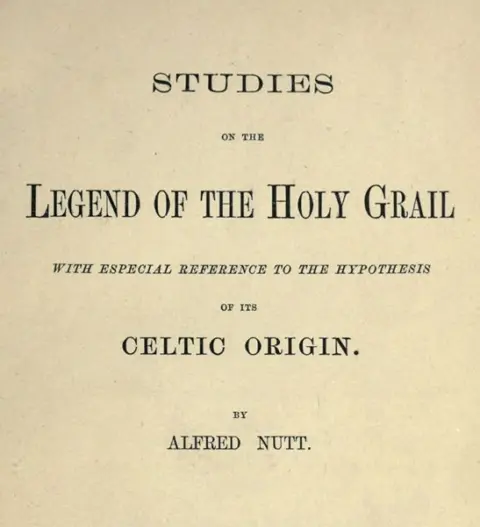
"Studies on the Legend of the Holy Grail" by Alfred Trübner Nutt is a scholarly publication written in the late 19th century. This work examines the various forms and origins of the Holy Grail legend, with a strong emphasis on its connections to Celtic traditions and influences. The book serves as both a study of the Grail Romance cycle and an investigation into the historical, literary, and mythical aspects of the legend. The opening of the scholarly work introduces the author’s intent to explore the different iterations of the Grail legend and their relationships to one another. It begins with a dedication to J. F. Campbell, highlighting the significance of Celtic tradition in Nutt's interpretation. The introduction outlines the structure of the studies, noting that the work does not aim for exhaustiveness but rather focuses on specific aspects of the Grail narrative. Nutt emphasizes the challenges historians face in tracing the origins of the Grail stories, navigating through various manuscripts and forms of the legend, while preparing to delve into the particulars of significant texts that have shaped the legend's evolution.
Introduction adapted from the source catalogue; source summaries may be automatically generated.
Free to read · English · 125,175 words · No account needed
MAKE TIME FOR A GOOD BOOK
On by default. Untick to stop anonymous reading totals. Each page counts after 10 seconds in view. How this works.
Anonymous counting is on unless you have switched it off.
[75] In the notes to my two articles in the "Folk-Lore Record" will be found a number of references establishing this fact.
[76] The hero renews his strength after his various combats by rubbing himself with the contents of a vessel of balsam. He has moreover to enter a house the door of which closes to of itself (like the Grail Castle Portcullis in Wolfram), and which kills him. He is brought to life by the friendly raven. The mysterious carlin also appears, "there was a turn of her nails about her elbows, and a twist of her hoary hair about her toes, and she was not joyous to look upon." She turns the hero's companions into stone, and to unspell them he must seek a bottle of living water and rub it upon them, when they will come out alive. This is like the final incident in many stories of the Two Brothers class. Cf. note, p. 162.
[77] O'Daly's version consists of 158 quatrains; Campbell's of 63. The correspondence between them, generally very close (frequently verbal), is shown by the following table:--
O'D., 1, 2. C., 1, 2.
-- C., 3.
O'D., 3. C., 4.
O'D., 4-15. --
O'D., 16. C., 4.
O'D., 17-24. C., 5-12.
O'D., 25. --
-- C., 13-15.
O'D., 26-47. C., 16-36.
O'D., 48-56. --
O'D., 57-61. C., 37-40.
O'D., 62. --
O'D., 63-65. C., 41-43.
O'D., 66. C., 45.
O'D., 67. C., 44.
O'D., 68, 69. C., 46, 47.
O'D., 70. C., 49.
O'D., 71. C., 48.
-- C., 50.
O'D., 72. C., 52.
O'D., 73. --
O'D., 74. C., 53.
O'D., 75. C., 54.
O'D., 76-80. C., 55-59.
O'D., 81-134. --
O'D., 135, 136. C., 60, 61.
-- C., 62.
O'D., 137. --
O'D., 138. C., 63.
O'D., 139-158. --
[78] Of this widely spread group, Grimm's No. 60, Die zwei Brüder, may be taken as a type. The brethren eat heart and liver of the gold bird and thereby get infinite riches, are schemed against by a goldsmith, who would have kept the gold bird for himself, seek their fortunes throughout the world accompanied by helping beasts, part at crossways, leaving a life token to tell each one how the other fares; the one delivers a princess from a dragon, is cheated of the fruit of the exploit by the Red Knight, whom after a year he confounds, wins the princess, and, after a while, hunting a magic hind, falls victim to a witch. His brother, learning his fate through the life token, comes to the same town, is taken for the young king even by the princess, but keeps faith to his brother by laying a bare sword twixt them twain at night. He then delivers from the witch's spells his brother, who, learning the error caused by the likeness, and thinking advantage had been taken of it, in a fit of passion slays him, but afterwards, hearing the truth, brings him back to life again. Grimm has pointed out in his notes the likeness between this story and that of Siegfried (adventures with Mimir, Fafnir, Brunhilde, and Gunnar). In India the tale figures in Somadeva's Katha Sarit Sagara (Brockhaus' translation, ii., 142, et seq.). The one brother is transformed into a demon through accidental sprinkling from a body burning on a bier. He is in the end released from this condition by his brother's performing certain exploits, but there is no similarity of detail. Other variants are Zingerle (p. 131) where the incident occurs of the hero's winning the king's favour by making his bear dance before him; this I am inclined to look upon as a weakened recollection of the incident of a hero's making a princess laugh, either by playing antics himself or making an animal of his play them (see supra, p. 134, Kennedy's Irish Tale). Grimm also quotes Meier 29 and 58, but these are only variants of the dragon-killing incident. In the variant of 29, given p. 306, the hero makes the king laugh, and in both stories occurs the familiar incident of the hero coming unknown into a tournament and overcoming all enemies, as in Peredur (Inc. 9). Wolf., p. 369, is closer, and here the hero is counselled by a grey mannikin whom he will unspell if he succeeds. Stier, No. I. (not p. 67, as Grimm erroneously indicates) follows almost precisely the same course as Grimm's 60, save that there are three brothers. Graal, p. 195, has the magic gold bird opening, but none of the subsequent adventures tally. Schott, No. 11, is also cited by Grimm, but mistakenly; it belongs to the faithful-servant group. Very close variants come from Sweden (Cavallius-Oberleitner, Va, Vb) and Italy (Pentamerone, I. 7 and I. 9). The Swedish tales have the miraculous conception opening, which is a prominent feature in tales belonging to the Expulsion and Return group (e.g., Perseus, Cu-Chulaind, and Taliesin), but present otherwise very nearly the same incidents as Grimm. The second of the Italian versions has the miraculous conception opening so characteristic of this group of folk-tales, and of the allied formula group, the attainment of riches consequent upon eating the heart of a sea dragon, the tournament incident (though without the disguise of the hero), the stag hunt, wherein the stag, an inimical wizard haunting the wood, is a cannibal and keeps the captured hero for eating. In the story of the delivery by the second brother, the separating sword incident occurs. The first version opens with what is apparently a distorted and weakened form of the hero's clearing a haunted house of its diabolical inmates (see infra Ch. VII., Gawain) and then follows very closely Grimm's Two Brothers, save that the alluring witch is young and fair, the whole tale being made to point the moral, "more luck than wit." Straparola, a 3, is a variant of the dragon fight incident alone. It is impossible not to be struck by the fact that in this widely spread group of tales are to be found some of the most characteristic incidents of the Perceval and allied Great Fool group. The only version, however, which brings the two groups into formal contact is O'Daly's form of the Great Fool.
Your reading position is saved on this browser. Take it to another device with a library code. Reading pages adapt to text, rather than matching a printed edition.
BEHIND THE BOOK
This eBook is for the use of anyone anywhere in the United States and most other parts of the world at no cost and with almost no restrictions whatsoever. You may copy it, give it away or re-use it under the terms of the Project Gutenberg License included with this eBook or online at www.gutenberg.org. If you are not located in the United States, you will have to check the laws of the country where you are located before using this eBook. Read the source licence.
The original source file, including credits and licence, is retained by this library. Request an original-format copy at no charge. Please include the book title and Project Gutenberg identifier #42205.
KEEP YOUR CURIOSITY GOING
Cécile Tormay

Moritz Busch
John L. Ransom

Maurice Baring
Frances Wright
Cécile Tormay