THE CLASSIC COLLECTION✦An outlaw’s diary: the CommuneCLASSIC FREE BOOKS
An outlaw’s diary: the Commune
Cécile Tormay
THE CLASSIC COLLECTION · 1888
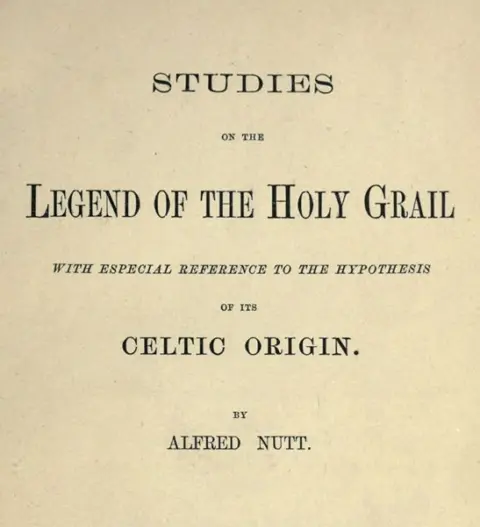
"Studies on the Legend of the Holy Grail" by Alfred Trübner Nutt is a scholarly publication written in the late 19th century. This work examines the various forms and origins of the Holy Grail legend, with a strong emphasis on its connections to Celtic traditions and influences. The book serves as both a study of the Grail Romance cycle and an investigation into the historical, literary, and mythical aspects of the legend. The opening of the scholarly work introduces the author’s intent to explore the different iterations of the Grail legend and their relationships to one another. It begins with a dedication to J. F. Campbell, highlighting the significance of Celtic tradition in Nutt's interpretation. The introduction outlines the structure of the studies, noting that the work does not aim for exhaustiveness but rather focuses on specific aspects of the Grail narrative. Nutt emphasizes the challenges historians face in tracing the origins of the Grail stories, navigating through various manuscripts and forms of the legend, while preparing to delve into the particulars of significant texts that have shaped the legend's evolution.
Introduction adapted from the source catalogue; source summaries may be automatically generated.
Free to read · English · 125,175 words · No account needed
MAKE TIME FOR A GOOD BOOK
On by default. Untick to stop anonymous reading totals. Each page counts after 10 seconds in view. How this works.
Anonymous counting is on unless you have switched it off.
[58] It almost looks as if the author of C were following here a version in which the hero only has to go once to the Grail Castle; nothing is said about Perceval's first unsuccessful visit, and Merlin addresses Perceval as if he were telling him for the first time about matters concerning which he must be already fully instructed.
[59] It is remarkable, considering the scanty material at his disposal, how accurate Schulz' analysis is, and how correct much of his argumentation.
[60] Wagner has admirably utilised this hint of Simrock's in his Parsifal, when his Kundry (the loathly damsel of Chrestien and the Mabinogi) is Herodias. Cf. infra, Ch. X.
[61] Excepting, of course, the late fifteenth and early sixteenth century Paris imprints, which represented as a rule, however, the latest and most interpolated forms, and Mons. Fr. Michel's edition of Borron's poem.
[62] Hucher's argument from v. 2817 (supra p. 106) that the poem knew of the Grand St. Graal is, however, not met.
[63] Vide p. 200, for Birch-Hirschfeld's summary comparison of the two works, and cf. infra p. 127.
[64] Cf. infra p. 128, for a criticism of this statement.
[65] Opera V. 410: Unde et vir ille eloquio clarus W. Mapus, Oxoniensis archidiaconus (cujus animae propitietur Deus) solita verborum facetia et urbanitate praecipua dicere pluris et nos in hunc modum convenire solebat: "Multa, Magister Geralde, scripsistis et multum adhue scribitis, et nos multa diximus. Vos scripta dedistis et nos verba."
[66] Printed in full, Hucher, I. 156, etc.
[67] Printed by Hucher, I. p. 35, etc.
[68] The remainder of Birch-Hirschfeld's work is devoted to proving that Chrestien was the only source of Wolfram von Eschenbach, the latter's Kiot being imagined by him to justify his departure from Chrestien's version; departures occasioned by his dissatisfaction with the French poet's treatment of the subject on its moral and spiritual side. This element in the Grail problem will be found briefly dealt with, Appendix A.
[69] I have not thought it necessary, or even advisable, to notice what the "Encyclopædia Britannica" (Part XLI, pp. 34, 35) and some other English "authorities" say about the Grail legends.
[70] They are brought together by Hucher, vol. i, p. 383, etc.
[71] In the preface to the second volume of his edition of Chrestien's works (Halle, 1887), W. Förster distinguishes Peredur from the Lady of the Fountain and from Geraint, which he looks upon as simple copies of Chrestien's poems dealing with the same subjects. Peredur has, he thinks, some Welsh features.
Your reading position is saved on this browser. Take it to another device with a library code. Reading pages adapt to text, rather than matching a printed edition.
BEHIND THE BOOK
This eBook is for the use of anyone anywhere in the United States and most other parts of the world at no cost and with almost no restrictions whatsoever. You may copy it, give it away or re-use it under the terms of the Project Gutenberg License included with this eBook or online at www.gutenberg.org. If you are not located in the United States, you will have to check the laws of the country where you are located before using this eBook. Read the source licence.
The original source file, including credits and licence, is retained by this library. Request an original-format copy at no charge. Please include the book title and Project Gutenberg identifier #42205.
KEEP YOUR CURIOSITY GOING
Cécile Tormay

Moritz Busch
John L. Ransom

Maurice Baring
Frances Wright
Cécile Tormay