THE CLASSIC COLLECTION✦An outlaw’s diary: the CommuneCLASSIC FREE BOOKS
An outlaw’s diary: the Commune
Cécile Tormay
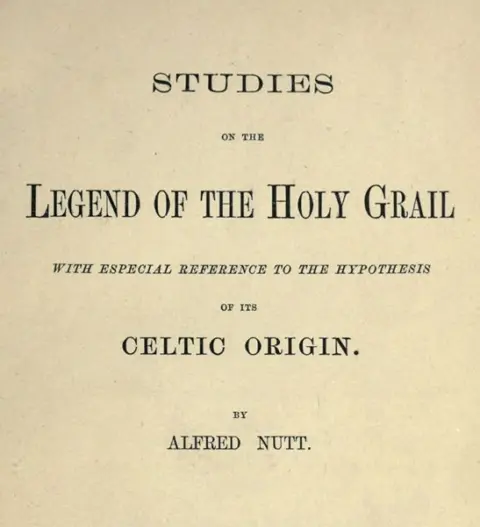
THE CLASSIC COLLECTION · 1888
"Studies on the Legend of the Holy Grail" by Alfred Trübner Nutt is a scholarly publication written in the late 19th century. This work examines the various forms and origins of the Holy Grail legend, with a strong emphasis on its connections to Celtic traditions and influences. The book serves as both a study of the Grail Romance cycle and an investigation into the historical, literary, and mythical aspects of the legend. The opening of the scholarly work introduces the author’s intent to explore the different iterations of the Grail legend and their relationships to one another. It begins with a dedication to J. F. Campbell, highlighting the significance of Celtic tradition in Nutt's interpretation. The introduction outlines the structure of the studies, noting that the work does not aim for exhaustiveness but rather focuses on specific aspects of the Grail narrative. Nutt emphasizes the challenges historians face in tracing the origins of the Grail stories, navigating through various manuscripts and forms of the legend, while preparing to delve into the particulars of significant texts that have shaped the legend's evolution.
Introduction adapted from the source catalogue; source summaries may be automatically generated.
Free to read · English · 125,175 words · No account needed
MAKE TIME FOR A GOOD BOOK
On by default. Untick to stop anonymous reading totals. Each page counts after 10 seconds in view. How this works.
Anonymous counting is on unless you have switched it off.
Witch who brings the dead to life, 165-69.
Wolfram von Eschenbach, numbered F 3, sources, 6, 25-26, 65-67, 69,
and Gerbert, 92, 99-102, 104, 107, 121-25, 150, 157,
brother incident in, 164, 172-73,
branch in, 193,
magician lord, 199,
account of mediæval morality, 240-41, 246,
ideal of, 248-52, 254, 255, 256,
pattern for future growth of legend, 261,
relation to Chrestien, 261-63.
Woman in Celtic tradition, 231-33.
Wülcker, Evangelium Nicodemi, 220-21.
Zarncke, views, 106-07, 115, 132, 220.
[1] Fully described by Potvin, VI, lxix, etc.
[2] Potvin, VI, lxxv, etc.
[3] Birch-Hirschfeld: Die Sage vom Gral, 8vo., Leipzig, 1877, p. 81.
[4] Birch-Hirschfeld, p. 89.
[5] Birch-Hirschfeld, p. 110.
[6] Birch-Hirschfeld, p. 232, quoting the colophon of a Paris MS., after Paulin Paris, Cat. des MSS. français, vol. ii, pp. 361, etc.
[7] Birch-Hirschfeld, p. 143.
[8] This prologue is certainly not Chrestien's work; but there is no reason to doubt that it embodies a genuine tradition, and affords valuable hints for a reconstruction of the original form of the story. Cf. Otto Küpp in Zeitschrift für deutsche Philologie, vol. xvii., No. 1.
[9] Potvin's text, from the Mons MS., is taken as basis.
[10] Several MSS. here intercalate the history of Joseph of Arimathea: Joseph of Barimacie had the dish made; with it he caught the blood running from the Saviour's body as it hung on the Cross, he afterwards begged the body of Pilate; for the devotion showed the Grail he was denounced to the Jews, thrown into prison, delivered thence by the Lord, exiled together with the sister of Nicodemus, who had an image of the Lord. Joseph and his companions came to the promised land, the White Isle, a part of England. There they warred against them of the land. When Joseph was short of food he prayed to the Creator to send him the Grail wherein he had gathered the holy blood, after which to them that sat at table the Grail brought bread and wine and meat in plenty. At his death, Joseph begged the Grail might remain with his seed, and thus it was that no one, of however high condition, might see it save he was of Joseph's blood. The Rich Fisher was of that kin, and so was Greloguevaus, from whom came Perceval.
It is hardly necessary to point out that this must be an interpolation, as if Gauvain had really learnt all there was to be told concerning the Grail, there would have been no point in the reproaches addressed him by the countryfolk. The gist of the episode is that he falls asleep before the tale is all told.
Your reading position is saved on this browser. Take it to another device with a library code. Reading pages adapt to text, rather than matching a printed edition.
BEHIND THE BOOK
This eBook is for the use of anyone anywhere in the United States and most other parts of the world at no cost and with almost no restrictions whatsoever. You may copy it, give it away or re-use it under the terms of the Project Gutenberg License included with this eBook or online at www.gutenberg.org. If you are not located in the United States, you will have to check the laws of the country where you are located before using this eBook. Read the source licence.
The original source file, including credits and licence, is retained by this library. Request an original-format copy at no charge. Please include the book title and Project Gutenberg identifier #42205.
KEEP YOUR CURIOSITY GOING
Cécile Tormay

Moritz Busch
John L. Ransom

Maurice Baring
Frances Wright
Cécile Tormay