THE CLASSIC COLLECTION✦An outlaw’s diary: the CommuneCLASSIC FREE BOOKS
An outlaw’s diary: the Commune
Cécile Tormay
THE CLASSIC COLLECTION · 1888
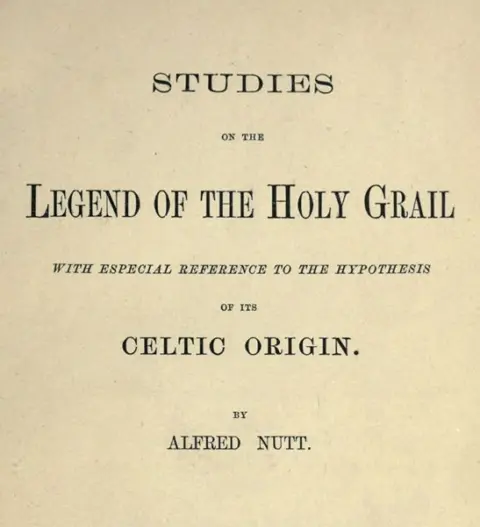
"Studies on the Legend of the Holy Grail" by Alfred Trübner Nutt is a scholarly publication written in the late 19th century. This work examines the various forms and origins of the Holy Grail legend, with a strong emphasis on its connections to Celtic traditions and influences. The book serves as both a study of the Grail Romance cycle and an investigation into the historical, literary, and mythical aspects of the legend. The opening of the scholarly work introduces the author’s intent to explore the different iterations of the Grail legend and their relationships to one another. It begins with a dedication to J. F. Campbell, highlighting the significance of Celtic tradition in Nutt's interpretation. The introduction outlines the structure of the studies, noting that the work does not aim for exhaustiveness but rather focuses on specific aspects of the Grail narrative. Nutt emphasizes the challenges historians face in tracing the origins of the Grail stories, navigating through various manuscripts and forms of the legend, while preparing to delve into the particulars of significant texts that have shaped the legend's evolution.
Introduction adapted from the source catalogue; source summaries may be automatically generated.
Free to read · English · 125,175 words · No account needed
MAKE TIME FOR A GOOD BOOK
On by default. Untick to stop anonymous reading totals. Each page counts after 10 seconds in view. How this works.
Anonymous counting is on unless you have switched it off.
I.--=Sir Perceval of Galles=, English metrical romance, printed for the first time from the Thornton MS., of circa 1440, by Halliwell: The Thornton Romances, printed for the Camden Society, small 4to., London, 1884; from which I shall quote it as Sir Perceval.
Finally there exists an independent German version of certain adventures, the hero of which in the Conte du Graal, in Wolfram, and in the Mabinogi, is Gawain. This is--
K.--=Heinrich von dem Türlin.= Diu Crône. Edited by G. H. F. Scholl. Bibliothek des Litterarischen Vereins, vol. xxvii., Stuttgart, 1852.
The positive information which the different MSS. of the above mentioned works afford respecting their authors, date of composition, sources, etc., is as follows:--In the prologue to his poem, Chrestien (Potvin i., pp. 307-308) dedicates his work to "Li quens Felippes de Flandres," who as he states (verse 67), "li bailla le livre," which served him as model, and whom he praises at great length as surpassing Alexander. We know that Count Philip of Flanders took the cross in 1188, set out for the Holy Land in 1190, and died on the 1st of June, 1191, before Akkon.[3] As Chrestien says not a word about the crusading intentions of Philip, it may be inferred that he wrote his prologue before 1188, and began the poem in 1189 at the latest. Gautier de Doulens (probably of that ilk, in Picardy, some miles from Amiens)[4] has only left his name, verse 33,755, Gautiers de Dons qui l'estore, etc. Manessier the next continuator has been more explicit; he describes himself as completing the work at the command of ...
Jehanne la Comtesse
Qu'est de Flandre dame et mestresse.
(Potvin, vi., p. 157.)
This Joan, daughter of Baldwin the VIth, ruled Flanders alone during the imprisonment of her husband after the battle of Bouvines (1214-1227), and Manessier's words can only apply to her during this period, so that his continuation must have been written between 1214-1227.[5] The third continuator, Gerbers, only mentions his name (Potvin, vi., p. 212).
The author of version B, names himself, B I, verse 3,461, Messires Roberz de Beron; verses 3,488-94 state that no mortal man had told the story, until he had it from
Mon seigneur Gautier en peis
Qui de Mont Belyal estoit.
Verse 3,155 gives the name somewhat differently, Meistres Robers dist de Bouron. The prose versions follow the poem with additions, thus Cangé Jos. (p. 275); Messires Roberz de Borron lou restrait à mon seigneur Gautier, lou preu conte de Mobéliart.
Your reading position is saved on this browser. Take it to another device with a library code. Reading pages adapt to text, rather than matching a printed edition.
BEHIND THE BOOK
This eBook is for the use of anyone anywhere in the United States and most other parts of the world at no cost and with almost no restrictions whatsoever. You may copy it, give it away or re-use it under the terms of the Project Gutenberg License included with this eBook or online at www.gutenberg.org. If you are not located in the United States, you will have to check the laws of the country where you are located before using this eBook. Read the source licence.
The original source file, including credits and licence, is retained by this library. Request an original-format copy at no charge. Please include the book title and Project Gutenberg identifier #42205.
KEEP YOUR CURIOSITY GOING
Cécile Tormay

Moritz Busch
John L. Ransom

Maurice Baring
Frances Wright
Cécile Tormay