THE CLASSIC COLLECTION✦An outlaw’s diary: the CommuneCLASSIC FREE BOOKS
An outlaw’s diary: the Commune
Cécile Tormay
THE CLASSIC COLLECTION · 1888
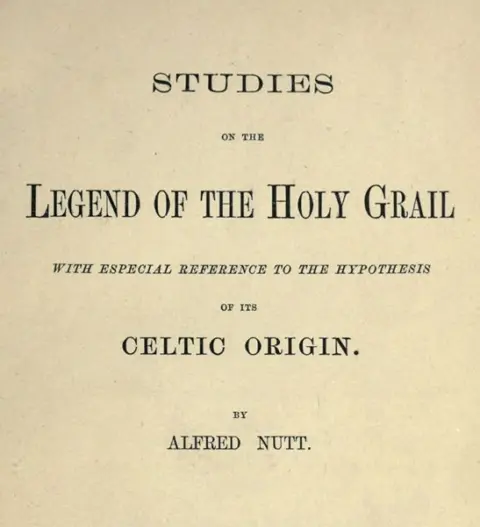
"Studies on the Legend of the Holy Grail" by Alfred Trübner Nutt is a scholarly publication written in the late 19th century. This work examines the various forms and origins of the Holy Grail legend, with a strong emphasis on its connections to Celtic traditions and influences. The book serves as both a study of the Grail Romance cycle and an investigation into the historical, literary, and mythical aspects of the legend. The opening of the scholarly work introduces the author’s intent to explore the different iterations of the Grail legend and their relationships to one another. It begins with a dedication to J. F. Campbell, highlighting the significance of Celtic tradition in Nutt's interpretation. The introduction outlines the structure of the studies, noting that the work does not aim for exhaustiveness but rather focuses on specific aspects of the Grail narrative. Nutt emphasizes the challenges historians face in tracing the origins of the Grail stories, navigating through various manuscripts and forms of the legend, while preparing to delve into the particulars of significant texts that have shaped the legend's evolution.
Introduction adapted from the source catalogue; source summaries may be automatically generated.
Free to read · English · 125,175 words · No account needed
MAKE TIME FOR A GOOD BOOK
On by default. Untick to stop anonymous reading totals. Each page counts after 10 seconds in view. How this works.
Anonymous counting is on unless you have switched it off.
Such, all too briefly sketched, has been the fate and story of these tales, first shaped in a period of culture wellnigh pre-historic, gifted by reason of their Celtic setting with a charm that commended them to the romantic spirit of the middle ages, and made them fit vehicles for the embodiment of mediæval ideas. Quickened by Christian symbolism they came to express and typify the noblest and the most mystic longings of man. The legend, as the poets and thinkers of the twelfth century fashioned it, has still a lesson and a meaning for us. It may be likened to one of the divine maidens of Irish tradition. She lives across the western sea. Ever and again heroes, filled with mysterious yearning for the truth and beauty of the infinite and undying, make sail to join her if they may. They pass away and others succeed them, but she remains ever young and fair. So long as the thirst of man for the ideal endures, her spell will not be weakened, her charm will not be lessened. But each generation works out this Quest in its own spirit. This much may be predicted with some confidence: henceforth, whosoever would do full justice to the legend must take pattern by Wolfram von Eschenbach rather than by any of his rivals; he must deal with human needs and human longings; his ideal must be the widening of human good and human joy. Above all, he must give reverent yet full expression to all the aspirations, all the energies of man and of woman.
The various arguments for and against the use of any other French source than Chrestien by Wolfram have been clearly summed up by G. Bötticher, Die Wolfram Literatur seit Lachmann, Berlin, 1880. The chief representative of the negative opinion is Birch-Hirschfeld, who first gives, Chapter VIII. of his work, a useful collection of passages relating to the Grail, the Castle, and the Quest, from both authors. His chief argument is this:--The Grail in all the romances except in Wolfram is a cup or vessel, but in Wolfram a stone, a peculiarity only to be explained by Wolfram's ignorance of any source than Chrestien, and by the fact that the latter, in accordance with his usual practice of leaving objects and persons in as mysterious an atmosphere as possible, nowhere gives a clear description of the Grail. He undoubtedly would have done so if he had finished his work. Such indications as he gave led Wolfram, who did not understand the word Graal, to think it was a stone. It is inconceivable that Kyot, if such a personage existed, should have so far departed from all other versions as not to picture the Grail as a vessel, inconceivable, again, that his account of it should have been just as vague as Chrestien's, that he should have afforded Wolfram no hint of the real nature of the object. In Chrestien Perceval's question refers to the Grail, but Wolfram, missing the significance of the holy vessel owing to the meagreness of the information respecting it given to him by Chrestien, was compelled to transform the whole incident, and to refer it solely to the sufferings of the wounded King. Again, Chrestien meant to utilise the sword, and to bring Gawain to the Grail Castle; but his unfinished work did not carry out his intention, and in Wolfram Gawain also fails to come to the Grail Castle; the sword is passed over in silence in the latter part of the poem.--Simrock, jealous for the credit of Wolfram, claimed for him the invention of all that could not be traced to Chrestien, resting the claim chiefly upon consideration of a sentimental patriotic nature.--In opposition to these views, although the fact is not denied that Wolfram followed Chrestien closely for the parts common to both, it is urged to be incredible that he, a German poet, should invent a prologue to Chrestien's unfinished work connecting with an Angevin princely genealogical legend. It was also pointed out, with greatest fulness by Bartsch, Die Eigennamen im Parcival und Titurel, Germanist. Studien, II., 114, et seq., that the German poet gives a vast number of proper names which are not to be found in Chrestien, and that these are nearly all of French, and especially Southern French and Provençal origin.--Simrock endeavoured to meet this argument in the fifth edition of his translation, but with little success.--Bötticher, whilst admitting the weight of Birch-Hirschfeld's arguments, points out the difficulties which his theory involves. If Wolfram simply misunderstood Chrestien and did not differ from him personally, why should he be at the trouble of inventing an elaborately feigned source to justify a simple addition to the original story? If he only knew of the Grail from Chrestien, what gave him the idea of endowing it, as he did, with mystic properties? Martin points out in addition (Zs. f. d. A., V. 87) that Wolfram has the same connection of the Grail and Swan Knight story as Gerbert, whom, ex hypothesi, he could not have known, and who certainly did not know him.--In his Zur Gralsage, Martin returned to the question of proper names, and showed that a varying redaction of a large part of the romance is vouched for by the different names which Heinrich von dem Türlin applies to personages met with both in Chrestien and in Wolfram. If, then, one French version, that followed by Heinrich, who is obviously a translator, is lost, why not another?
Your reading position is saved on this browser. Take it to another device with a library code. Reading pages adapt to text, rather than matching a printed edition.
BEHIND THE BOOK
This eBook is for the use of anyone anywhere in the United States and most other parts of the world at no cost and with almost no restrictions whatsoever. You may copy it, give it away or re-use it under the terms of the Project Gutenberg License included with this eBook or online at www.gutenberg.org. If you are not located in the United States, you will have to check the laws of the country where you are located before using this eBook. Read the source licence.
The original source file, including credits and licence, is retained by this library. Request an original-format copy at no charge. Please include the book title and Project Gutenberg identifier #42205.
KEEP YOUR CURIOSITY GOING
Cécile Tormay

Moritz Busch
John L. Ransom

Maurice Baring
Frances Wright
Cécile Tormay