THE CLASSIC COLLECTION✦An outlaw’s diary: the CommuneCLASSIC FREE BOOKS
An outlaw’s diary: the Commune
Cécile Tormay
THE CLASSIC COLLECTION · 1888
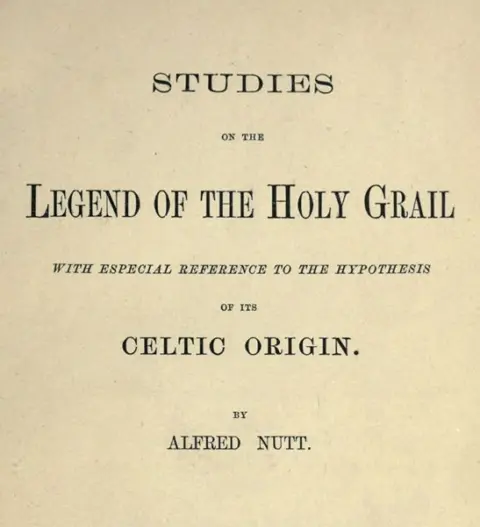
"Studies on the Legend of the Holy Grail" by Alfred Trübner Nutt is a scholarly publication written in the late 19th century. This work examines the various forms and origins of the Holy Grail legend, with a strong emphasis on its connections to Celtic traditions and influences. The book serves as both a study of the Grail Romance cycle and an investigation into the historical, literary, and mythical aspects of the legend. The opening of the scholarly work introduces the author’s intent to explore the different iterations of the Grail legend and their relationships to one another. It begins with a dedication to J. F. Campbell, highlighting the significance of Celtic tradition in Nutt's interpretation. The introduction outlines the structure of the studies, noting that the work does not aim for exhaustiveness but rather focuses on specific aspects of the Grail narrative. Nutt emphasizes the challenges historians face in tracing the origins of the Grail stories, navigating through various manuscripts and forms of the legend, while preparing to delve into the particulars of significant texts that have shaped the legend's evolution.
Introduction adapted from the source catalogue; source summaries may be automatically generated.
Free to read · English · 125,175 words · No account needed
MAKE TIME FOR A GOOD BOOK
On by default. Untick to stop anonymous reading totals. Each page counts after 10 seconds in view. How this works.
Anonymous counting is on unless you have switched it off.
In the light of the foregoing investigations and hypotheses we may now amplify the sketch history of the whole cycle given in Chapter III. The Peredur-saga probably came into existence in much its later form at an early date in the Middle Ages. A number of older mythical tales centered in a, perhaps, historical personage. The circumstances of his life and adventures may have given them not only cohesion, but may also have coloured and distorted them; nevertheless they remained, in the main, mythical tales of the same kind as those found all over the world. One of these tales was undoubtedly a Cymric variant of the Celtic form of the Expulsion and Return formula; another dealt with the hero's journey to the Land of Shades; traces of many others are to be found in the Mabinogi. Another Celtic worthy, Gwalchmai, was early associated with Peredur, and the two stood in some such relation to each other as the twin brethren of a widely spread folk-tale group. Curiously enough, whilst comparatively few incidents in the Peredur-saga were worked up into the version which served as immediate model to the North French romances, that version contained many adventures of Gwalchmai's which have not been preserved in Welsh. We can trace three main crystallizations of the original saga-mass; one represented by the Proto-Mabinogi contained the feud quest, and, probably, some only of the other adventures found in the present Mabinogi; the second, based more on the lines of the Expulsion and Return formula, is represented by the Thornton MS. romance; in the third the feud quest was mixed up with the hero's visit to the Bespelled Castle, and those portions of the Gwalchmai-saga which told of his visit to Castle Perillous as well as to the Bespelled Castle. Whilst the Proto-Mabinogi was probably in prose, the Proto-Conte du Graal was probably in verse, a collection of short lais like those of Marie de France. Meanwhile, one of the chief personages of the older mythic world which appear in the Peredur-saga, Bran, the Lord of the Land of Shades, of the Bespelled Castle, of the cauldron of healing, increase and wisdom, and of the knowledge-giving salmon, had become the Apostle of Britain, his pagan attributes thus suffering a Christian change, which was perfected when Joseph took the place of Brons, bringing with him his gospel associations and the apocryphal legends that had clustered round his name. Thus a portion of the saga was Christianised, whilst the other portion lost its old, fixed popular character, owing to the fusion of originally distinct elements, and the consequent unsettling both of the outlines and of the details of the story. Incidents and features which in the earlier folk-tale stage were sharply defined and intelligible became vague and mysterious. In this state, and bearing upon it the peculiarly weird and fantastic impress of Celtic mythic tradition, the story, or story-mass rather, lay ready to the hand of courtly poet or of clerical mystic. At first Christian symbolism was introduced in a slight and meagre way--the Brons-Joseph legend supplied the Christian meaning of the talismans, and that was all. But the Joseph legend was soon vigorously developed by the author of the work which underlies the Queste and the Grand St. Graal. He may either not have known or have deliberately discarded Brons, the old Celtic hero of the conversion, as he certainly deliberately thrust down from his place of pre-eminence Perceval, the Celtic hero of the Quest, substituting for him a new hero, Galahad, and for the adventures of the Conte du Graal, based as they were upon no guiding conceptions, fresh adventures intended to glorify physical chastity. With all his mystic fervour he failed to see the full capacities of the theme, his presentment of the Grail itself being in especial either over-material or over-spiritual. But his work exercised a profound influence, as is seen in the case of Chrestien's continuators. Robert de Borron, on the other hand, if to him the merit must be assigned, if he was not simply transcribing an older, forgotten version, was a more original thinker, if a less gifted writer. Although he was not able to entirely harmonise the conflicting accounts of which he made use, he yet succeeded in keeping close to the old lines of the legend whilst giving a consistent symbolical meaning to all its details. His work came too late, however, to exercise the influence it should have done upon the development of the legend; the writers who knew it were mere heapers together of adventures, and the very man who composed a sequel to it abandoned Robert's main conception.
Your reading position is saved on this browser. Take it to another device with a library code. Reading pages adapt to text, rather than matching a printed edition.
BEHIND THE BOOK
This eBook is for the use of anyone anywhere in the United States and most other parts of the world at no cost and with almost no restrictions whatsoever. You may copy it, give it away or re-use it under the terms of the Project Gutenberg License included with this eBook or online at www.gutenberg.org. If you are not located in the United States, you will have to check the laws of the country where you are located before using this eBook. Read the source licence.
The original source file, including credits and licence, is retained by this library. Request an original-format copy at no charge. Please include the book title and Project Gutenberg identifier #42205.
KEEP YOUR CURIOSITY GOING
Cécile Tormay

Moritz Busch
John L. Ransom

Maurice Baring
Frances Wright
Cécile Tormay