THE CLASSIC COLLECTION✦An outlaw’s diary: the CommuneCLASSIC FREE BOOKS
An outlaw’s diary: the Commune
Cécile Tormay
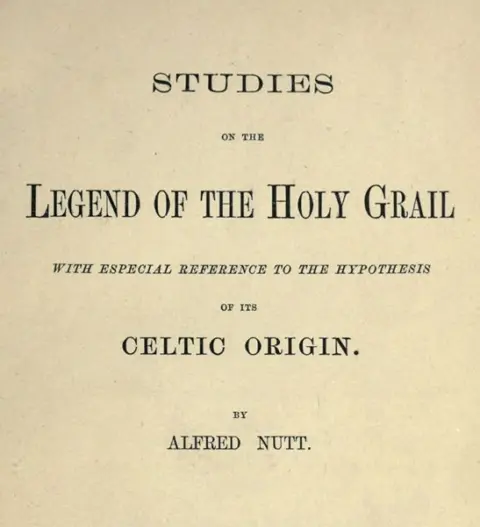
THE CLASSIC COLLECTION · 1888
"Studies on the Legend of the Holy Grail" by Alfred Trübner Nutt is a scholarly publication written in the late 19th century. This work examines the various forms and origins of the Holy Grail legend, with a strong emphasis on its connections to Celtic traditions and influences. The book serves as both a study of the Grail Romance cycle and an investigation into the historical, literary, and mythical aspects of the legend. The opening of the scholarly work introduces the author’s intent to explore the different iterations of the Grail legend and their relationships to one another. It begins with a dedication to J. F. Campbell, highlighting the significance of Celtic tradition in Nutt's interpretation. The introduction outlines the structure of the studies, noting that the work does not aim for exhaustiveness but rather focuses on specific aspects of the Grail narrative. Nutt emphasizes the challenges historians face in tracing the origins of the Grail stories, navigating through various manuscripts and forms of the legend, while preparing to delve into the particulars of significant texts that have shaped the legend's evolution.
Introduction adapted from the source catalogue; source summaries may be automatically generated.
Free to read · English · 125,175 words · No account needed
MAKE TIME FOR A GOOD BOOK
On by default. Untick to stop anonymous reading totals. Each page counts after 10 seconds in view. How this works.
Anonymous counting is on unless you have switched it off.
Such a legend is surely more likely to have been shaped by Welsh or Breton monks than by North French trouvères. And when we notice the Celtic names of the personages, and their connection with the Celtic paradise, Avalon, there can remain little, if any, doubt respecting the first home of the story. We may thus look upon Brons, owner of a mystic vessel, fisher of a mystic fish, as the hero of an early conversion legend. But the name Brons has at once suggested to most students of the cycle that of Bran. The latter is, as we saw in the last Chapter, the representative of an old Celtic god of the otherworld. He is the owner of the cauldron of renovation. He is also the hero in Welsh tradition of a conversion legend, and is commonly known as Bran the Blessed. Unfortunately the only explanation we have of this epithet occurs in a late triad, to which it is not safe to assign an earlier date than the fourteenth century. He is described therein as son of Llyr Llediath, "as one of the three blissful Rulers of the Island of Britain, who first brought the faith of Christ to the nation of the Cymry from Rome, where he was seven years a hostage for his son Caradawc."[138] But if late in form this triad may well embody an old tradition. It gives the significant descent of Bran from Llyr, and thereby equates him with Mannanan Mac Lir, with whom he presents otherwise so many points of contact. It is quite true that the Bran legend, as is pointed out to me by Professor Rhys, is mentioned neither in the earliest genealogies nor in Geoffrey. But it should be noted that the Grand St. Graal does bring one member of the Brons group, Petrus, into contact with King Luces, the Lucius to whom Geoffrey ascribes the conversion. Again, the epithet "blessed" is applied to Bran in the Mabinogi of Branwen, daughter of Llyr. I have placed this tale as a whole as far back as the eleventh-tenth centuries, and my arguments have met with no opposition, and have won the approval of such authorities as Professor Windisch and Monsieur Gaidoz. But the Mabinogi, as we have it, was written down in the fourteenth century; the last transcriber abridged it, and at times did not apparently understand what he was transcribing. By his time the full-blown Bran legend of the triad was in existence, and it may be contended that the epithet was due to him and did not figure in his model. On the other hand, Stephens (Lit. of the Cymry, p. 425) quotes a triad of Kynddelw, a poet of the twelfth century, referring to the three blessed families of the Isle of Britain, one of which is declared by a later tradition to be that of Bran.[139] Again, the triads of Arthur and his Warriors, printed by Mr. Skene, Four Ancient Books, Vol. II., p. 457, from MS. Hengwrt, 566, of the beginning of the fourteenth century, and probably at least fifty years older, mentions the "blessed head of Bran."[140] On the whole, in spite of the silence of older sources, I look upon the epithet and the legend which it presupposes as old, and I see in a confusion between Bran, Lord of the Cauldron, and Bran the Blessed, the first step of the transformation of the Peredur sage into the Quest of the Holy Grail. In the first capacity Bran corresponds to the Lord of the Castle of Talismans. From the way in which the fish is dwelt upon in his legend, it may, indeed, be conjectured that he stood to Peredur in some such relation as Finn-eges to Fionn. As hero of a conversion legend he came into contact with Joseph. We do not know how or at what date the legend of the conversion of Britain by Joseph originated. It is found enjoying wide popularity in the latter half of the twelfth century, the very time in which the romances were assuming their present shape. Wülcker (Das Evangelium Nicodemi in der abendländischen Literatur, Paderborn, 1872) shows that the legend is not met with before William of Malmesbury; and Zarncke, as already stated (supra, p. 107), has argued that the passage in William is a late interpolation due to the popularity of the romances.[141] But to accept Zarncke's contention merely shifts back the difficulty. If William did not first note and give currency to the tradition, the unknown predecessor of Robert de Borron and of the authors of the Queste and Grand St. Graal did so; and the question still remains how did he come by the tradition, and what led him to associate it with Glastonbury. Birch-Hirschfeld, it is true, makes short work of this difficulty. The fact that there is no earlier legend in which Joseph figures as the Apostle of Britain is to him proof that Borron evolved the conception of the Grail out of the canonical and apocryphal writings in which Joseph appears, and then devised the passage to Britain in order to incorporate the Arthurian romances with the legend he had invented. It is needless to repeat that this theory, unacceptable on a priori grounds, is still more so when tested by facts.
Your reading position is saved on this browser. Take it to another device with a library code. Reading pages adapt to text, rather than matching a printed edition.
BEHIND THE BOOK
This eBook is for the use of anyone anywhere in the United States and most other parts of the world at no cost and with almost no restrictions whatsoever. You may copy it, give it away or re-use it under the terms of the Project Gutenberg License included with this eBook or online at www.gutenberg.org. If you are not located in the United States, you will have to check the laws of the country where you are located before using this eBook. Read the source licence.
The original source file, including credits and licence, is retained by this library. Request an original-format copy at no charge. Please include the book title and Project Gutenberg identifier #42205.
KEEP YOUR CURIOSITY GOING
Cécile Tormay

Moritz Busch
John L. Ransom

Maurice Baring
Frances Wright
Cécile Tormay