THE CLASSIC COLLECTION✦An outlaw’s diary: the CommuneCLASSIC FREE BOOKS
An outlaw’s diary: the Commune
Cécile Tormay
THE CLASSIC COLLECTION · 1888
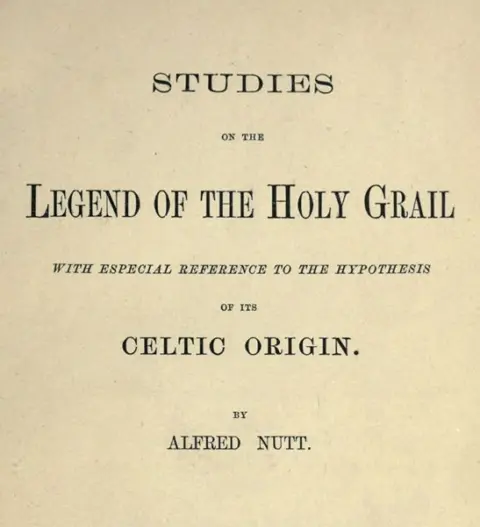
"Studies on the Legend of the Holy Grail" by Alfred Trübner Nutt is a scholarly publication written in the late 19th century. This work examines the various forms and origins of the Holy Grail legend, with a strong emphasis on its connections to Celtic traditions and influences. The book serves as both a study of the Grail Romance cycle and an investigation into the historical, literary, and mythical aspects of the legend. The opening of the scholarly work introduces the author’s intent to explore the different iterations of the Grail legend and their relationships to one another. It begins with a dedication to J. F. Campbell, highlighting the significance of Celtic tradition in Nutt's interpretation. The introduction outlines the structure of the studies, noting that the work does not aim for exhaustiveness but rather focuses on specific aspects of the Grail narrative. Nutt emphasizes the challenges historians face in tracing the origins of the Grail stories, navigating through various manuscripts and forms of the legend, while preparing to delve into the particulars of significant texts that have shaped the legend's evolution.
Introduction adapted from the source catalogue; source summaries may be automatically generated.
Free to read · English · 125,175 words · No account needed
MAKE TIME FOR A GOOD BOOK
On by default. Untick to stop anonymous reading totals. Each page counts after 10 seconds in view. How this works.
Anonymous counting is on unless you have switched it off.
Another Highland tale (Campbell, lviii., The Rider of Grianaig) furnishes a fresh example of this fact. Here, also, the deeds to be done of the hero were prophesied of him. But these deeds he would never accomplish, save he were incited thereto and aided therein by a raven, who in the end comes out as a be-spelled youth, and a steed, a maiden under spells, and the spells will not go off till her head be off. Even so Peredur is urged on and helped by the bewitched youth. In other respects, there is no likeness of plan and little of detail[76] to the Mabinogi, certainly no trace of direct influence of the Welsh story upon the Highland one.
It may, however, be asserted that all of these tales are derived more or less directly from the French romance. This has been confidently stated of the Breton ballad cycle of Morvan le Breiz (Barzaz Breiz) and of the Breton Märchen, Peronik l'idiot (Souvestre, Foyer Breton), and I have preferred making no use of either. In the matter of the Scotch and Irish tales a stand must be made. The romance, it is said, may have filtered down into the Celtic population, through the medium of adaptations such as the Mabinogi or Sir Perceval. Granted, for argument sake, that these two works are mere adaptations, it must yet follow that the stories derived from them will be more or less on the same lines as themselves. Is this so? Can it be reasonably argued that the folk-tale of the Great Fool is a weakened copy of certain features of the Mabinogi, which itself is a weakened copy of certain features of the French poem? Is it not the fact that the folk-tale omits much that is in the Mabinogi, and on the other hand preserves details which are wanting not alone in the Welsh tale but in Chrestien. If other proof of the independent nature of these tales were needed it would be supplied by the close similarity existing between the Great Fool opening and the Fionn legend. This is extant in several forms, one of which, still told in the Highlands (Campbell's lxxxii.), tells how Cumhall's son is reared in the wilderness, how he drowns the youth of a neighbouring hamlet, how he slays his father's slayer, and wins the magic trout the taste of which gives knowledge of past and to come, how he gets back his father's sword and regains his father's lands, all as had been prophesied of him. Another descendant of the French romance it will be said. But a very similar tale is found in a fifteenth century Irish MS. (The Boyish Exploits of Finn Mac Cumhall, translated by Dr. J. O'Donovan in the Transactions of the Ossianic Society, vol. iv.); Cumhall, slain by Goll, leaves his wife big with a son, who when born is reared by two druidesses. He grows up fierce and stalwart, overcomes all his age-mates, overtakes wild deer he running, slays a boar, and catches the magic salmon of knowledge. An eighteenth century version given by Kennedy ("Legendary Fictions," p. 216) makes Cumhall offer violence to Muirrean, daughter of the druid Tadg, and his death to be chiefly due to the magic arts of the incensed father. It will hardly be contended that these stories owe their origin to adaptations of Chrestien's poem. But in any case no such contention could apply to the oldest presentment of Fionn as a formula hero, that found in the great Irish vellum, the Leabhar na h'Uidhre, written down from older materials at the beginning of the twelfth century. The tract entitled "The cause of the battle of Cnucha" has been translated by Mr. Henessey ("Revue Celtique," vol. ii., pp. 86, et seq.). In it we find Cumhall and Tadhg, the violence done to the latter's daughter, the consequent defeat and death of Cumhall, the lonely rearing of Fionn by his mother, and the youth's avenging of his father. I must refer to my paper in the "Folk-Lore Record" for a detailed argument in favour of the L.n.H. account being an euhemerised version of the popular tradition, represented by the Boyish Exploits, and for a comparison of the Fionn sage as a whole with the Greek, Iranian, Latin, and Germanic hero tales, which like it are modelled upon the lines of the Expulsion and Return formula. I have said enough, I trust, to show that the Fionn sage is a variant (a far richer one) of the theme treated in the boyhood of Perceval, but that it, and a fortiori the allied folk-tales are quite independent of the French poem. It then follows that this portion of Chrestien's poem must itself be looked upon as one of many treatments of a theme even more popular among the Celts than among any other Aryan race, and that its ultimate source is a Breton or Welsh folk-tale.
Your reading position is saved on this browser. Take it to another device with a library code. Reading pages adapt to text, rather than matching a printed edition.
BEHIND THE BOOK
This eBook is for the use of anyone anywhere in the United States and most other parts of the world at no cost and with almost no restrictions whatsoever. You may copy it, give it away or re-use it under the terms of the Project Gutenberg License included with this eBook or online at www.gutenberg.org. If you are not located in the United States, you will have to check the laws of the country where you are located before using this eBook. Read the source licence.
The original source file, including credits and licence, is retained by this library. Request an original-format copy at no charge. Please include the book title and Project Gutenberg identifier #42205.
KEEP YOUR CURIOSITY GOING
Cécile Tormay

Moritz Busch
John L. Ransom

Maurice Baring
Frances Wright
Cécile Tormay