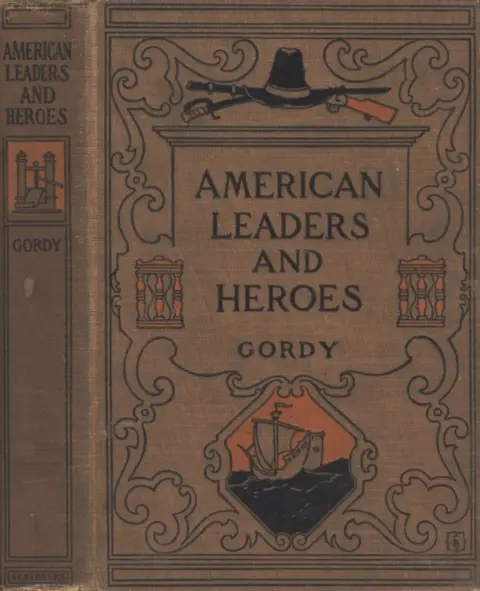
American Leaders and Heroes: A preliminary text-book in United States History
Wilbur F. (Wilbur Fisk) Gordy
THE CLASSIC COLLECTION · 1915
"Stories of Later American History" by Wilbur F. Gordy is a historical account written in the early 20th century. The book aims to present biographical narratives about key figures and events in American history that are essential for young students, particularly focusing on the time period following the Revolutionary War. It is designed to provide an engaging and vivid portrayal of America's past to help instill a sense of patriotism and understanding of the nation's development. The opening portion introduces the context surrounding the Stamp Act, a significant turning point that stirred revolutionary sentiments among the colonists. It highlights the growing unrest leading to Patrick Henry's rise as a powerful orator advocating for colonial rights. Patrick's tenacity is captured as he challenges the authority of the British Parliament, culminating in his famous speech that calls for liberty. The narrative emphasizes his early life, drawing connections between his personal struggles and eventual emergence as a leader during a pivotal moment in American history. This opening sets the stage for a rich exploration of influential characters and key events that shaped the United States.
Introduction adapted from the source catalogue; source summaries may be automatically generated.
Free to read · English · 60,230 words · No account needed
MAKE TIME FOR A GOOD BOOK
On by default. Untick to stop anonymous reading totals. Each page counts after 10 seconds in view. How this works.
Anonymous counting is on unless you have switched it off.
4. How are we all dependent upon one another? How may we be truly
patriotic?
Adams, John
Adams, Samuel
Alamo
Anna, Santa
Antietam, battle of
Appomattox Court House, Lee's surrender at
Atlanta, capture of
Backwoodsmen, life among
Barlow, Joel
Bon Homme Richard (bo-nom'-re-shar')
Boone, Daniel
Boone, Squire
"Boston Tea Party"
Brandywine Creek
Bull Run, battle of
Bunker Hill, battle of
Burgoyne (ber-goin'), General, his invasion
Cabinet, the President's
Calhoun, John C.
Camden, battle of
Carson, Kit
Cattle-raising
Cedar Creek, battle of
Cherokee Indians
Civil War
Clark, George Rogers
Clark, William
Clay, Henry
Clermont
Clinton, DeWitt
Coal
Colonies become States
Compromise, Missouri
Compromise of 1850
Concord, battle of
Confederate States of America, organization of
Congress, Continental, first meeting of
second meeting of
Congress, United States
Continental Army
Cornwallis, General
Cotton
Cotton-gin, invention of
Cowpens, battle of
Creek Indians
Custis, Mrs. Martha
Davis, Jefferson
Dawes, William
Declaration of Independence
Donelson, Fort
Dorchester Heights
Douglas, Stephen A.
Early, General, at Cedar Creek
Emancipation Proclamation
Erie Canal
Ferguson, Major
Fitch, John
Flatboat
Florida, purchase of
France aids the Americans
Franklin, Benjamin
Fremont, John C.
French villages, old, life in
Fulton, Robert
Gage, General
Gates, General
George III
Gettysburg, battle of
Gold, discovery of, in California
Grant, Ulysses
Greene, Nathanael
Guilford Court House, battle of
Hale, Nathan
Hamilton, Alexander
Hamilton, Colonel
Hancock, John
Hayne, Senator
Henderson, Richard
Henry, Fort
Henry, Patrick
Hessians
Houston, Sam
Howe, General
Hutchinson, Governor
Independence of the United States
Iron
Jackson, Andrew
Jackson, Thomas J. ("Stonewall")
Jay, John
Jefferson, Thomas
Johnston, Albert Sydney
Johnston, Joseph E.
Jones, John Paul
Kaskaskia (Kas-kas'-ki-a)
Kentucky
King's Mountain, battle of
Knox, Henry
La Fayette (Lae f[=a]-yet)
Lee, Robert E.
Lewis and Clark's Expedition
Lewis, Meriwether
Lexington, battle of
Lincoln, Abraham;
and slavery;
and the Emancipation Proclamation;
assassinated
Lincoln, General
Livingston, Chancellor
Livingston, Robert R.
Long Island, battle of
Louisiana Purchase
McClellan, General
Mandan Indians
Marion, Francis
Meade, General
Mexican Cession
Mexican War
Minutemen
Missouri Compromise
Mohawk Valley
Monroe, James
Morgan, Daniel
Morse, Samuel F.B.
Napoleon I
National Road
Negroes
New Orleans in 1803
Nullification
Old North Church
Old South Church
Pack-horse
Partisan warfare in the South
Pitcairn, Major
Pitt, William
Pittsburg Landing, battle of
Prescott, Samuel
Prescott, William
Protective tariff
Provincial Congress
Putnam, General
Railroad
Randolph, Edmund
Republican Party
Revere, Paul
Revolution, causes of
Robertson, James
Rotch, Benjamin
Rowe, John
Rumsey, John
Scott, General
Secession of South Carolina and ten more slave States
Seminole Indians
Serapis (se-ra-pis)
Sevier, John
Shelby, Isaac
Shenandoah Valley, Sheridan in
Sheridan, Philip H.
Sherman, William Tecumseh
Sherrill, Kate
Shiloh, battle of
Slavery
Smith, Colonel
Sons of Liberty
South Carolina
Stamp Act
Steamboat
Steel
Stephens, Alexander H.
Stuart, J.E.B.
Sutter, Captain
Your reading position is saved on this browser. Take it to another device with a library code. Reading pages adapt to text, rather than matching a printed edition.
Wilbur F. (Wilbur Fisk) Gordy
BEHIND THE BOOK
This eBook is for the use of anyone anywhere in the United States and most other parts of the world at no cost and with almost no restrictions whatsoever. You may copy it, give it away or re-use it under the terms of the Project Gutenberg License included with this eBook or online at www.gutenberg.org. If you are not located in the United States, you will have to check the laws of the country where you are located before using this eBook. Read the source licence.
The original source file, including credits and licence, is retained by this library. Request an original-format copy at no charge. Please include the book title and Project Gutenberg identifier #18618.
KEEP YOUR CURIOSITY GOING
Cécile Tormay

Moritz Busch
John L. Ransom
Frances Wright
Cécile Tormay

Mabel Potter Daggett